What the cartridge draws
Under each picture is where it comes from and what is on it.
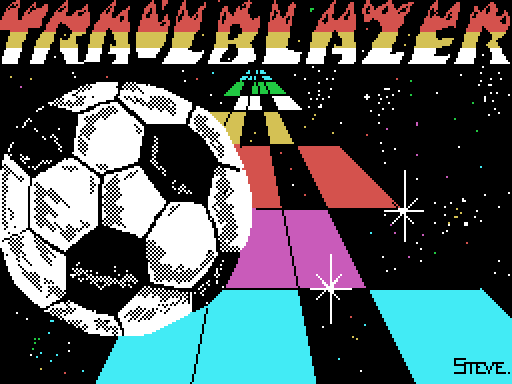
The loading screen, built the way the tape builds it: the patterns with their transposition undone and the colour stretched eight to one from the 0x300 bytes that hold it. Bottom right, in small type, the only signature anywhere on the tape: STEVE.

The first track, EASY GOING, whole and laid on its side: the start is on the left. Blue is track, black is hole, green speeds up, red slows down and white bounces. It is 219 rows of five tiles, and the tape stores it in 219 bytes.

And the last one, LAST BUT NOT LEAST!, at the same scale. Set against the first, the comparison speaks for itself: the difficulty is not in the length but in how many holes there are per row.

The distinct rows in the table at 0x7800, the first 176 of them. A track does not store tiles: it stores a list of indices into this table, which is how fourteen tracks of 3,494 rows fit in 3,494 bytes.
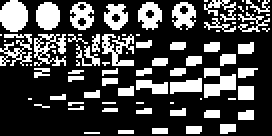
The 0x400 bytes the startup code dumps into VRAM: the ball, in the sizes the perspective needs, and its masks. Checked against openMSX's VRAM: zero bytes different.

The game's font, from 0xBB25 to 0xBE0E. It is the sheet the startup code leaves in (0xA41E), the pointer the text routine works from; for the large caption in the options screen it is swapped for another and put back.