The game
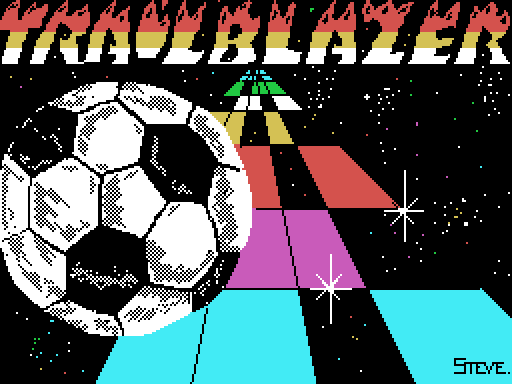
The loading screen, drawn from the bytes of the tape. Bottom right, in small type, the only signature in the whole game: STEVE.
A ball rolling down a track in perspective, strewn with holes, with stretches that speed you up, stretches that slow you down and tiles that bounce you. There are fourteen tracks and a clock, and that is the whole game.
How you play
The keys are given by the game itself, in the scroller on the title screen: Q left, W right, P speed up, L slow down and space to jump. A Kempston stick works too, and the options screen picks between the two.
One more the game never mentions: CTRL+STOP quits the game in progress and goes back to the title. It is the only two-key combination in the whole tape — 0x8A4B asks for CTRL and, if it is down, for STOP, and both together jump to 0x8AC1.
There are two games:
- PLAY ARCADE, the fourteen tracks one after another, with seven lives and four jumps. The clock counts up.
- 3 COURSE TEST, three tracks chosen with A, B and C. Here the clock counts down: it is a race against time.
That is what the twin routines at 0x9284 and 0x92A7 say: the first takes the clock down digit by digit and the second adds to it.
The tiles

The distinct rows in the table, the first 176 of them.
The engine understands eight kinds of tile, and no more. That is what the dispatcher at 0x8E65 says, comparing the tile against these values and no others:
| value | what it is | what it does |
|---|---|---|
| 0 | hole | the ball falls through |
| 1 and 5 | track | nothing; they are the two colours of the check |
| 2 | speed up | pushes speed to 6 |
| 6 | slow down | drops it to 2 |
| 7 | bounce | starts one of the seven jump curves |
| 3 and 4 | controls reversed | left and right swap |
The last two are the dirtiest: 0x8E21 flips the two joystick bits by rotating them over one another, and from then on left is right.
The ground, and when you fall
The ball does not fall for being over a hole: it falls if both sides are open air. 0x8E94 reads the colour of three tiles out of VRAM — not out of the map, out of what is painted — and checks whether there is ground to the left and to the right. With both, nothing happens; with only one, the ball slides seven pixels towards the side that does have ground; with neither, it falls.
The jump
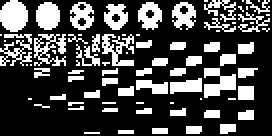
The sprite patterns: the ball, in the sizes the perspective needs.
There are seven jump curves, of 52, 40, 30, 23, 21, 18 and 13 values. Each is the sprite's row frame by frame: it drops to a minimum and comes back up symmetrically, closing with 0xFF.
The table at 0x87E8 has eight entries and repeats the longest in its last three, so of the eight possible bounces only six curves ever come out. And there is a seventh, at 0x8722, that this table does not point at: it is reached another way, by jumping with the space bar.
The sound
Three voices, each with its own interpreter. The background one is driven by 0x8294, which runs two voices at once using both of the Z80's register sets; the effects go through 0x81B9 and 0x8258, one per channel.
Notes are stored as indices into the period table at 0x812D, which is a genuine chromatic scale: twelve entries further on the period halves, which is what defines an octave. The tests check it.
And the volume is not held in any variable: it is written into the instruction that sets it (0x81CF writing at 0x81C6).
The tracks
They are drawn one by one in The 14 tracks.