Under the hood
Getting started
What you need
pasmo and z80dasm to assemble and disassemble, and Python 3 for the tools.
Nothing else.
The cartridge is not distributed with this repository: you need your own copy,
named pippols.rom in the project root. It is exactly 16384 bytes with this
sha256:
ad011203f1295bf75fc30423cead68e12f96169ffeb9f13474303d9a553e41f7
With any other dump the listing will not reassemble. make comprueba tells you
in one line.
The commands
make          # trace, generate the listing and check everything
make verify   # assemble the listing and compare its sha256 with the cartridge
make sanity   # what reassembly cannot catch
make test     # the 28 tests on the listing, which do not need the cartridge
make imagenes # redraw the reconstructed pictures
make medir    # measure what the scroll costs, in openMSX
make web      # the pictures and these pages
make chains the first four. If all goes well, the line that matters is this
one:
  ensamblado : 16384 bytes  ad011203...553e41f7
  original   : 16384 bytes  ad011203...553e41f7
OK: reproducible byte a byte
What is in each folder
src/pippols.asm |
the commented listing, generated; never edited by hand |
src/pippols.notes |
the annotations: labels, comments, headers and data ranges, anchored to addresses |
src/pippols.entries |
the entry points the trace cannot deduce, each with its justification |
src/pippols.nocode |
the zones the tracer must not read as code |
tools/ |
the tracer, the listing generator, the checks and the drawing tools |
tests/ |
28 tests on the listing, the notes and the site |
docs/ |
this site |
work/ |
what make produces along the way |
How to read the listing
Every routine has an uppercase name and a comment saying what it does and what
it takes. Data blocks are labelled DATA_<use>, with the width of their
structure, and each has an explanation of what it is and how that is known.
Addresses are the real ones of the cartridge in page 1: 0x4000-0x7FFF.
To change anything, edit src/pippols.notes and run make again: the listing is
regenerated and the checks say whether it still holds.
How it was done
The tracer (tools/z80trace.py) follows the flow from the header's entry point
and from what pippols.entries declares: the interrupt and the targets of the
dispatchers, which jump through tables. Whatever is not code is left as a gap,
and every gap is closed by finding the instruction that reads it
(tools/quien_apunta.py, tools/refs.py) and checking that the format matches
what the consuming code does with it.
What cannot be read is measured. tools/graficos.py rebuilds the background in
Python —the strips, the generator of the 192 characters, the map decompressor and
the name table dump— and draws the screen: if the reading were wrong, it would
come out as noise. And tools/omsx_scroll.tcl measures in openMSX, with the
emulated Z80's clock, what each frame costs.
Reproducibility
- assembling returns the cartridge's sha256
- no range declared as data comes out as code in the trace
- no entry point falls inside a data range
- all 16384 bytes are assigned: 9099 of code, 7285 of data, 0 unidentified
The cartridge
The header and the machine
The first sixteen bytes are the header the BIOS reads:
4000  41 42        "AB", a cartridge's signature
4002  4A 40        INIT = 0x404A
4004  00 00 00 00 00 00   STATEMENT, DEVICE and TEXT set to zero
400A  00 x6        padding
With the header at 0x4000 the BIOS maps the cartridge into page 1
(0x4000-0x7FFF) and jumps to INIT once it has finished booting. From there the
program never comes back: INIT writes jp 0x4010 into the H.KEYI hook (0xFD9A)
and drops into a two-byte jr $ at 0x4074. The whole game runs inside the
interrupt, one step per frame.
RAM is used from 0xE000 up, with the stack at 0xF000, so a 16 KB MSX is enough.
Video memory
SCREEN 2, with the eight registers at 0x43FD:
| register | value | what it says |
|---|---|---|
| R0 | 0x02 | graphics mode 2 |
| R1 | 0xE2 | 16 K, screen and interrupt on, 16 × 16 sprites |
| R2 | 0x0E | name table at 0x3800 |
| R3 | 0x7F | colour table at 0x0000 |
| R4 | 0x07 | pattern table at 0x2000 |
| R5 | 0x76 | sprite attributes at 0x3B00 |
| R6 | 0x03 | sprite patterns at 0x1800 |
| R7 | 0xE4 | ink 14 on background 4 |
In SCREEN 2 the screen is split into three thirds of eight rows, and each third has its own 256 patterns. Pippols loads all three the same, so a character number means the same thing whatever row it is on; without that, the background would break as it crossed row 8 or row 16.
The 256 characters are shared out like this:
| characters | what they are |
|---|---|
| 0x00-0x0F | plain background and fixed decorations (0x00 and 0x0C are the empty pair) |
| 0x09-0x0A | the ground, which changes on every screen |
| 0x10-0x39 | the font: ten digits and twenty-six letters |
| 0x40-0xFF | the 192 of the scrolling background |
Those 192 are the point of the whole cartridge: eight copies of the same set of 24 characters, each one a pixel lower. They are explained in The pixel scroll.
What goes to VRAM is compressed with a three-order RLE (0x43AE): a command byte, and if it is 0 it ends, if bit 7 is clear it repeats the next byte that many times, and if it is set it copies that many bytes as they are. 0x80 starts another block with a new address. The font, for example, takes 264 bytes in the cartridge and 336 in VRAM; the KONAMI logo patterns, 151 and 216.
The sprites
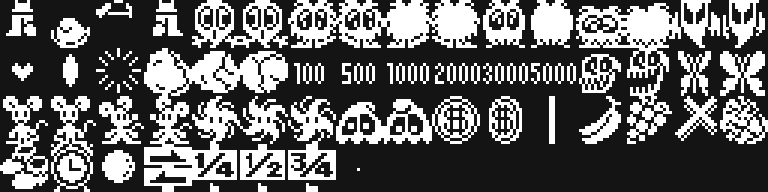
The 52 common patterns are decompressed in one go into 0x1880 (0x5E67), and the player's are loaded separately: there are 26 blocks in the table at 0x643A, and each frame whichever one matches the current sprite set —walking, sitting on the throne, dying— is sent up to 0x1800. That is how the little fellow is animated without burning spare patterns.
The attribute table holds 32 sprites: the boss, four for the player, ten creatures, seven objects, two of your shots and three of theirs. The order they are written in alternates from one frame to the next (0x7F83), creatures first on one frame and objects first on the next, so that the MSX's limit of four sprites per line does not always hide the same ones.
The RAM map
| address | what it holds |
|---|---|
| 0xE000/0xE001 | the program's state and substate |
| 0xE005 | the interrupt's lock |
| 0xE010-0xE039 | the three sound channels, 14 bytes each |
| 0xE043-0xE048 | high score and score, three BCD bytes each |
| 0xE050 | lives |
| 0xE060-0xE0EF | the name table buffer: 24 rows of 6 bytes |
| 0xE100/0xE101 | the position within the stage, in pixels |
| 0xE103 | the background stage (0-7) |
| 0xE11C | the offset of 0 to 7 pixels within the character |
| 0xE120-0xE126 | the player: state, direction, animation, Y, X and sprite set |
| 0xE132 | which world screen you are on (0-17) |
| 0xE1B0-0xE1C7 | three enemy shots of 8 bytes |
| 0xE1E0-0xE1EF | the player's two shots |
| 0xE200-0xE29F | the ten creatures, 16 bytes each |
| 0xE400-0xE42F | the seven objects, 6 bytes each |
| 0xE500-0xE91F | the 44 map pieces, 24 rows each |
| 0xEA00-0xEABF | the four background strips and their four colour strips |
A creature's slot is 16 bytes: type, substate, animation, counter, Y, X, pattern, colour, the Y and X fractions, the Y and X velocities in 8.8 fixed point, and the target. A negative type means it is dying.
What it is made of
| bytes | ||
|---|---|---|
| code | 9099 | 55.5 % |
| data | 7285 | 44.5 % |
| unidentified | 0 |
The data, from the inside: 1201 bytes are the music and effect tracks, 1485 the compressed common sprite patterns and 883 the player's 26 blocks, 647 the whole map (the dictionary, the sequence, the stretches and the plans), 409 the background strips with their colour, 408 the KONAMI logo and the title, 358 the object lists of the six roads and 264 the font. The rest are tables of a few dozen bytes each: which creatures each stage gets, the sideways movement curves, the jump steps and the corners each creature comes in through.
At the end of the cartridge there are 45 padding bytes of 0xFF and, behind them, nine bytes nobody reads: Konami's hidden mark, the title ピポルス backwards and the 29 of RC-729. It is in Findings.
The code
Nine thousand bytes of Z80, with 152 routines somebody calls by name and a frame Konami reused across its cartridges of those years: the interrupt as the program, a dispatcher that jumps through tables and a three-channel sound player.
The interrupt is the program
INIT (0x404A) sets up the VDP, loads the fixed characters, writes jp 0x4010
into the BIOS's H.KEYI hook and drops into a two-byte jr $ at 0x4074. From then
on the main loop does absolutely nothing: everything —sound, controls, the
player, the creatures, the objects and the scroll— happens inside the interrupt,
one step per frame.
The first thing the interrupt does is read the VDP status, which is what lowers the request, and the last thing is read it again in case another arrived meanwhile. In between there is a lock (0xE005): if the previous step has not finished, the new one just gives the sound a step and leaves. That way the music does not break when a frame overruns, which happens here often: the whole interrupt averages 73 % of the frame.
The dispatcher
	call DESPACHA
	defw target_0, target_1, ...
DESPACHA (0x4043) is six instructions: add a,a because the index is in
words, pop hl to pick up the return address —which is exactly where the table
begins—, read word number A from there and jp (hl). You go in with a call and
you never come back.
There is a second, cheaper dispatcher for things indexed by type: a push bc /
ret with the table two bytes below its base, so the index can start at 1
instead of 0. The three creature tables (0x6861, 0x6894, 0x68B4) and the
per-frame routine table (0x6B58) all work that way.
The eight states
0xE000 says what the program is doing, and 0xE001 is a substate that each state
eats away with djnz:
| state | what it does |
|---|---|
| 0 | the KONAMI logo rising three rows every two frames |
| 1 | the title on screen, with its countdown |
| 2 | the menu: PUSH SPACE KEY blinking |
| 3 | starts the demo |
| 4 | starts the stage: clear, paint the panel and build it |
| 5 | playing: one step of the game per frame |
| 6 | end of game, with sound 0x98 |
| 7 | GAME OVER and back to the title |
States 0, 1 and 2 push the return address 0x4184 before dispatching, which is a trick for the three of them to share the menu handling without repeating it: on return, that stretch reads the controls and starts the game if space was pressed.
One step of the game
PASO_DE_PARTIDA (0x5087) is what runs on every frame while you play, in this
order: the sprite table, the controls, the player, the creatures, the shots
—yours and theirs—, the objects, the scroll and the collisions. At the end,
ELIGE_MUSICA (0x5168) looks at what the player is up to and asks for the music
that fits; since the highest number wins in each channel, it can ask every frame
without cutting off whatever is already playing.
The sound
Three 14-byte channels at 0xE010, and a table of 40 sounds at 0x4AD8 pointing at 36 tracks. The sound number also says how many channels it wants: below 7, only channel C, which is the effects one; from 7 to 14, two; from 15 up, all three. And if a channel is already playing something with a higher number, the new one does not take its place.
A track is a run of bytes: the high nibble is the note and the low one the
length, 0x2n changes the length of whatever follows, 0xFF silences the channel
and 0xFE is end-or-jump —with a loop count, which is how repeats are done. The
notes come from fifteen PSG periods (0x4AC9), one octave and three notes over,
each one the previous times 0.944, which is the semitone; reading three bytes
earlier drops three semitones at once, and that is what bit 6 of a channel does.
The background and the map
Here is what sets this cartridge apart, and it has its own page: The pixel scroll. In short: the background characters are in VRAM eight times over, each copy a pixel lower, and scrolling the screen means adding 24 to the character number and writing the whole name table again, 24 rows by 22 columns, on every frame.
The road is not stored as screens but on four floors:
position in pixels
  --> stretch (0..12) and row within the stretch (0..23)
        --> plan (0x53A2): 10 plans x 13 stretches
              --> stretch (0x5424): 19 stretches x 6 pieces
                    --> piece (0xE500): 44 pieces of 24 rows
A stage is thirteen stretches of 24 rows, that is 2496 pixels, and each stretch is six pieces of four columns laid side by side. The 44 pieces are built in RAM by gluing groups of three rows from a dictionary of 25, with the index list at 0x550B: 328 bytes for the game's whole map.
The player and the creatures
The player's state (0xE120) comes straight from the controls through a
sixteen-entry table (0x5D32), and everything hangs off it: the animation, the
sprite that gets loaded and which way the shot goes. Before moving, the character
ahead is checked with four probes (0x5B6A), and the comparison is made against
0x40 + 24 × phase because background characters change number with the scroll
offset.
The creatures are ten 16-byte slots with 8.8 fixed-point velocity, and twelve routines, one per type. The chase engine (0x6B72) does not turn on a sixpence: it eases the current velocity towards the one that would reach the target, and that is why they trace those curves instead of heading straight for the player.
Code shared with other Konami cartridges
This disassembly has been compared, instruction by instruction, with
every other Konami one in the series. A block counts when the same
instructions, at least six of them from a label to its ret or its
unconditional jump, are in both cartridges; the addresses are left
aside, because they change from one cartridge to the next. Of the
other 57, 53 have at least one block in common with this one;
these are the ones that share the most:
| Cartridge | Blocks | Instructions | For example (here = there) |
|---|---|---|---|
| Knightmare | 22 | 249 | PISTA_NOTA (0x49D6) = toca_la_nota |
| Hyper Sports 3 | 20 | 229 | PISTA_MANDOS (0x4A31) = mandato_de_pista_larga |
| The Goonies | 18 | 205 | PISTA_NOTA (0x49D6) = toca_la_nota |
| King's Valley | 16 | 203 | PISTA_MANDOS (0x4A31) = procesa_comando_de_control |
| Konami’s Soccer | 16 | 176 | PISTA_NOTA (0x49D6) = escribe_el_periodo_y_el_volumen |
| Hyper Rally | 15 | 158 | PISTA_NOTA (0x49D6) = CANAL_TONO_60BA |
| Yie Ar Kung-Fu II | 15 | 147 | ESCRIBE_ROTULO (0x4393) = pinta_guion |
| Konami's Ping Pong | 14 | 142 | ESCRIBE_ROTULO (0x4393) = pinta_rotulo |
| Yie Ar Kung-Fu | 14 | 153 | ESCRIBE_ROTULO (0x4393) = dibuja_la_lista |
| Konami's Boxing | 13 | 133 | ESCRIBE_ROTULO (0x4393) = pinta_texto |
The whole matrix, the 58 cartridges against each other, is on The routines in the series database, along with the method and the program that measures it.