What the cartridge draws
Under each picture is where it comes from and what is on it.
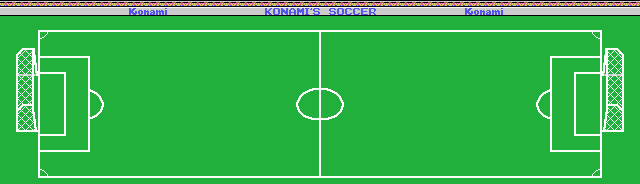
The whole pitch: 80 columns by 23 rows, 640 by 184 pixels. Not a capture nor a montage of captures: it is the map 0x8538 decompresses into 0xE600, drawn tile by tile with the patterns and colours the ten graphics batches at 0x4279 leave behind. The screen only ever shows 32 of those 80 columns.
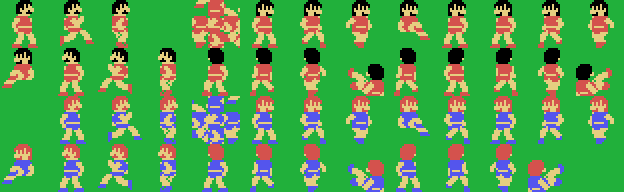
The 51 player poses, taken from the patch tree: 26 for one side and 25 for the other, each of them nine 8x8 tiles. They are the same drawings with two different colour tables. The grass behind is tile 0x01, the same one the map fills the pitch with.
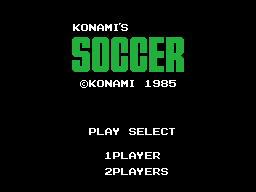
The title screen with its menu, assembled step by step the way the cartridge does it. The big logo is not a stored image: it is five rows of fourteen CONSECUTIVE patterns that 0x4CD3 stamps from 0x40 on. Checked against the emulator's VRAM: zero bytes different across all three tables.
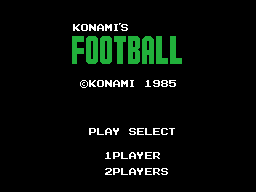
The same screen, built from the OTHER build: Konami's Football, the same RC-732 cartridge under another name. Of its 9,755 instructions only one differs from Soccer's, and it is exactly the one saying how many rows of tiles this logo is tall: five in Soccer, four here. Checked against the emulator's VRAM: zero bytes different across all three tables.

The 44 tiles of the font, from 0x10 to 0x3B, laid out in a row so they can be looked at. The layout explains the labels: the ten digits start at 0x10, 0x20 is the dash between the two goal counts, the letters run from 0x21 to 0x3A, and 0x3B is the diamond the final screen's frame is hand-drawn with.