The other build: Konami's Football
The same cartridge also came out as Konami's Football. Same year, same size, and the same catalogue number, RC-732. The question is what changes, and the answer fits in one figure: one instruction out of 9,755.
Konami's Soccer      b9536809a1784afb2e49a43d80ba9c6c8c15cd31ecbd6c284e9bf62c6927dcd4
Konami's Football    1fee5ce4d4d5f48a92849eb7bed7ebb653f7e773fd4467824c27f54204b0fe7f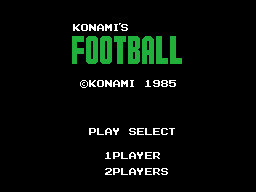
The byte-by-byte diff is worth nothing
Compared byte by byte, the two cartridges differ in 28,586 bytes out of 32,768, that is 87.2 %. That number says nothing: the second build is shifted. Football's logo takes less room than Soccer's, everything behind it moves, and from then on every call points somewhere else even though it calls exactly the same thing.
Aligning the two ROMs, the shift changes only four times in 32 KB:
| from | to | shift |
|---|---|---|
0x4000 | 0x4D1C | 0 |
0x4E1D | 0x6DBC | −46 |
0x6DDE | 0x73C9 | −44 |
0x73CA | 0x8599 | −40 |
0x85A9 | 0xBFF3 | −38 |
So Football starts 46 bytes shorter and gets 2, 4 and 2 back at three points. And 0xBFF3 lines up again because Konami's mark is glued to the very end.
Instruction by instruction
With that map the two builds can be compared the way they have to be: by disassembling both and translating one's addresses into the other's space, so that a call 04ef7h in Football and a call 04f25h in Soccer look the same, which is what they are. tools/coteja_builds.py does it:
python3 tools/coteja_builds.py soccer.rom football.rom \
        work/soccer.trace.json 0x4000

9755 instrucciones cotejadas, 1 distintas (0.01 %)
  0x4cdb  A: ld c,005h    B(0x4cdb): ld c,004h
That is the whole code difference between the two cartridges. And it is on the title screen: 0x4CDB loads into C the number of rows of the big logo, which 0x4CDD walks stamping fourteen consecutive patterns per row. Soccer paints five rows of tiles and Football four.
And in the data, four things
Of the 125 declared data blocks, 97 are identical byte for byte. Of the remaining 28, twenty-four are pointer tables —sub-scenes, patches, sounds— that change only because the addresses they point at have moved. Four real changes are left, and all four are the same change:
| block | what it is | what changes |
|---|---|---|
patrones_4d1c | the big title logo | 262 of 280 bytes: it is a different drawing |
patrones_6d8d | the pitch tiles | Football writes 104 bytes of VRAM instead of 96: one tile more |
color_739b | the colour of those tiles | 7 of 120 bytes |
mapa_del_campo | the pitch's 1,840 tiles | 7 tiles, all on row 1, columns 41 to 48 |
Those seven tiles are the advertising hoarding that runs across the top of the pitch.
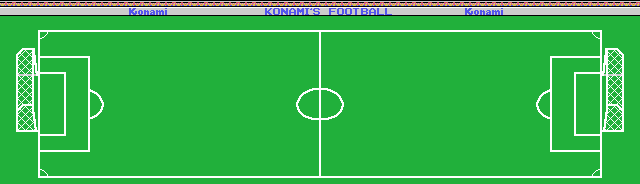
Compare it with Soccer's: it is the same pitch, line for line, and the only thing that changes is what the hoarding says.
What does NOT change
- The header from
0x4000to0x4025is identical byte for byte: same "AB", same INIT at0x4070and the same Konami Game Master header at0x4010with its0x07and its0x32. - Konami's hidden mark too: the thirteen bytes at
0xBFF3are the same,BA 85 B5 8A 00 98 00 9F 94 89 0A 32 AA. The katakana title the cartridge carries hidden inside still reads サッカー, Soccer, even though the label says Football. - And the game. The five difficulty tables, the aim, the offside, the player patches, the sound: the 97 identical blocks.
Checked against the emulator
Football's pitch above is built by running the cartridge's own steps in Python, and checked against an openMSX VRAM dump just like Soccer's:
COLOUR 0    PATTERNS 0    SPR PATT 0
MAP at 0xE600, 80x23:   2 of 1840   (the two goalkeepers)
WINDOW of 23x32:       44 of 736    (42 are player patches)
Exactly the same figures as Soccer's.