The game
Konami's Soccer came out in 1985 for the MSX, on a 32 KB cartridge with catalogue number RC-732. A six-a-side football match plus goalkeepers, with a clock, a penalty shoot-out and a name editor for both teams.
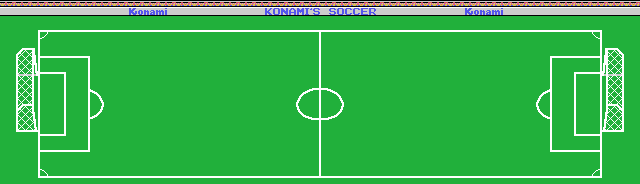
The pitch does not fit on the screen
An MSX1 shows 32 tiles across. This game's pitch is 80 wide, and it lives decompressed in RAM at 0xE600: 80 columns by 23 rows, 1,840 tiles. The screen is a 32-column window sliding over it, and where it sits is held in (0xE2C1), which starts at 24.
That measurement is written nowhere in the cartridge: it is fixed by the arithmetic of vuelca_el_campo (0x5DD6), which pushes out 32 tiles with outi and then skips 48 before the next row. 32 plus 48 is 80.
In pixels the pitch is 640 wide. The touchlines are at heights 0x1D and 0xB3 —150 pixels apart—, the goal lines at pixel 30 and 601, the posts take up 0x49-0x4A and 0x81-0x82 —two pixels thick each— and between them there are 54 pixels of goal. The net is at pixel 0x12 and at 0x267: that is where a scoring ball is pinned, with its own sound.
The players
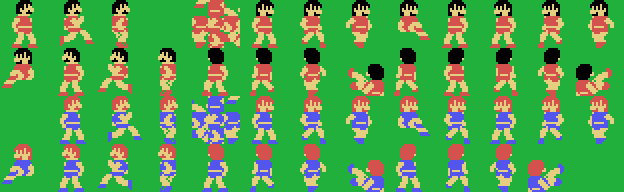
The twelve outfield players are not drawn the same way. One side is stamped onto the map, as three-by-three tile patches; the other is drawn with five sprites per player. Findings has the reason and the exact order of the frame.
The poses come from a two-level tree: (ix+0x0C) picks the group and (ix+0x0D) the drawing within it. There are 26 poses for one side and 25 for the other, and they are all above.
The two goalkeepers are not pieces like the rest: they are two patches with their own table and their own background store, stamped after the six.
The rules the cartridge carries
- Offside is called. With two players, always; against the machine, only from level 3 up.
- Winning the ball depends on the angle. If the tackler and the carrier are not facing each other, instead of a tackle there is a collision: both go down.
- The crossbar returns half the speed, and the post only flips the sign of the sideways drift, with its own sound.
- Level at the end: penalties, and the shoot-out has its own steps, its own goalkeeper and its own aim.
The five levels
There is no separate intelligence per level: there are dead bands and permissions.
| level | 1 | 2 | 3 | 4 | 5 |
|---|---|---|---|---|---|
| height at which the keeper stops reacting | 32 | 44 | 24 | 20 | 16 |
| frames the machine takes to react | 16 | 14 | 12 | 10 | 8 |
| machine's stride with the ball | 0x0E0 | 0x0F0 | 0x100 | 0x110 | 0x120 |
| machine's stride when loose | 0x130 | 0x140 | 0x150 | 0x160 | 0x170 |
The human's side reacts always in 8 frames, so the machine never gets to beat it: at level 5 it matches it. And level 3 is the level that is level: it is where the machine's stride is exactly the human's —0x100 with the ball and 0x150 loose, the two fixed values 0x5721 gives side 0—. Below 3 the machine walks slower than you; above, faster.
The odd one out is the level 2 keeper, who at 44 is the most passive of the five, more than the level 1 one. From 3 to 5 the progression falls cleanly.
And there are four things the machine only does from a certain level up:
| what it does | from level |
|---|---|
aim where the target will be, not where it is (0x9260) | 4 |
the diagonal feint (0xB12C) | 3 |
clearing after a shot (0xB19D) | 4 |
correcting to the corner away from the keeper (0xB266) | 4 |
calling offside (0xB671) | 3 |
At level 1, on top of that, half the passes do not even dodge (0xB0D4).
The menu
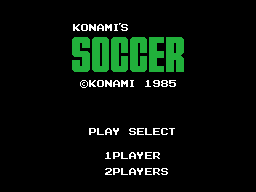
You choose one or two players, the kit colour of each team —eight sets of three tones, and the menu will not let them match—, the level and the length of a half. The team names are edited letter by letter, and out of the factory they are EAGLES and STONES.