The game
Hyper Sports 3 is from 1985 and it is four events, in this order:
| (0xE06A) & 3 | event | label | starting mark |
|---|---|---|---|
| 0 | cycling | CYCLING | 1'45"34 |
| 1 | triple jump | TRIPLE JUMP | 17.97 m |
| 2 | curling | CURLING | 100 points |
| 3 | pole vault | POLE VAULT | 5.90 m |
The order is not guesswork: it is what the table at 0x5A90 says, the one the code at 0x5913 indexes with (0xE06A) & 3. And that same index picks each event's engine in the table at 0x5548. Something turns up there you cannot see while playing: the triple jump and the pole vault share an engine, both enter through 0x5550. Cycling and curling go to places of their own.
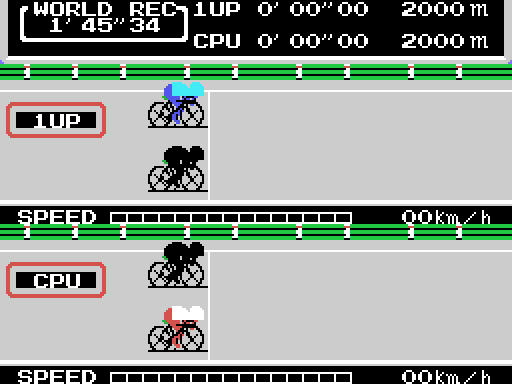
Cycling
The event that departs most from the norm. The circuit is not in VRAM. It lives in two RAM windows —0xE140 and 0xE260, nine rows of thirty-two tiles each—, shifts one column per frame and is dumped whole to the screen.
And the cyclist is not a sprite either: he is four tiles from the pattern table. So that tiles can move pixel by pixel, 0x9CC7 generates eight copies of the drawing, each shifted one pixel, when the event starts, by rotating the bits and feeding ones in from the left to get the mask for free. On top of those four tiles go five sprites, which are the rider.
In each player's window you can see the other one, drawn with six tiles instead of four, sixteen rows higher up.
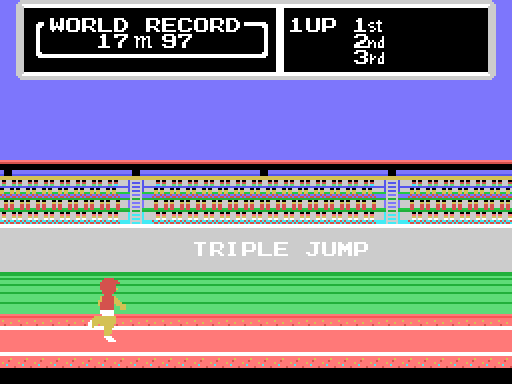
The triple jump and the pole vault
They share a screen and an engine; only the bar and the length of the runway change. The runway is stored twice, in place and shifted four pixels, and the game alternates between them: that is why it moves half a tile at a time. The shifting is done in RAM, with chained sla and rl across twelve consecutive tiles.
The marks for both events sit in BCD at 0x757D: eight for the triple jump, from 13.00 to 20.00 m, and ten for the pole vault, from 5.65 to 5.94. The sixth triple jump bar, 17.89 m, was Joao Carlos de Oliveira's world record.
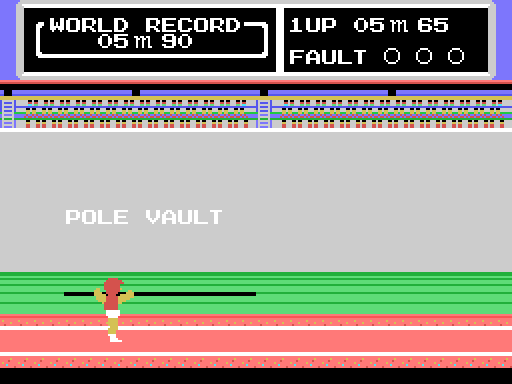
The athlete is not a sprite, he is two to seven 16x16 sprites placed side by side, and their patterns are not sitting in VRAM beforehand: they are decompressed there on every frame. That is how the cartridge can hold hundreds of poses that would never fit at once in the 2 KB of sprite patterns.
On the pole vault run-up the athlete does not even come out of a figure table: he is composed from two different blocks —three pieces from 0x6E15 and whatever 0x6B6A brings— plus the sprite for the pole tip and the twelve tiles of the pole itself.
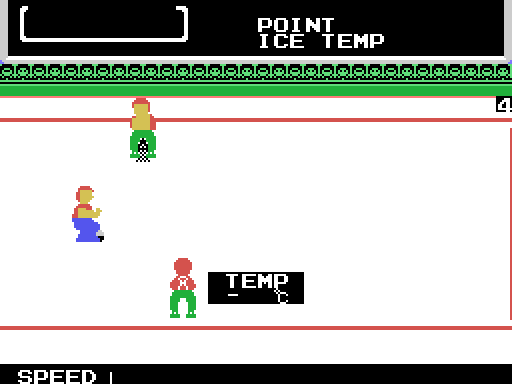
Curling
The heaviest of the four. The right half of the ice is stored nowhere: it is mirrored by hand, bit by bit, as the screen is built. The house rings are drawn by a clipped-rectangle routine that takes the screen's scroll into account, and at the start they fall outside the view.
And the stone is not steered with angles: the two curves that move it normalise the vector —divide it by its approximate modulus— and keep the two components.
The demo
Nobody plays it. It is a recording: each event has its own tape of controller readings stored in ROM, and the loop feeds it frame by frame as if it were the joystick. That is why the demo always does exactly the same thing.
The exception is cycling, which has no recording: there the rival moves off ld a,r —the DRAM refresh register— used as a die.