Findings
Everything here is measured on this cartridge, with the tools in tools/.
The world records live in RAM
The twelve bytes INIT copies from 0x40CF to 0xE053 are the four marks to beat: 1'45"34 for cycling, 17.97 m for the triple jump, 100 points for curling and 5.90 m for the pole vault. They are the only values in the whole work RAM that do not start at zero.
They sit in RAM rather than ROM because the game overwrites them: 0x93D1 writes the cyclist's time straight over the record as soon as it is improved. The ROM holds no record at all, it holds a starting value.
The two that can be checked match the cartridge's own moment: the 17.97 m are Willie Banks's, from June 1985, and the 5.90 m are Sergei Bubka's, from 1984.
And there is a third dated mark where you would not look for one: of the eight triple jump bars, the sixth is 17.89 m, which was Joao Carlos de Oliveira's world record.
The cartridge defends itself: copy protection
Two instructions in the start-up write inside the cartridge itself:
- 0x4013 puts a
pop hland aretover thedjnzat 0x412F. It loads0xC9E1into HL and drops it in one go: in memory those two bytes areE1 C9, which read aspop hlandret. - 0x4040 leaves a zero at 0x413B, which is not data: it is the operand of the
jpat 0x413A. In memory that turns it intojp 00000h, a dead reset.
Neither of them does anything here. The cartridge runs from ROM, and ROM takes no writes: that is why they look like dead code. They are not. A pirated cartridge is a copy loaded into RAM, and there the write does land and breaks the game. Doing nothing on the original is exactly the point.
This is no one-off idea in this cartridge: the same pair —a write over a djnz and another over the operand of a jp— turns up in ten cartridges of this series, always in the same two start-up routines. Manuel Pazos identified them in his disassembly of RC-727, where he named them ReadKeys_AC and VRAM_writeAC.
The demo is a recorded game
Each event has its own tape of controller readings stored in ROM, and the loop feeds it frame by frame as if it were the joystick. That is why the demo always does exactly the same thing, down to the marks.
Cycling has no recording. There the rival moves off ld a,r —the DRAM refresh register, which climbs with every instruction— used as a die. It is the only event whose demo never comes out the same twice.
Real sine and cosine
The table at 0x7346 is ninety degrees of sine, one byte per degree, with 0xFF at ninety. With it and a quarter-turn offset you get both components of any angle.
And in curling the angle is never worked out at all: the stone's two curves normalise the vector and keep the two components. The stone travels straight without the cartridge ever knowing how many degrees it is on.
The period table has twelve values, not ten
It looked like ten entries with two indices left over. The two missing ones are hidden inside entry [0] of the track table, the one written off as dead because no track uses it: its two bytes are the continuation of the table next door. L_4D75 indexes it with the high nibble of the note byte, which reaches 0x0B, that is twelve.
It is the same trick as the pole vault bar table, pointed at two bytes low so the index can start at one instead of zero.
Three different scrolling tricks
All four events move the screen, and no two do it the same way. Cycling keeps the circuit in two RAM windows and shifts them one column per frame. The jumps store the runway twice, in place and shifted four pixels, and alternate. Curling does not store half a sheet: it mirrors the right half of the ice by hand, bit by bit.
The cyclist is not a sprite
He is four tiles from the pattern table. To move pixel by pixel, 0x9CC7 generates eight copies of the drawing each shifted one pixel when the event starts, by rotating the bits; and it gets the mask for free, the 0xFF with zeros pushed in from the left. Five sprites go on top, and those are the rider.
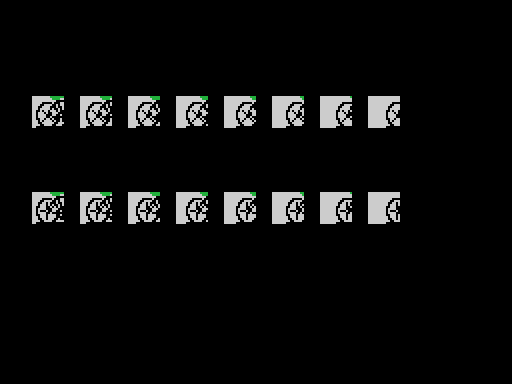
The pole vault athlete is composed from two blocks
On the run-up the athlete comes out of no figure table at all: he is three pieces from 0x6E15 and whatever 0x6B6A brings, plus the sprite for the tip and the twelve tiles of the pole. Both groups share the pattern counter, because the patterns are decompressed consecutively into 0x1800.
Checked against the emulator's VRAM on the first frame the cartridge draws him: all six sprites identical and zero of 2,048 pattern bytes different.
Ten bytes that are not data
Between the figures and the relative scripts there is a complete routine nobody calls: it divides HL by 32 without losing anything off the top. That is exactly what the curling stone's address arithmetic does by hand. Somebody wrote it, stopped using it, and nobody deleted it.
Konami's hidden mark
The last sixteen bytes are the title in katakana and backwards —ハイパースポーツ3—, its length, the 0x33 of RC-733 and an 0xAA. Nothing reads it. The mark was discovered by Manuel Pazos.
What the pictures cost
All five screens are checked byte for byte against openMSX's VRAM, and the check turned up things that looking at the drawing did not:
- The cycling screen is not finished by the routine that builds the event, but by scene 0 (
L_91F9), which brings the scoreboard frame and 140 bytes of sprite patterns. Without it half the scoreboard was missing. - The two cyclists were not showing up because their row is written by a lone
ld a,020h / ld (0e0e3h),aat0x54CD, inside the variable setup. - The starting light is not a light: it is a gun, with its muzzle flash and its GO.
- Curling was missing the two brooms —which do not come from the figure table, they are a single sprite with the player's row plus 0x10— and the two line sprites, which are eight bytes copied verbatim from
0xA911.