Open questions
What is not known goes here, it does not get papered over.
An invisible piece in the pole vault table
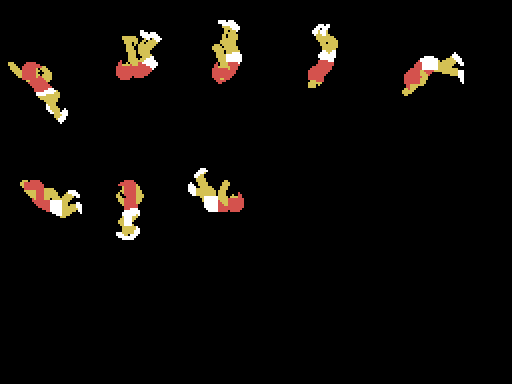
Figure [5] in the table at 0x6E33 has a piece with dy = 114 and colour 0, that is, invisible and off the screen, with the same pattern as the piece after it. Whether it is a leftover that stayed put or something the engine uses in a case not yet seen is still open.
A write that does nothing
0x4010 does ld hl,0c9e1h / ld (0412fh),hl, and 0x412F is ROM: the write goes nowhere. The 0xC9E1 is pop hl / ret, so there was self-modifying code there when that stretch lived in RAM. Still to be confirmed.
Ten bytes of a routine nobody calls
Between the figures and the relative scripts there is a complete routine —it divides HL by 32 without losing anything off the top— that no instruction in the cartridge points at. What it does is exactly what the curling stone's address arithmetic does by hand a few lines below. What is not known is whether it was deliberately abandoned or is a leftover from an earlier version.
The logo dump
Of the five screens, the logo is the only one whose emulator dump has not been squared yet: it needs its right instant found, the way the title screen did, where the first dump taken as good turned out to be the logo under another name. The other four are checked.
The athlete's pose at build time
The triple jump and the pole vault draw the athlete in the starting pose, the one the four bytes at 0x6DE6 name. The emulator never captures that pose standing still: by the time a dump has him drawn, he is already running. The pole vault could be checked against the first frame he appears on —six identical sprites, zero differing pattern bytes— because the row and column had not changed yet. The triple jump could not: there the athlete has already moved, and its starting pose is left unchecked against the machine, derived only from the listing.