The flicker
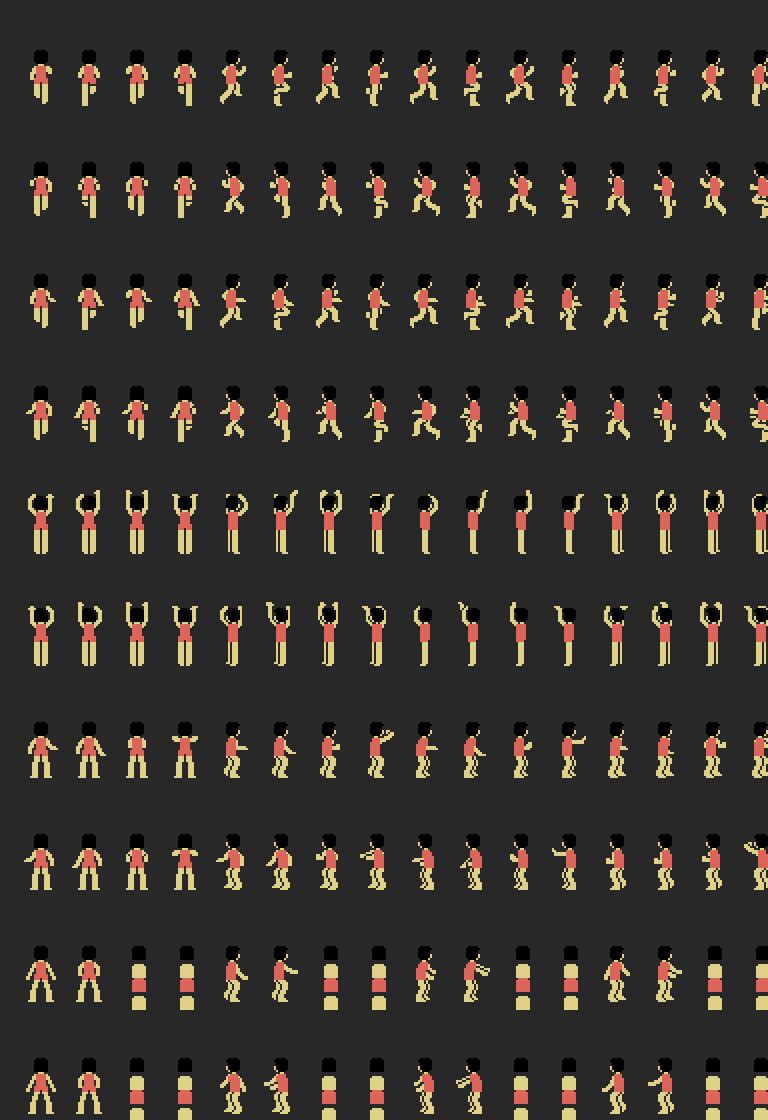
Every player in Dunk Shot is four 16 × 16 sprites stacked on top of each other: hair, upper skin, shirt and lower skin. Six players are 24 sprites; with the net, the ball, its shadow and the arrow, 28 of the 32 the VDP has. Two of a player's four sprites can fall on the same line, so two players side by side already fill the four sprites per line the TMS9918 of the MSX1 can draw. From the fifth on, the VDP does not draw them.
How the game shares them out
The flicker is not an accident: the game manages it.
0x5E1Bsorts the seven groups (six players and the ball) by depth, the nearest first, with a bubble sort, and leaves each one's place in field +0x0E of its record.0x5C0Bbuilds their attributes in that order in the list at 0xE7B0 (0x5C40works out each player's four sprites from the position of the feet and the offsets of the pose).0x5BABcopies the same groups reversed into 0xE730 and sends the two lists to the two attribute tables, 0x1B00 and 0x1F00.- On every interrupt
0x5B77flips bit 2 of register 5: one frame the VDP shows the table with the near players in front, the next the one with the far players in front.
When players bunch up, the sprites that do not fit on a line are a different set each frame: what is lost one frame is drawn the next, at 30 Hz on a 60 Hz machine. That is the flicker.

What changes on an MSX2
The V9938 of the MSX2, in sprite mode 2 (SCREEN 4 and up), draws eight sprites per line instead of four. With eight, four players can share a line, and the moments when more than eight pile up are few. The patch takes the game to SCREEN 4 and, on an MSX2, stops the alternation: register 5 always points at the table sorted by depth. The game's code does not change; it keeps sorting and building both lists, but the VDP only shows the first one.
So on an MSX2 the nearest player is always in front, and who is in front no longer changes from frame to frame. When more than eight sprites do fall on a line, the ones the VDP leaves out are the last in the table, the farthest, which are the ones behind anyway. The numbers are in In the emulator; how it is done, in The patch.
On an MSX1 nothing changes: the two tables keep alternating as in the original, only moved to other addresses.