The game
Bomber Man, by Hudson Soft, 1983. Eight kilobytes. You drop a bomb, you run, the bomb breaks the bricks next to it, and under one of them is the door.
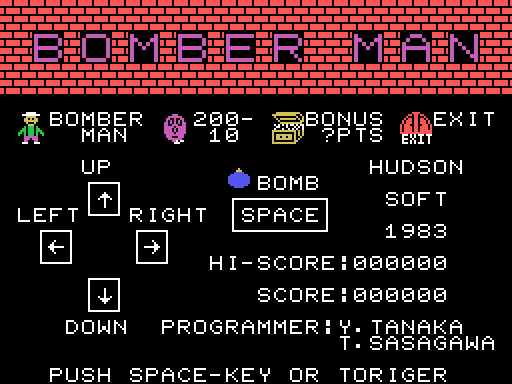
The title screen, drawn from the ROM. At the top the big wordmark — not a stored picture but nine two-by-two letters painted by a loop — and below it a legend that explains the whole game: the bomber, the monster with what it is worth, the prize chest and the door.
The rules, measured on the code
| thing | value | where |
|---|---|---|
| board | 15 columns × 11 rows | 0x4E15 |
| fixed pillars | 35, where both coordinates are odd | 0x4DB7 |
| bricks per stage | 35 draws, repeats allowed | 0x4E65 |
| lives | 3 | 0x4069 |
| starting bonus | 1000, dropping by 10 every 50 frames | 0x4080 |
| bombs at once | 5 | list at 0xE359 |
| enemies at once | 8 | list at 0xE31C |
The score is shown multiplied by ten: escribe_cinco_cifras_y_un_cero (0x4F29) prints five digits and sticks a zero on the end. The caller strips that zero off the bonus, and into the gap it leaves fits the leading space of " STG:".
How many enemies, and how fast
The table at 0x4217, two bytes per stage. From the sixth on, every stage plays with the fifth line.
| stage | enemies | cadence |
|---|---|---|
| 1 | 1 | 0x10 |
| 2 | 2 | 0x15 |
| 3 | 3 | 0x1A |
| 4 | 2 | 0x1F |
| 5 and on | 4 | 0x24 |
Stage four has fewer enemies than stage three. It is the first auto-bomb stage, which may be why.
The auto-bomb stages
Every fourth stage the game stops asking for the trigger and drops the bombs itself. Two instructions decide it, 0x4922 and 0x4D3A, with the same and 003h on the stage number: one disables the trigger check and the other turns on the label that announces it at the bottom, blinking sixteen frames on and eight off:
BOMB AUTO SETTING STAGEHow you die
Two ways, and one single comparison covers both. When painting the bomber, pinta_una_casilla_del_bombero (0x4BEB) looks at what was underneath: if it is 0xC0 or above, the death animation starts. Monsters live from 0xC0 to 0xCF and flames from 0xE0 to 0xEF, laid out next to each other on purpose.
Because the bomber is painted after the enemies and the flames, what it reads is this very frame's.

Eight frames, running backwards through the tile sheet: from 0x4E down to 0x40. The last one is not a drawing of the bomber, it is a green OUT on top of what is left of him.
The monster hunting you is the red one
The same byte of the enemy's record picks the drawing and decides the behaviour. When it is zero, the enemy goes after the bomber (0x477B); the rest of the time it wanders and changes its mind at random. And zero is precisely the red drawing frame.

The first two are frame 0. The other six, purple.
What everything is worth
- A monster:
(drawing frame × 4) + 2, plus a random number from 1 to 4. That is 3 to 18, or 30 to 180 points on screen. The title screen's legend, next to the monster, announces200-10. - The prize: a random number between
0x10and0x7E, always even and always with bit 4 set. Between 160 and 1260 points. - The bonus: on clearing the stage it is turned into score ten at a time, with a beep for each ten.
The two ways to finish a stage
Step on the door (0xE316) or kill everything (0xE318). Only the second one collects the bonus.
And there is a third that is not an ending but a punishment: if the bonus reaches zero, se_agoto_el_bonus (0x449F) wipes the whole board. The thirty-five bricks, the prize and the door vanish at once, and with both "already found" flags set they are never looked for again. The stage is left with no way out.
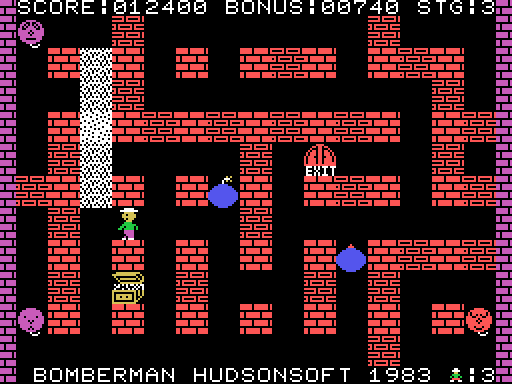
A game in progress, dealt with the cartridge's three rules and painted with its routines. The bricks are one of the possible deals: the real one is decided by the Z80's R register at the instant the trigger is pressed.