The cartridge
8 KB in page 1 (0x4000–0x5FFF), MSX1. It is the smallest cartridge in the series, and the first Hudson Soft one.
The header is code
An MSX cartridge starts with AB, the INIT address, and then STATEMENT, DEVICE, TEXT and six reserved bytes. Here INIT is 0x4004, which is exactly where those fields should begin. Read as instructions:
4000  41 42        "AB"
4002  04 40        INIT = 0x4004
4004  31 00 F0     ld sp,0F000h
4007  CD D1 4F     call 4FD1h        the RAM's starting values
400A  CD 62 50     call 5062h        the VDP
400D  CD 4E 40     call 404Eh        the PSG, with its table right behind
Only the first four bytes of the cartridge are really a header. The other nine are the first four instructions, and there is not one byte left for STATEMENT, DEVICE or TEXT.
The memory map
| where | what |
|---|---|
0x4000–0x5FFF | the cartridge |
0xE000–0xE2FF | the screen, 768 bytes: what is seen |
0xE300–0xE389 | the variables |
0xE38A–0xE689 | the board, another 768 bytes: what stays |
0xF000 | the stack |
The two RAM screens are what organises the whole game, and they are explained in The code.
The VDP
The eight registers come from the table at 0x5144 and monta_el_vdp (0x5062) writes them out:
| register | value | what it says |
|---|---|---|
| R0 | 0x02 | SCREEN 2 |
| R1 | 0xC2 | 16 KB, display on, 16×16 sprites |
| R2 | 0x06 | name table at 0x1800 |
| R3 | 0x7F | colour at 0x0000, three banks of 0x800 |
| R4 | 0x07 | patterns at 0x2000, three banks |
| R5 | 0x38 | sprite attributes at 0x1C00 |
| R6 | 0x07 | sprite patterns at 0x3800 |
| R7 | 0xF0 | white ink on transparent background |
The sprite registers are declared and never used. Right after writing them, 0x507C puts a 0xD0 into the first attribute — the "no more sprites" marker — and the cartridge never touches the list again. Everything that moves in this game is a name-table tile.
No interrupt and no sync
monta_el_vdp puts a ret into H.TIMI (0xFD9F): the BIOS stops interfering on every interrupt. And the game does not wait for the display sweep: the pace is set by an empty loop of 0x500 turns at the end of cierra_el_cuadro (0x46C8). The screen is dumped when it is due, not when the VDP is safe.
The three graphics blocks
The format used by carga_los_graficos_en_los_tres_tercios (0x5088) is:
2 bytes   destination in VRAM; the third is added to the high byte
1 byte    how many tiles, and ZERO means 256
n*8       the patterns, which LDIRVM dumps in one go
pairs     (colour, how many tiles) for FILVRM, closed by 0xFF
It is called three times with A = 0, 8 and 0x10, which added to the destination's high byte give the three thirds of SCREEN 2.
| block | destination | tiles | what it brings |
|---|---|---|---|
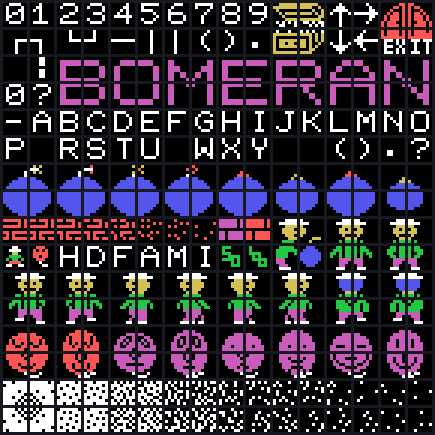
0x514C | 0x0000 | 256 | the whole title screen |
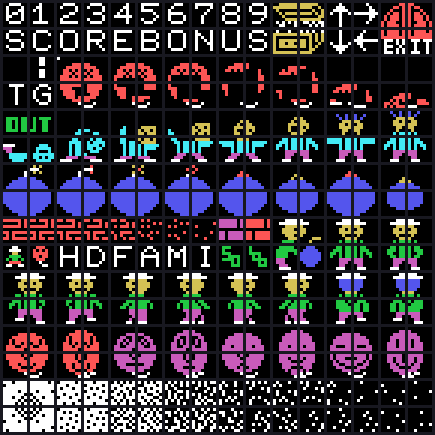
0x5B26 | 0x0080 | 10 | the letters of SCORE and BONUS |
0x5B7C | 0x0100 | 64 | the digits, the monsters and the bomber |
The three tile without a gap: 0x514C ends at 0x5B26, which ends at 0x5B7C, which ends at 0x5E38. That is what proves the format is read correctly: if the tile count or the colour-run count were off by one byte, the next block would not start where it starts.
The font changes halfway through
The big block loads the title screen's 256 tiles. When the game starts, 0x4074 and 0x407A load the two small ones on top: where the title screen has the big BOMBER MAN wordmark, the game puts the monsters.
Everything from tile 0x90 up is never overwritten, and that is where the H, D, F, A, M and I needed by the bottom label come from. So the in-game caption is written with tiles from three different blocks, and that is why there is no way to read a text out of this cartridge without drawing it.
The sound
Two formats, both made of (register, value) pairs closed by 0xFF.
The short one is embedded right behind the call. vuelca_la_tabla_del_psg (0x404E) starts with a pop hl: it does not pick up a datum, it picks up the return address, which is where the table starts because the table is glued behind the call. When it is done it does push hl / ret and carries on executing after it. There are three such places, and they are the three ranges in .nocode.
The long one is kept with one pointer per voice, at (0xE305) and (0xE307), and sigue_los_dos_guiones_de_sonido (0x4025) advances it one frame per turn. Here each 0xFF closes the frame, not the script: the script ends with a double 0xFF. There are five: the door fanfare, the prize picked up, the enemy blowing up, the bomber's death and the footstep.