Findings

What turned up while taking the game apart, roughly most to least surprising.

A message almost nobody got to read

Clear the sixth and last level and you get a screen with scrolling text:

The ending message

ENHORABUENA!!! HAS CONSEGUIDO SUPERAR LOS OBSTACULOS QUE TE SEPARABAN DE LA VICTORIA... TOPO SOFT TE FELICITA. PERO... PODRAS CON TEMPTATION??

("Congratulations!!! You've overcome the obstacles that stood between you and victory... Topo Soft congratulates you. But... think you can handle Temptations?")

The interesting part is how it's done. The screen framing it has two empty boxes: the text isn't drawn anywhere. It sits in ASCII at 0xC3F0, and a routine reads it letter by letter, pulls each glyph's bitmap back out of video memory with a BIOS call, and shifts it one pixel per frame. A hand-rolled smooth scroller.

The sign-off advertises another game Topo Soft had published the year before, Temptations — which in turn ended by pointing at this one. They call out to each other.

And you only see it by finishing the whole game, so not many people can have read it in 1988.

The game loads on top of the ROM

A 64 KB MSX doesn't have 64 KB within reach: the bottom page, 0x0000 to 0x3FFF, is occupied by the BIOS ROM, and the RAM underneath is covered. The usual move for a tape game is not to bother and load from 0x4000 up.

Ale Hop! does the opposite. It puts the 42645-byte block into page 0, on top of where the BIOS lives, then moves three chunks up into high RAM and covers what's left with the ROM again.

So the 35 KB of graphics and maps spend nearly all their time hidden under the BIOS. The game only uncovers them for an instant each time it loads a level, between a call 0xF00F and a call 0xF000, copies what it needs and covers them back up. That way it can keep calling the BIOS normally the rest of the time.

It's the decision that shapes everything else, including why this disassembly is five listings instead of one.

There's room for two levels that don't exist

Background maps are located with 0x3000 + level * 0x200. There's space for eight, but only six have data: the 1024 bytes that levels 7 and 8 would occupy are 0xFF filler, and the loader stops at the sixth with a cp 6 / jp z,0xC000.

135 bytes that never execute

Four stretches of perfectly coherent Z80 that no path reaches. Among them, a full-screen colour effect that turns every black into transparent — 3673 of the screen's 6144 colour bytes — and which only makes sense paired with a change of backdrop colour. Half a fade that got left out.
The effect that was never used

The full story of all four is in DEAD-BYTES.md.

Parallax in one instruction

The background moves four times slower than the track, and the trick is disarmingly simple. Both blit routines read the same variable — the camera column — but the background's does an and 0x3F on it and its map is 64 columns wide, while the track's uses the whole byte over a 256-column map. That's all. Depth at zero cost.

A multicolour sprite on a machine without them

The MSX1 allows one colour per sprite. The main character is drawn by stacking three sprites at the same position, one per colour — black, white and light yellow — rebuilt every frame. The bouncing ball on the title screen does exactly the same.

The sound engine came from outside

The music player doesn't look like it was written for this game so much as dropped into it as a library. The evidence is in the binary itself: it brings its own interrupt handler, ready to hook into the system — and the game doesn't use it, because it has its own. It just sits there, 21 bytes nobody executes.

The credits

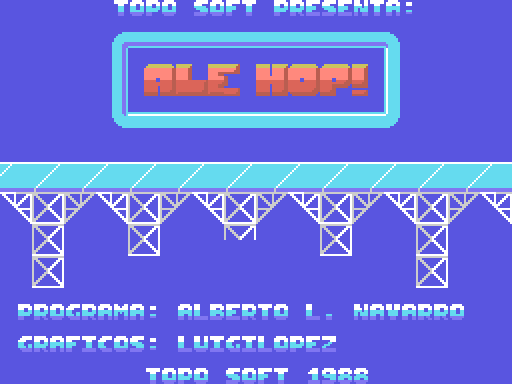
The title screen, reconstructed by decompressing the graphics and assembling the map, reads:

PROGRAMA: ALBERTO L. NAVARRO · GRÁFICOS: LUIGILOPEZ · TOPO SOFT 1988

That's read out of the binary, not from external sources. It's what the game itself claims.