The 135 bytes that never execute
Inside the game block there are four stretches that disassemble as perfectly coherent Z80 and that no path reaches: no CALL, no JP, no pointer in any table. 135 bytes out of 42645.
They were hunted down one at a time: for each address, its pointer (the two bytes, little-endian) was searched across the whole binary — all three code regions, the engine's tables, and the 35 KB of page-0 data — and it doesn't appear. The search was done over the real disassembly, not by scanning bytes: a naive scan mistakes operands for opcodes and produces false positives.
They're marked as data in the listing on purpose. Something disassembling cleanly doesn't prove it runs, and reassembly can't tell: the bytes are identical either way, only their interpretation changes.
1. The colour effect that was left out — 43 bytes at 0xC38E
The most interesting of the four. It walks the 0x1830 bytes of the VRAM colour table and applies the routine at 0xC3A7 to each byte twice:
0xC3A7:  rlc a / rlc a / rlc a / rlc a   ; swap the two nibbles
         ld d,a
         and 0x0F                        ; look at the result's low nibble
         xor 0x01                        ; is it 1?
         ld a,d
         ret nz                          ; if not, return the rotated value
         and 0xF0                        ; if so, zero it
         ret
Applied twice the nibbles end up back where they started, and the net effect is a one-line rule: every nibble equal to 1 becomes 0. Tested across all 256 possible combinations: 31 change.
On the TMS9918, colour 1 is black and colour 0 is transparent, and transparent shows the backdrop colour from register R7. So this routine turns every black on screen into "whatever the backdrop says".
On the actual title screen it changes 3673 of the 6144 colour bytes, 60 % of the display. With the black backdrop the game uses (R7 = 0x01) you'd see nothing: it only makes sense alongside a change to R7. In other words, it was half of a full-screen fade or flash.
Here's how it would look with a blue backdrop:
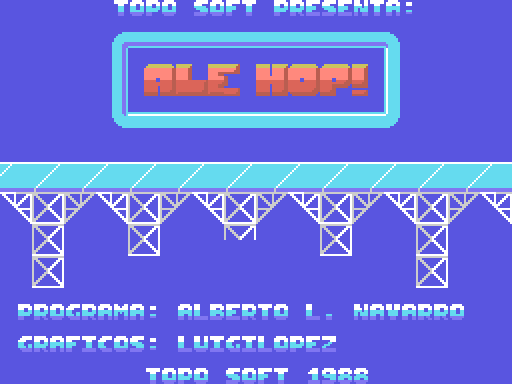
2. A title-screen loop from another version — 26 bytes at 0xC264
ld hl,0xC532 / ld a,(0xC52F) / add a,(hl) / ld (hl),a
call 0xC17A / push af / call 0xC134
ld bc,0x7C05 / call 0xC245 / pop af
ret z / halt / jr 0xC264
It calls three routines that are very much alive (0xC17A, 0xC134 and 0xC245) and touches a variable that's in use (0xC532), so this is code from this game, not some other one. What gives it away is 0xC52F: not a single live instruction reads or writes that variable. It's a title animation loop that was replaced by another, leaving an orphaned variable behind.
3. The sound library's interrupt handler — 21 bytes at 0xB000
di / pop hl / call 0xB036 / pop ix / pop iy / pop af / pop bc / pop de / pop hl
ex af,af' / exx / pop af / pop bc / pop de / pop hl / ei / ret
This is the classic "fast interrupt": pop hl throws away the return address into the BIOS handler and the registers the BIOS had just saved are unwound by hand, skipping the rest of the system interrupt routine.
It sits immediately before the music player and calls its frame routine (0xB036), which makes it the library's standard entry point — the one you'd hook into H.TIMI if all you wanted was music. Ale Hop! doesn't use it because it has its own handlers, at 0xC105 for the title screen and 0xD345 during play, which do the same thing plus keep a frame counter. All three are the same skeleton byte for byte.
It's the best evidence that the sound player arrived as a reusable library rather than as code written for this game: it travels with its own interrupt handler even though the game integrating it never calls it.
4. A loader from another build — 45 bytes at 0x8850
This one isn't among the code but at the end of the data, right behind the last block of compressed graphics.
in a,(0xA8) / and 0xC0 / ld c,a / ld b,3
[srl c / srl c / or c / djnz]      ; replicate page 3's slot across all four
ld (0xA87D),a
and 0xFC / di / out (0xA8),a       ; page 0 -> ROM, pages 1,2,3 -> RAM
ld hl,0x9000 / ld de,0x7000 / ld bc,0x184D / ldir
ld a,(0xA87D) / and 0xF0 / out (0xA8),a   ; pages 0 and 1 -> ROM, 2 and 3 -> RAM
ei / xor a / jp 0xC000
It ends by jumping to 0xC000, the same entry point the real game uses. But the memory layout it leaves behind is different: ROM in pages 0 and 1 (0x0000-0x7FFF), RAM only in the top two. The shipped version puts ROM in page 0 only and RAM in the other three.
In that version, then, the game lived in the top 32 KB and hid its data under the BASIC ROM in page 1, rather than under the BIOS as the shipped one does. It moves 0x184D bytes (6221) to 0x7000, and the arithmetic lands exactly on 0x884D — which happens to be where the compressed graphics end in the shipped version.
One more thing places it outside this build: it uses a variable at 0xA87D, and the game block ends at 0xA694. That address doesn't exist here.
Summary
| where | bytes | what |
|---|---|---|
| 0x8850 | 45 | Loader from a build with a different memory layout |
| 0xC38E | 43 | Full-screen colour effect, never invoked |
| 0xC264 | 26 | Title-screen loop replaced by another |
| 0xB000 | 21 | The sound library's interrupt handler, unused |
| 135 |