The game
Twin Bee is a vertical shoot'em up Konami published for the MSX in 1986, catalogue number RC-740, on a 32 KB cartridge. Two little ships with arms fly over an island, shoot at clouds and collect the bells that fall out of them.
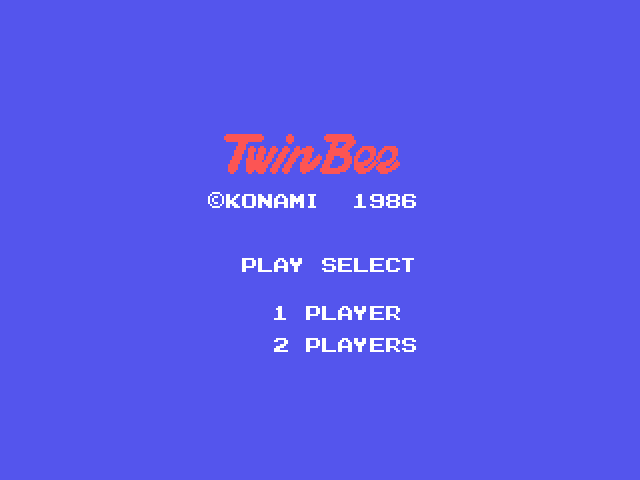
What a game looks like
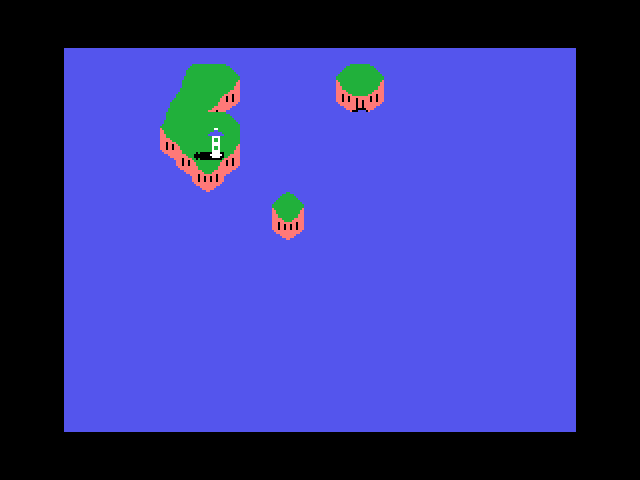
You control a ship that moves in all four directions and fires upwards. Two buttons: one shoots, the other drops a bomb on the ground. Two players can play at once, each with their own ship, their own score and their own lives.
The stage number climbs one at a time to 99, but there are only five sceneries: (0xE076) holds which one is showing, and when its low nibble reaches six it goes back to 0x11 -the first one again, with the high nibble counting laps. Reaching stage 99 is the only way to finish the game.
The bells
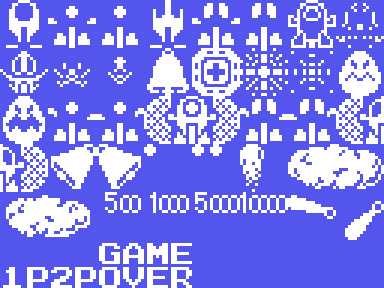
Shoot a cloud and a bell falls out. While it falls it keeps changing colour, and the game lets you keep it in the air by shooting it: that is the whole mechanic. What it gives, though, does not come from the colour you see. It comes from a 32-step counter that advances one place every time a bell is collected, and only five of those thirty-two slots carry a prize:
| slot | prize |
|---|---|
| 4 | one more power level, up to seven |
| 8 | the twin shot |
| 16 | the arm |
| 20 | the weapon, sixteen uses |
| 32 | the shield |
The other twenty-seven only give points. That table is not even in the ROM: empieza_la_partida writes it into RAM by hand with five ld and four rlca.
The arm
The ship can stretch an arm upwards. It is nace_el_disparo_uno (0x65F1) that drives it: the arm appears at the top of the screen, waits, and then climbs three pixels a frame until its counter runs out.
Two ships that hold hands
This is the part almost no two-player game of the period had. If the two ships get close enough -mira_si_se_dan_la_mano (0x667C) measures the distance on both axes and asks for both to fit inside 0x22 pixels- they latch together and from then on mueve_las_dos_agarradas (0x6326) moves them as one.
While they are joined, the input that counts is the sum of both joysticks, and 0x5EC7 zeroes it the moment one of the two pulls the other way: that is what pulls them apart. And the drawing of the arm that joins them is not improvised either - it comes out of an 81-value table, nine steps of vertical distance by nine of horizontal.
The scenery
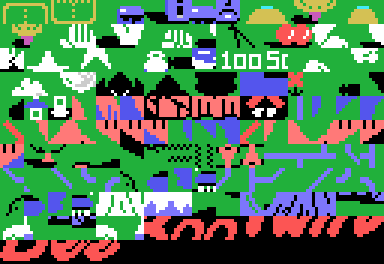
The scenery is a single strip of 1,761 rows, built out of 248 blocks of 32 tiles —one whole screen row each—, and the five stages run through it back to back: stage 1 goes from row 0 to row 261, where its boss arrives; stage 2 carries on from there to 585; stage 3 to 945; stage 4 to 1272, and stage 5 to 1760, the end of the strip (the table at 0x6132). When a boss falls, 0x613C uploads the next scenery's tiles without moving the screen. What changes from stage to stage is the artwork; what does not repeat is the terrain: each stage has its own.
And while playing, VDP register 7 holds 0xE0: the border and every transparent tile are black, not the title's blue. The maps here are drawn that way, which is how they look.
It scrolls one row every sixteen frames -avanza_el_decorado (0x6CD1) is what counts them- and the map is stored bottom to top: the row at the top of the screen is the higher index, and the counter climbs as the game goes on.
The enemies
Fourteen slots of 0x20 bytes each, from 0xE160. Byte 1 of a slot says what that enemy is: that number indexes the forty-pointer table at 0xAD60 and out comes the routine that moves it. Five of those forty do double duty as the boss's shots.

With two players, the enemies do not aim at the nearest ship or the most annoying one: they take turns. elige_a_quien_apuntar (0xBA72) flips (0xE150) with an xor 1 on every call, so one enemy aims at the first ship and the next one at the second.
The bosses
One per stage, in its own slot at 0xE320, with its behaviour taken from the five-pointer table at 0xADCC. A boss does not fit in a 16x16 sprite, so it is drawn by writing tiles into the screen buffer: coloca_al_jefe (0xBBC9) takes its tile script and places two tiles on one row and two on the row below.

The demo
Leave the cartridge alone and it plays by itself. It is not an AI: it is a recorded game. Twenty-eight joystick readings, one every 32 frames, fed in through the very same door the player's input uses. And so the same string of presses gives the same game every time, the Z80's R register -which is where this cartridge gets its randomness- is set to zero before starting.