The game
Stardust is a vertically scrolling shoot'em up. You fly a ship — the Astrohunter — over the surface of a fleet of enemy supercruisers heading for Earth, dodging or destroying whatever comes at you until you reach the shield generators.
And then, out of nowhere, it changes game. On clearing the last ship zone the character lands and carries on on foot, and that's the final stage.
This page gathers the game as it looks and sounds: the graphics, the 7+1 levels with their maps, the texts, the music, and two shots of the game running. The how and the why of each thing is in Findings.
The graphics, taken out of the tape
None of what follows is a screenshot: it's all drawn from the bytes of the binary, using the exact same geometry the game itself uses. Which is what makes it a check rather than an illustration — if the block's layout were wrong, what would come out is noise.
The logo

It's the first thing in the game block: its first 256 bytes, a 128×16 bitmap at 16 bytes per row. It's the same sign the attract mode animates bouncing over the play area, and the same one heading this site's front page.
The 111 scenery tiles
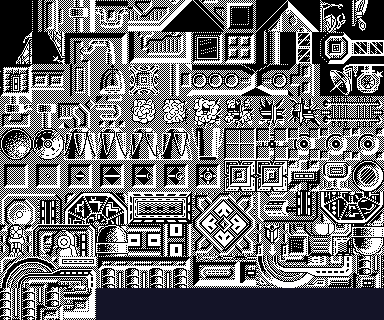
They run from 0x6DE0 to 0xA55F and are 32×32 pixels, four bytes per line, 128 bytes each. The arithmetic closes on its own: 111 × 128 = 14,208, and 0x6DE0 + 14,208 = 0xA560, which is exactly where the sprites begin.
The 83 sprites
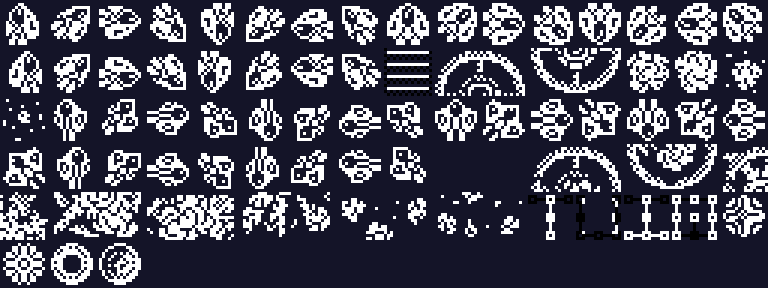
From 0xA560 to 0xBA1F, 16×16 pixels with a mask: each line carries the bits of the drawing and the bits of the mask that says which pixels belong to it, 64 bytes per sprite in all. The mask isn't a flourish — it's what the Spectrum's software drawing needs, opening a hole with AND before painting with OR.
The charset and the sentinels

59 characters of 8×8 at 0x6000, and the fifteen 24×24 sentinel nodes, at 0x69A8:

The eight levels: seven zones and a tower
The game is really 7+1 levels: seven zones you fly over piloting the ship, and an eighth — the scoreboard itself numbers it ZONA:08 — that gets climbed on foot.
The seven ship zones
Each zone takes about 250 bytes on the tape, nowhere near enough for a full map. They're compressed, and the scheme has real charm: a recursive phrase dictionary. Every byte of the stream is a token — with bit 7 clear it's a tile number that goes straight into the map, and with bit 7 set the low seven bits index a phrase in the dictionary. That phrase gets expanded by calling the same routine, so a phrase can contain other phrases. It's a grammar, not a plain copy-paste. An 0xFF ends the level.
Expanded, all seven zones come to exactly 450 bytes, and seven different streams landing on the same size is the sign the decompressor's reading it right. And 450 = 6 × 75: the width isn't a choice, it follows from the screen buffer being 24 characters wide and each tile being four — the buffer's axes are easy to read backwards, and with the right width the maps come out symmetrical, their structures whole.
Every byte is a tile index, running 0 to 110, exactly when there are 111 tiles in total. Zone 7 uses number 110, the very last one: another check that falls out on its own without anyone hunting for it. Each zone's colour comes from the same table as its pointer, and the seven cycle through three: red, white and cyan.







They get rebuilt with tools/descomprime_nivel.py and tools/render_niveles.py.
Zone 8: the on-foot tower
The last zone isn't flown over: it's climbed. Its map sits at 0x840B — 78 rows of 6 cells — and gets drawn with its own pool of 45 tiles of 32×32, so the whole tower measures 192×2496 pixels, nearly twice as tall as the seven ship zones laid side by side. Every byte of the map is two things at once, the cell's drawing and its physics, and that story — the camera, the checkpoints, death by falling — is in Findings.

Below the starting point sits the arrow sign pointing up — tiles 0x28 and 0x29 appear nowhere else at all — and row 0 is a cornice of rosettes. The bare structure, without the background pattern, and its tile pool:

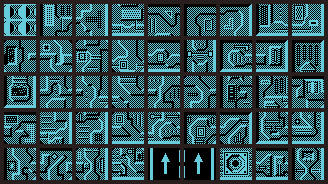
They get rebuilt with tools/render_torre.py.
The frame and the loading screen
The play screen carries a decorated frame on all four sides and leaves a central window for the action, with the score and the zone number along the bottom. The frame is very much of its time and very much of the Spectrum: it takes advantage of the borders never changing to fill them with detail at no cost at all. It's never drawn piece by piece — it ships ready-drawn inside the game block itself, which is exactly why it can be composed straight from the tape:
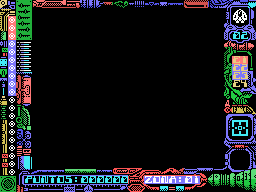
How it inherits its name table from the loading screen — and why that lets the scoreboard write drawings instead of letters — is told in Findings.
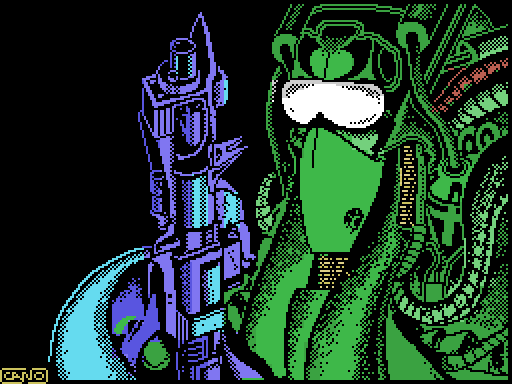
The loading screen isn't a capture either: it's drawn from the 12,288 bytes its own block sends to video memory. It's signed CANO, bottom left.
The game's text
Read out of the binary, exactly as it sits there:
- The menu:
JOYSTICK,TECLADO,REDEFINIR TECLAS,JUGAR— joystick, keyboard, redefine keys, play. - The high-score table ships from the factory with in-house names:
JAVIER 100000,JUAN C 080000,MARTA 060000,MARIA 050000,TOPO 030000,SOFT 020000. - And the notice that the good part is coming, right before the second load:
HAS CONSEGUIDO PENETRAR LAS DEFENSAS DE LA NAVE INSIGNIA / PERO LO PEOR AUN NO HA LLEGADO— you've broken through the flagship's defences, but the worst is yet to come.
And the credits, easily the most interesting thing in the whole text block, because they answer the question underlying this whole disassembly: who made the MSX version. The authors of the ZX Spectrum version warn in their own repository that they didn't make it, and here's the name, right there in the binary:
CONVERSION POR
CARLOS ARIAS
GRAFICOS
JUAN CARLOS Y JAVIER AREVALO
...ADEMAS DE...
JULIO MARTIN
MUSICA COMPUESTA POR
GOMINOLAS
BASADO  EN
UNA IDEA  ORIGINAL
JOSE MANUEL  MU&OZ
TOPO SOFT
"Conversion by Carlos Arias; graphics by Juan Carlos and Javier Arévalo; and also Julio Martín; music composed by Gominolas; based on an original idea by José Manuel Muñoz." The graphics are still the Arévalo brothers', same as the original version, which fits with the artwork having been carried across untouched. The conversion of the code, on the other hand, is signed by Carlos Arias. That & in MU&OZ isn't a transcription slip: it's simply how the game's charset encodes the letter ñ.
The music, as the chip put it out
Stardust stores its music in a language of its own, fifteen commands strong, and that story — the interpreter, the three voices, a score that doesn't hold a single note — is in Findings. Here's the result: what 1987 actually got to hear.
These two pieces aren't a synthesis of the listing, mind — they're what the sound chip genuinely put out, captured register by register with the game running in the emulator and turned back into sound. That's why their names say "medida", measured. The reading of the score was checked separately, frame by frame, against these same captures.
The ship game's music — the C–A–F–G progression, two bars per chord:
And the on-foot stage's high-score table music:
And this is it running
Everything above is drawn from the tape. These two are the exact opposite: two frames of the recorded playthrough that ships with the repository (Stardust.omr), taken with openMSX at seconds 1002 and 2150 of the recording. A render proves the data's been understood correctly; a screenshot proves something else entirely — that the program starts and runs for real.
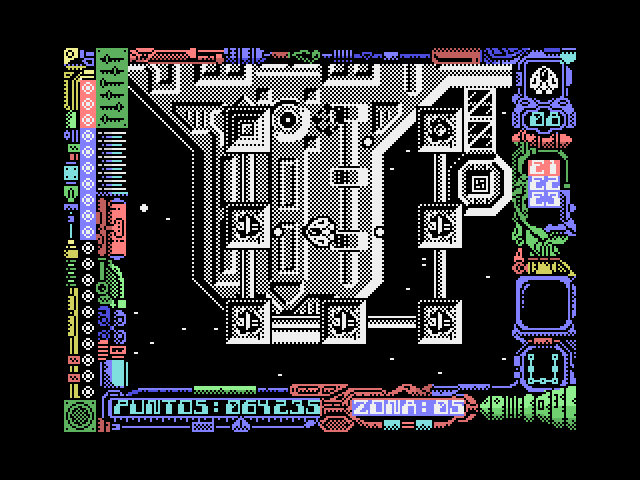
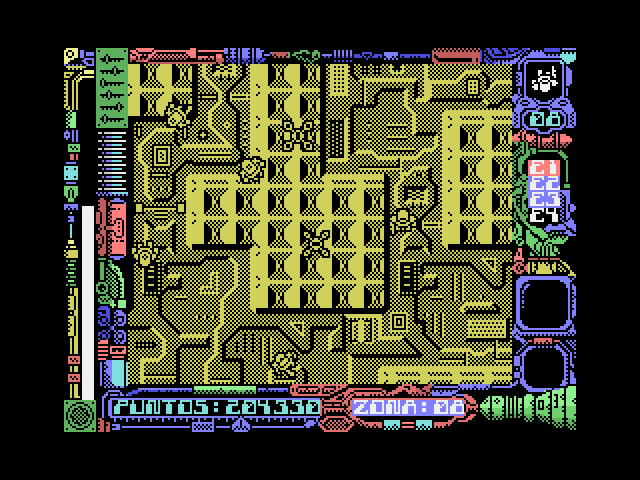
The second one doubles as proof of the multiload, which is why it's taken so late: in that playthrough the player clears zone 7, the game goes back to the tape — the motor comes on at second 1552.20 — and what carries on running is the other program. You don't have to take the scoreboard's word for it, either: dumping memory from 0x61D0 to 0xD674 at that instant, 29,585 of its 29,861 bytes — 99.08% — are those of the tape's fourth block, against just 674 of the ship block that sat at those same addresses before. And the program counter sits at 0xA9BA, already inside the second part.