Findings
That Stardust is a ZX Spectrum conversion was already known. What you don't expect is quite how far that conversion goes: they didn't just bring the graphics across and rebuild the rest, they brought the whole recording system, the load routine, and even the way the screen gets drawn. What follows is what kept turning up as the tape came apart, each thing with the evidence behind it, grouped by theme: the conversion itself, the loading, the two engines, the craft of drawing, the world and its creatures, the sound, and the ending.
Who actually made this version
The ZX Spectrum authors warn in their own repository that somebody else made the MSX version. And the game answers that on its own, in its credits screen, at 0xF124:
CONVERSION POR
CARLOS ARIAS
GRAFICOS
JUAN CARLOS Y JAVIER AREVALO
...ADEMAS DE...
JULIO MARTIN
MUSICA COMPUESTA POR
GOMINOLAS
BASADO  EN
UNA IDEA  ORIGINAL
JOSE MANUEL  MU&OZ
TOPO SOFT
The conversion is Carlos Arias's, and the graphics still belong to the Arévalo brothers, same as the original — which fits with the artwork having been carried across exactly as it was, untouched.
A conversion down to the bone
The first thing that jumps out on close inspection is how much of this tape isn't MSX at all, but the Spectrum it came from.
This isn't an MSX tape
MSX games are recorded in KCS blocks, the system's own format: the BIOS writes them and the BIOS reads them, and that's how the rest of Topo Soft's titles for this machine do it.
Not Stardust. Its four data blocks are ZX Spectrum blocks, with the structure from over there: a flag byte, the data, and a final byte that's the XOR of everything before it. All four carry that checksum correctly — checked one by one — and it's the only integrity check the tape has at all.
The tape carries it, yes, but nobody looks at it: the load routine works out the XOR and returns with the carry saying whether it matches, and both call sites (0x4018 and 0x403D) carry on without testing it. There is no retry and no error message: if the tape reads badly, the game starts anyway.
And the loader isn't native either: it's a reimplementation of LD-BYTES, the Spectrum ROM's own load routine, with the same register interface:
ld ix,047a0h    ; IX = where it goes
ld de,0b647h    ; DE = how many bytes
ld a,000h       ; A  = the flag expected
scf             ; carry set = load, don't verify
call 0405ch
Anyone who's ever programmed a Spectrum will recognise that call: it's the one at 0x0556 in its ROM, parameter for parameter.
The flat 48K the Spectrum has and the MSX doesn't
Before loading anything, the loader does something an ordinary MSX game wouldn't ever need to bother with: it hunts for RAM and maps it into pages 1 and 2.
ld hl,04000h / call sub_d30fh
ld hl,08000h / call sub_d30fh
The routine at 0xD30F keeps trying to write into each slot with ENASLT (the BIOS call at 0x0024) until it finds actual RAM. Why bother? Because the Spectrum has 48K of flat RAM and the MSX doesn't: here, the lower half of memory is taken up by the BASIC ROM, so for the ported game to find memory exactly where it expects it, that ROM has to be shoved out of the way first.
The second load brings the Spectrum's LD-BYTES again
We already know the loader reimplements LD-BYTES, the routine the ZX Spectrum's ROM uses to read from tape. Well, the routine the game uses to load its own second part isn't a copy of that one — its signature was searched for byte by byte across the whole tape and turns up nowhere — but it comes from the same place, and it says so right there in its constants: three numbers, each in its own spot and in the same order as the original.
0x16     LD-EDGE-1's delay
0x0415   LD-START's wait
0x9C and 0xC6   the thresholds LD-LEADER uses to recognise the guide
                tone by measuring how long the pulse lasts
Even the split into two routines is the same: one calls the other and bails out if it fails, exactly what LD-EDGE-2 and LD-EDGE-1 do. The only thing that's genuinely ported is the bit read itself, because the Spectrum goes through in a,(0feh) and here it has to go through PSG register 14 instead.
And as a bonus, the show: on every edge read, the routine dumps the masked refresh register into the border colour (ld a,r / and 00fh), which is exactly the colour stripes the Spectrum flashes while loading, dressed up over the one place the MSX has anything resembling a border colour at all.
Worth being clear about what kind of proof this is: it's an identification by structure and by constants, not a diff — there's no Spectrum ROM in this repository to compare against byte by byte. With three numbers that specific landing exactly where they should, it's hard to imagine it's anything else, but it's worth saying plainly what kind of evidence this is.
The explosions carry a Spectrum fossil inside
Both stages have their own particle explosion, each with its own copy of the code. The ship one — when the ship gets shot down — seeds 64 particles at the ship's position and moves them with gravity: vertical speed grows by one point per frame, and each particle is just a loose pixel drawn onto the buffer. The happy-ending one — the flagship seen from outside — is 200 particles of shrapnel, biased upward, no gravity this time.
And in both, buried inside the loop that paints each particle, sits this:
c663: and 018h / out (0feh),a0xFE is the ZX Spectrum's border port. On the original, every particle made the screen border flicker; here on the MSX that port does absolutely nothing, and the instruction just sits there anyway, firing uselessly on every single particle since 1987. Both copies of the effect carry the same fossil, and it's the cleanest proof this project has that these routines were carried across from the original as they were, without anyone reviewing them.
While we're at it: the randomness for the particles — and for the 48-star field in the ship stage's background, which are actually random heights painted with the same fixed pattern 0x18 — comes from a generator that reads the BIOS ROM as if it were an entropy table. And the immortality POKE from Input MSX magazine, the one that patches 0xC06E, sends the ship through 0xC05C on every frame, where a 3 goes into the shield counter: immortality here is, literally, a shield that is recharged before it can ever run out.
A slip in the enemy spawner, inherited instruction by instruction
The routine at 0xD41A works out the difficulty with rrca, which rotates instead of shifting. Since 7 − zone comes out odd on exactly the even zones, the low bit spills into bit 7 right there, the mask saturates to 0xFF, and the odds of an enemy spawning that way drop to one in 256. The progression only stays clean on the odd zones — 1/8, 1/4, 1/2 — and on zone 7 the enemy just walks in without rolling anything.
And it's not the conversion's fault: it comes straight from the factory. Checked against the disassembly the ZX Spectrum authors published themselves, the matching routine sits at $D4CF with the exact same sequence — LD A,$07 / SUB B / RRCA / ADD A,E — 52 of its 68 bytes identical and not a single opcode different: the 16 that change are just address operands. The rrca was there back in 1987, and the port copied it instruction by instruction, untouched.
And in play, that's exactly what happens. Pointing the emulator at the add a,e at 0xD436 — right after the rrca, with the zone sitting alongside — over the stretch of the recorded game where the ship stage runs the show, the 206 times it fires give this table and no other:
zone 2   A=0x82      zone 3   A=0x02
zone 4   A=0x81      zone 5   A=0x01
zone 6   A=0x80      zone 7   A=0x00
The three even zones that actually got played all carry bit 7 set, so the mask really does saturate; the odd ones give the clean progression. And zone 7 comes out 0x00, exactly the case where the enemy walks in without rolling anything at all. It's softened a bit, mind you, because those tables have another spawn route, through the map tiles, that ignores the zone entirely.
What can't be claimed is intent. That a shift was meant is what everything suggests — the game uses srl to divide in both blocks, and rra sits one bit away from rrca — but nobody can read the mind of whoever wrote it, and the original authors left that routine uncommented too.
The loader, and what it carries
The loader alone is good for several findings, and the game hides a second loader inside it besides.
The loader ships with a back door for trainers
And this is the best one of all. Before starting the game, the loader copies 94 bytes from 0xDAC0 to 0xFDE8 — high memory, where nothing's going to overwrite them — and then takes a look at what's in there:
4040: ld hl,0fde8h / ld b,003h
4045: ld a,(hl) / cp 0c9h / jp nz,0bd85h   ; three 0xC9 signature bytes?
404e: ld b,(hl)                            ; B = how many patches
4050: ld e,(hl) / ld d,(hl) / ld a,(hl)    ; address and value
4056: ld (de),a / djnz 4050                ; apply them
4059: jp 0bd85h                            ; and now, at last, into the game
If those 94 bytes start with three 0xC9, the loader treats them as a list of patches and applies them straight onto the game it just loaded. So the commercial loader itself ships, from the factory, with a POKE applicator built in.
And the arithmetic settles on its own: three signature bytes, one counter byte, and thirty patches of three bytes each, ninety-four in total. It's sized for exactly thirty pokes.
Which explains, in passing, why the magazine loaders of the day worked so well with this particular game. The one in Input MSX issue 19 writes with FOR I=56000 TO 56012, and 56000 is exactly 0xDAC0: the mailbox. Its three patches, read straight from the binary before they get applied:
0xC06E/6F:  38 1F (jr c,+31)  ->  18 EC (jr -20)
0xF7B1:     01 -> 00
The second one changes the 1 of an ld a,001h into a 0. Applied by the game's own loader, the ship survived sixteen minutes straight without dying once.
And the first one jumps into a routine the game ships and never calls
That patch's displacement is EC, which is −20: the jump doesn't skip anything by going forward, it goes backwards, to 0xC070 − 20 = 0xC05C.
And at 0xC05C there are seven bytes that aren't filler, whatever they might look like:
c05c:  ld a,003h        ; the shield
c05e:  ld (0c188h),a    ; back to three
c061:  jr  0c08fh       ; and on with the ship, as if nothing happened
So immortality here isn't about dodging the explosion at all: it's that the shield gets refilled to three on every single frame, faster than the game can ever spend it.
And the striking part is whose routine this actually is. It's sitting on the tape, and in the game as it was sold, nobody calls it at all: its address doesn't appear even once among the block's 46,663 bytes, and no relative jump lands anywhere near it. Seven bytes doing exactly what you'd need in order never to die, sitting exactly twenty bytes away from the jump you have to patch to reach them.
That the authors left it there on purpose, as some kind of test switch, is what it looks like — but that's a guess, and it's stated as one. What is actually measured is the behaviour, and twice over: in the PC sampling of the long session, played with the trainer on, those three instructions turn up 28, 13 and 33 times, and the explosion's particle seeder not once; in the sampling of a session played by hand without the trainer, it's the other way round, 0xC05C never shows up and the explosion does.
How the game asks for the second part
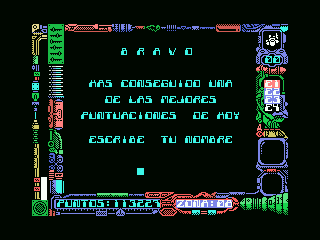
Clearing the last ship zone brings up a screen reading
FELICIDADES
HAS CONSEGUIDO PENETRAR LAS DEFENSAS DE LA NAVE INSIGNIA
PERO LO PEOR AUN NO HA LLEGADO
and the game goes back to the tape for the second part, the one on foot.
The interesting bit is how it does that. The loader's own load routine survives the whole game in page 1 — the game loads from 0x47A0 up and never treads on it — so calling it back would be the obvious move. It doesn't. The game brings its own routine instead, and it turns out to be a second port of the Spectrum's LD-BYTES, the same one the tape loader had already reimplemented on its own account:
f7f6: ld hl,0f89fh / push hl    ; the return address, pushed by hand
f7fb: ld a,008h / out (0abh),a  ; switches on the tape MOTOR
f7ff: ld a,00eh / out (0a0h),a  ; PSG register 14, the tape-bit one
f804: inc d / ex af,af' / dec d / di      ; LD-BYTES, opcode for opcode
f808: ld a,005h  ...  ld hl,00415h        ; and its very constant, 0x0415
f848: ld (ix+000h),l            ; each byte read, stored through IX
f887: in a,(0a2h) / cpl / xor c ; reads the tape bit back off the PSG
f893: ld a,r / and 00fh / out (099h),a    ; and flickers the border, via the
                                          ; VDP where the Spectrum used a port
And it isn't a copy of the loader's version either: its signature was searched byte by byte across the whole tape and turns up nowhere.
So how was this settled? Starting from a savestate grabbed right on the FELICIDADES screen and sampling the program counter every two milliseconds through the whole load: 84,441 samples, every single one inside 0xF7F6–0xF89E, not one in ROM, not one in page 1. Meanwhile IX — the pointer that ld (ix+000h),l stores through — walks from 0x61D0 to 0xD674, exactly the last byte of a 29,861-byte block. Neither the BIOS nor the loader has anything to do with any of this.
What's left in memory afterwards matches the tape's block to 99.78%: only 66 bytes out of 29,861 differ, spread across thirty short runs, and they're the variables the second part had already written to by the time the dump was taken — among them the three 46-byte sound-channel states at 0xD068, 0xD096 and 0xD0C4.
And if you replay a recorded playthrough, a breakpoint on 0xF7F6 never fires: the recording begins with the loader already running — its very first frame has the program counter sitting at 0xF849, inside the routine — so the entry point simply has nothing left to catch. The 0xF89F sitting on the stack is put there by the push hl at 0xF7F9.
Why the second part loads exactly at 0x61D0
The load address of the on-foot stage's block is not arbitrary at all: the font fixes it. That stage's two text printers — the one for the DEMO sign and the menu, which paints double-height through the checkerboard, and the frame one, which writes straight to video memory — use the same ASCII font, indexed as 0x5F00 + code×8. The ship block leaves that font loaded, and the on-foot stage simply reuses it.
The arithmetic closes on its own: the last character the font needs is Y (code 89), and 0x5F00 + 90×8 works out to exactly 0x61D0. The second part's block loads at the first free byte right after the Y glyph, not one byte earlier, so as not to eat into the inherited font.
Where the second part starts executing
0x61D0 is only where the block is loaded. The program starts executing at 0xA279, and the loader itself takes it there, as soon as the tape load succeeds:
f7b0: ld a,001h / ld (0a529h),a
f7b5: jp 0a279h            <- the second part starts here
And 0xA279 disassembles to a textbook program start: it disables interrupts, sets up its own stack with ld sp,05b32h, programs the graphics chip and writes JP 0xC46E into 0xFD9F, which is H.TIMI, the MSX interrupt hook. That same address, 0xC46E, had already been identified separately from the shape of its epilogue: two independent routes agreeing on the same spot.
Two engines, one shared library
The two halves of the game don't share an engine — but they do share the tools.
Two different engines on one tape
The two parts of the game don't share an engine, and it shows most clearly in how they carry their creatures around. In the ship stage, every entity keeps a pointer to its governing routine right in its own 8-byte structure, and the game jumps there with a jp (hl). Catching those jumps with the game actually running, the IX values step 8 at a time: 0xCB3A, 0xCB42, 0xC8D8, 0xC8E0...
And that jp (hl) is really a disguised call, not a jump, because the Z80 has no call (hl) instruction. What the game does is push the return address by hand:
ld hl,0cb9dh        <- the return address
push hl             <- onto the stack, as a CALL would
ld l,(ix+003h)
ld h,(ix+004h)
jp (hl)             <- and off to the object's behaviour
The ret that ends that behaviour lands on 0xCB9D, which is the very next instruction: an indirect call built out of two plain instructions.
And there's an even finer touch. When an object has nothing to do, instead of storing a null pointer and checking for it every time, the game installs the address of a ret that already exists in the code (0xD959). That way the loop never has to ask anything: it always calls, and whatever has nothing to do just returns immediately.
The on-foot part doesn't treat its enemies this way at all. They live in 5-byte tables — walkers at 0xACE4, four at most; flyers at 0xACF9; the turret's two shots at 0xAD04 — and carry no routine pointer: fixed loops move them, one per species.
And what the jp (hl) at 0xC544 actually dispatches isn't enemies at all: it's the sound interpreter's three channels.
The code says so, in the simplest possible way. The routine that starts a sound takes the channel number, multiplies it by 46, and adds a base to reach that channel's state. Both halves of the game carry the same routine for this, identical but for the base:
ships    and 07fh / ld de,0002eh / call ... / ld de,0ed75h
on foot  and 07fh / ld de,0002eh / call ... / ld de,0d068h
And 0xD068 is exactly where the mystery IX values landed. The arithmetic closes on both sides: three 46-byte channels counted from 0xED75 end at 0xEDFF, precisely the address the code loads for the interpreter's variables.
So that jp (hl) was never dispatching entities: it was dispatching music commands. It's the same interpreter in both halves, with the same three channels.
What they do genuinely share is the craft of drawing. It's the Spectrum technique, from a machine with no hardware sprites at all: the image gets shifted bit by bit with an unrolled run of adc hl,hl, a hole gets opened with AND, and it gets painted with OR.
And if you pair up the drawing run of one half against the drawing run of the other — not against the mask run, which is the other half of the same routine — 26 bytes come out identical out of 28, and the only difference is one jump's operand.
And it isn't just the sprites: they share a whole library
The rest of the service routines don't merely resemble each other: they're the exact same routines, copied and relocated from one place to the other. Five are identical byte for byte:
buffer_dir      0xC541 / 0xAACD   18 of 18 bytes
solapa_eje      0xCD7A / 0xAEC2   12 of 12
hay_tecla       0xF660 / 0xD30B   16 of 16
mul_a_de        0xE591 / 0xC8A6   21 of 21
vram_pon_dir    0xEE24 / 0xD117   16 of 16
And in the rest, what turns resemblance into proof is where the differences land: in pairs of consecutive bytes, exactly what a 16-bit operand measures. The sprite painter is 198 bytes long and 21 of them differ: twenty are ten addresses — the sprite pool, the row counter, the two jr instructions the routine patches into itself, the call to buffer_dir, the two jumps the shortcuts use to vault over the runs, and the one that closes the row loop — and the twenty-first is one loose byte, the bottom clip: 0x50 in the ship stage and 0x4F in the on-foot one. Out of the whole routine, that's the only thing that genuinely changes. The glyph painter, 144 bytes, gives the same picture: 13 differences, six addresses and that same byte again.
In borra_buffer the four differences are just that the di sits before the ld hl,0 / add hl,sp in one half and after it in the other. In the random number generator, all four differences are the seed's address, which shows up twice.
Counted in the raw, searching for identical stretches of 32 bytes or more between the two blocks turns up 58 stretches and 5,867 bytes, of which 1,200 fall in code territory. And that figure is deliberately on the low side, because every different address splits a stretch in two.
There are also differences that aren't relocation at all, but a genuine design choice. gira_rumbo exists in both halves and does the same thing — nudging the current heading toward the requested one an eighth at a time, the short way round — but the on-foot version is missing the bit that checks a wait counter tucked into bits 3 and 4 before applying the turn. Which is why the ship takes a few frames to tip over from one bank angle to the next, while the on-foot character changes direction instantly.
With that, the earlier line can be sharpened: the two game engines are different, the service library is exactly the same one.
How to place a drawing between two bytes: four ladders
Video memory works in bytes, eight pixels at a time. To put a ship at column 173 you have to shift the drawing within the byte, and on a Z80, that costs. The solution the game brings is the house special: a run of shift instructions written out one after another, entered at exactly the right height. The painter takes the low three bits of X and writes the jump into itself:
c494:  ld a,l / and 007h / jr z,...              the column lands exactly
c499:  dec a / ld c,a / add a,a / add a,c / add a,007h    (n−1)·3 + 7
c49f:  ld (0c4c4h),a / ld (0c4fbh),a             patches the two `jr`s
The 3 is what one rung costs (adc hl,hl is two bytes and adc a,a one), and the 7 is what the shortcut in front costs. That way the jump lands on exactly the right rung, and only the steps that are actually needed get taken.
And the steps go backwards from what you'd expect. To shift the drawing n pixels to the right, you take 8−n steps to the left over a three-byte window, because whatever spills out the top is exactly what needs to show up in the byte next door. With n=0 you'd need all eight steps, and those come free just by swapping registers around — that's the shortcut.
Looked at closely, the run doesn't shift at all: it rotates. A, H and L turn together as if they were a single 24-bit number, and it works like a shift only because it's the filler bits that come around the loop. And the filler is the only thing that tells the two runs each painter carries apart:
mask     enters with A=0xFF and `scf`   → fills with ONES  (lets the background show)
drawing  enters with `xor a`            → fills with ZEROES (doesn't overpaint)
Which is why it's the same code written out twice rather than one routine called twice: each copy ends up somewhere different — the one that stamps with AND and the one that stamps with OR — and all of this sits inside a sixteen-row loop, where a real call and its return would be paid thirty-two times over per sprite.
There are four ladders in total, two per painter — the sprite one works at 24 bits, the letter one at 16 — and all four show up in both halves of the game, identical byte for byte apart from where the jump lands:
mask 24-bit    0xC4C5 / 0xAA51   26 of 28 bytes
drawing 24-bit 0xC4FC / 0xAA88   26 of 28
mask 16-bit    0xC590 / 0xAB1C   18 of 20
drawing 16-bit 0xC5B5 / 0xAB41   18 of 20
The glyph painter's ladder starts six bytes before its declared range
In the glyph painter, the patch's arithmetic is n·2 + 4 instead of (n−1)·3 + 7, because its rungs are two bytes each and its shortcut is six (it's the same formula written differently: n·2 + 4 is (n−1)·2 + 6). And written that way it points straight at where the run starts: with n=1 the jump goes to 0xC5B5 + 6 = 0xC5BB.
And at 0xC5BB there's a run, not filler. The six bytes in front of its fourth rung — ed 6a three times over — are the ladder starting, and with them it has the same seven rungs as the other three.
Seeing it takes crossing two things no tool crosses on its own: the program-counter dump, which carries those three rungs at 40, 155 and 226 samples — more than plenty of already-declared addresses —, and the ranges declared as data. The guard that exists crosses data zones against the trace, but the tracer doesn't reach this ladder either; the cross-check has to be done by hand.
And that cross-check turns up two more ranges, both code: the seven bytes where the magazine's POKE lands — told above — and eight more at 0xE03D, which turn out to be an object behaviour installed as a pointer from two places in the block itself. Fifteen bytes sitting in the wrong column.
The craft of drawing on an MSX
What had to be invented to draw a Spectrum game on a machine that keeps its screen behind a port.
What the MSX forced them to change
There's a fundamental difference between the two machines the conversion couldn't dodge no matter what. The Spectrum writes directly into its screen memory, which is ordinary RAM at 0x4000. On the MSX, video memory sits behind the graphics chip and can't be addressed at all: it has to go out byte by byte through a port.
Which is why this version carries something the original never needed: a screen buffer in RAM, with a routine to dump it out. The buffer runs from 0x4000 to 0x4EFF, 3,840 bytes, 24 wide by 160 tall, and the dump sends it to VRAM in three bands — 0x4000 with 56 rows, 0x4540 with 64 and 0x4B40 with 40 — one per call, each into its own third of SCREEN 2. The code says so, with its three contiguous calls from 0xF3DC, and the emulator confirms it: that routine racked up 3,252,480 writes, with the pointer walking exactly 0x4000-0x4EFF.
And the axes are easy to read backwards, with everything that drags along if you do: the dump's ld b,028h looks like it's saying "40 columns", but it's the inner loop, and it walks the buffer in steps of 24 — which means it's actually collecting 40 bytes from a single column. The one really counting columns is the outer loop, ld c,018h, stepping one byte at a time, 24 times over.
Drawing it settles the question: split 24 at a time and the high-score table comes out legible; 40 at a time, pure noise. And it matches what you see while playing: 24 bytes are 192 pixels, narrower than the screen — that's why the frame down the sides never moves — and the surplus sits vertically, exactly where it scrolls.
One plane only, and why it looks like two
Anyone who's played this remembers two floors moving at different speeds, with that sense of depth. So it got checked properly: watching which routine writes to each band of the buffer, and building up, frame by frame, a table of which row got drawn from which address — which lets the shift get measured by exact number matches instead of eyeballing images.
And the result is unambiguous: the background is a single plane. Across four separate measurements — three moments in the on-foot stage and one in the ship stage — the buffer's eighteen strips, three bands by six columns, all shift exactly the same: +2 rows per frame walking, 0 standing still, −2 walking backwards, with 100% agreement and no horizontal shift at all.
The depth lives somewhere else: in the drawing order. Numbering every write to the buffer within a single frame, the ship stage always produces the same sequence: the whole background first, then the sprites, and after the sprites, still one more routine (0xC77A) that paints columns of scenery reading from its own tile store. And it got caught doing exactly that: a pillar coming down, the ship rising toward it, and right where the two crossed, the pillar ended up painted on top. The ship doesn't pass under the floor — it passes behind whatever gets repainted afterward.
In the on-foot stage, though, the parallax is real, only it isn't a plane: it's a drawing that redraws itself differently each time. The background gets painted twice per frame by patching an opcode: the game loop writes 0xC2 (jp nz) into 0xA98E and calls the redraw — so only the empty cells, the ones carrying tile 0, get painted — then writes 0xCA (jp z) and calls it again, this time for the solid ones. And that tile 0 is alive: every scroll step rotates it by one row of pixels (0xB140 going up, 0xB167 going down; the row that leaves comes back in on the other side). One row of pattern for every two of scroll means the background in the gaps moves at half the speed of the platforms. Which is why the buffer's strips all shift exactly the same — the earlier point still holds — and yet the eye still sees two different speeds. Measured across the whole game: 4,712 passes with each opcode, and not one frame comes out with any other value.
And there is a third opcode, which is an impossible jump
The background is painted with three opcodes, not two, and the third is the cleverest of the lot. The instruction right before the patched jump is an and a, which clears the carry by definition:
a98a: and a                <- carry is 0, always
a98b: ld b,(iy+004h)
a98e: jp ?,L_A9E4          <- the opcode that gets patched
So the third possible value, 0xDA (jp c), never jumps at all. It isn't a third condition — it's the way of having no condition whatsoever. With 0xC2 only the empty cells get painted, with 0xCA only the solid ones, and with 0xDA everything gets painted in a single pass.
One routine writes it, and reaching that routine takes three things at once: the scroll at the very top (row 0x47), all six targets destroyed, and the player sitting between 0x50 and 0x5F. That is: the end of the stage.
Which explains why the 4,712-pass measurement over the bulk of the game never sees that third value — those three conditions simply aren't met until the very end. The third opcode's only use in the whole game is the closing travelling shot, told in How the game ends.
The same lettering, sharp or see-through
On the high-score table the text comes out with its pixels separated, as if it were half transparent, while the DEMO sign reads perfectly sharp. They look like two different typefaces. It's the same routine, and the difference is made by patching the code on the fly.
The routine that draws a character does it at double height: each line of the font gets painted twice, and each copy is masked with a different pattern.
d4d0: ld a,(de) / and 055h / or (hl) / ld (hl),a / add hl,bc
      ld a,(de) / and 0aah / or (hl) / ld (hl),a / add hl,bc
0x55 and 0xAA are 01010101 and 10101010: alternating pixels, shifted from one line to the next. Which gives you a checkerboard, and a checkerboard to the eye reads as halftone.
And here's the good part: those two masks aren't constants at all. They're the operands of those two ands, at 0xD4D3 and 0xD4D9, and the game rewrites them before drawing, every single time:
bfb4: ld a,0ffh / ld (0d4d3h),a / ld (0d4d9h),a   ; neutral mask
bfbc: ld ix,0ddf2h                                ; the string "DEMO"
bfc0: ld hl,04d94h / call 0d4e5h                  ; draw
bfc6: ld a,055h / ld (0d4d3h),a
bfcb: ld a,0aah / ld (0d4d9h),a                   ; and restore
With 0xFF the and doesn't strip anything, and every pixel comes through. It's self-modifying code used exactly like a function parameter.
Along the way, the routine confirms where the font lives: it indexes with 0x5F00 + code×8, and with the first code, 0x20, that comes out to 0x6000, right where the 59 characters live. And the stride between screen lines is 24, the buffer's height when read by columns.
Two call 0000h that don't exist, and 193 bytes that were not text
The very first thing the game does, before anything else, is bounce the STARDUST logo. And that animation is exactly why a cold disassembler can't handle this stretch.
Putting together one frame takes two operations: painting the logo stretched to whatever height it's at, and erasing whatever rows the previous frame left dirty. And which order those two happen in depends on whether the logo's going up or down. Instead of settling that with a plain if, the routine writes its own two calls into itself:
f000:  ld (0f016h),hl        the first call's operand gets written
f003:  ld (0f019h),de        and the second one's
...
f015:  call 0000h            HL fills this one in
f018:  call 0000h            and DE this one
On tape those operands sit at 00 00, so a cold listing shows two call 0000h — and an overly helpful disassembler will even hang the comment for a harmless BIOS routine on them. Running live, they're always the same two addresses, in whichever order an ex de,hl decides.
Worth checking twice before writing anything off as orphaned: no call names either of these two routines directly, but their addresses are written into the binary anyway, once each, as the operands of an ld.
The credits text is 234 bytes, 0xF1E7-0xF2D1. The 193 in front of it, 0xF126-0xF1E7, are the logo's frame table: 96 pairs of top-row and height that describe the bounce — the height grows from 1 to 16, the logo drops to row 186 squashing flat, and comes back up — with an 0xFF closing the list. Where the real text starts is stated by the code itself, and the binary confirms it: right before CONVERSION POR there are climbing pairs that aren't text and don't even look like it.
The credits scroll without moving the picture
The game's credits — the five cards naming whoever made the MSX version — show up one at a time in the middle band of the screen, with a pause to read each one, and each one signs off by sliding upward.
Moving that band should be expensive: it's 2,048 bytes of artwork. The routine doesn't touch a single one of them. Remember the MSX keeps two tables, one for which picture each cell carries and one for the pictures themselves — and it moves only the first: 256 bytes instead of 2,048. Since every cell already points at its picture, shifting the indices shifts the whole image. Eight times cheaper, no exaggeration.
Each nudge is 32 positions, exactly one screen row, and there are eight nudges total: the band's eight rows. When it's done, it wipes the pictures and rebuilds the cell table — and there's the nice confirmation: it rebuilds it with the exact same eight-by-eight interleaving the loading screen left behind — 0, 8, 16… 248, then 1, 9, 17… — in just six instructions. The game knows perfectly well how that table is supposed to arrive, and takes care of putting it back that way itself.
Up to this point, that interleaving had only ever shown up in the loading screen's code. Here it turns up a second time, written by a different hand in a different block entirely — and it explains, in passing, why the scoreboard can write pictures and always land on the right cell.
The scoreboard doesn't write letters: it redraws the cells
The whole ship stage's scoreboard — the score, the lives, the zone number — comes out of a single routine, at 0xF41D, and the first surprising thing about it is that it doesn't write characters at all. In MSX video memory there's a table saying which picture each screen cell carries, and another holding the pictures themselves. The normal way to write a "7" would be to put the seven's picture number into the right cell. This routine does exactly the opposite: it leaves the cells alone and changes the picture underneath instead.
And it can afford to, because the table's already set. The loading screen left the cell table behind, and the game inherits it untouched, so every gap in the scoreboard already points at a picture nobody else uses. Writing becomes just dumping the letter's eight bytes on top of that picture.
The detail that seals it is the stride between one glyph and the next: 0x40 bytes, eight pictures' worth. Looks like an odd jump until you remember the cell table arrives interleaved eight at a time from the loading screen. With that interleaving, skipping eight pictures lands you exactly on the cell next door. The two oddities cancel each other out.
Four places in the code call this routine, and each is a tell in its own right:
- The score is six digits kept as text at 0xDD80. One routine resets it to "000000" at the start, and another adds to it doing decimal arithmetic by hand straight on the ASCII: bump the digit, and if it goes past "9", roll it back to "0" and carry one to the left. There's never a binary number to convert, because the scoreboard is the number.
- Lives and zone are one digit each (0xE156 and 0xE157), painted by simply adding 0x30 to turn them into ASCII.
And there's a coincidence worth noting: the score is painted at the same video address, 0x12B0, in both halves of the game. The ship stage and the on-foot one don't share a single line of code, but they put the scoreboard in exactly the same spot on screen.
Both stages die the same way
Reading through the ship stage's lives turns up three things identical to the on-foot stage, and none of it is coincidence:
- They both get initialised twice, and the second one wins: the menu leaves a three in the counter, and the start of play overwrites it with a two. The exact same pair as on foot, right down to the order.
- The extra life from points caps out at nine in both.
- And the deduction only fires once a counter reaches 45, the same number that closes out the on-foot stage's dying state. The address changes — 0xC188 here, 0xA6ED there — but the mechanism is identical: a byte that's worth little while you're alive and starts counting the moment you're killed.
And that "worth little while you're alive" turns out to be more specific than it sounds: it's the shield. It runs 0 to 3, counting the hits the ship can take, and there are two kinds of hit, one that costs a point and one that costs two — the second checks twice, between one subtraction and the next, whether the first already finished the job. Of the six places that write to that variable, only one ever writes the four that starts the explosion, and ten spots in the listing lead there: death has exactly one door.
Which makes the 10,000-point bonus make complete sense. Before handing out a life, the game checks the shield: if you're below 2, instead of a life it refills the shield to 3. So the same bonus is one thing or the other depending on how you arrive at it — get there banged up and you get healed, get there at full shield and you get an extra life.
And that finally settles a loose piece that had been sitting around since day one: the immortality POKE published by Input MSX issue 19. This page used to say it left the player stuck in the dying state, and that is wrong. The arithmetic settles it.
The POKE replaces the jr c at 0xC06E with the bytes 18 EC — jr -20 counted from 0xC070, so 0xC070 − 20 = 0xC05C: three instructions that put a 3 into 0xC188 and carry on into the ship's movement. And 0xC188 is the shield. So what the POKE does is recharge your shield to full on every frame, not leave you dying: the ship always goes through there, the counter never reaches four and the explosion is never triggered.
The pretty detail is that those three instructions are called by nothing in the original game — their address does not appear once in the block. They are there for the POKE to land on.
The game frame travels in the block, and the loading screen sets the table
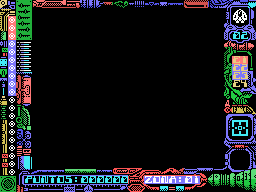
The decorated frame around the play area — with its HUD: the ship rosette, the colour meters, the SCORE and ZONE bar — isn't drawn piece by piece anywhere: it ships ready-drawn inside the game block itself. Its first 1,415 bytes are the STARDUST logo, a 128×16 bitmap the attract mode animates in the middle of the screen, and right behind it come the frame's patterns and colours, 0x900 bytes of each, which a startup routine copies to video memory.
The copy has an odd shape — two character rows per screen third, plus forty-eight loose strips — that only makes sense once you know the other half of the trick: the game doesn't build the SCREEN 2 name table at all, it inherits it from the loading screen, which had filled it in by counting in eights: character n of each third shows up in column n÷8, row n mod 8. Loading the tape wipes out the loading screen's program in RAM, but video memory survives untouched, and the game counts on exactly that. With that inherited mapping, the odd layout is simply the shape of the frame: each third's characters 0 to 31 and 224 to 255 are the four columns on each side, and the loose strips are the top row and the bottom bar.
Both halves check out against the emulator: the game's real running name table matches the inherited pattern 768 out of 768, and the tape's patterns and colours show up identical 97.4% of the time — the rest being whatever the game paints on top, the starfield, the live scoreboard. And the proof that beats all the others is drawing it straight from the tape with that same mapping:
The loading screen
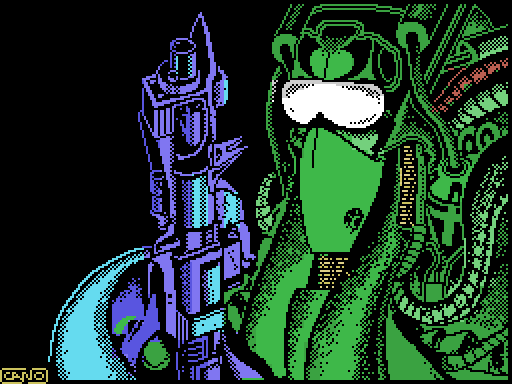
It's not a capture: it's drawn from the 12,288 bytes the block itself dumps — 6,144 of pattern to video memory at 0x0000 and 6,144 of colour at 0x2000 — following what its routine at 0x9C10 does.
And it has a trick worth knowing, the kind that teaches you something. The table saying which picture goes in each cell isn't filled in order 0, 1, 2, 3… it's filled counting in eights: 0, 8, 16… 248, 1, 9, 17… Same 256 values per screen third, just interleaved. Drawing it assuming sequential order gives you convincing-looking noise, which is the worst kind of error there is: it makes the block's layout look wrong when what's actually wrong is how you're reading it.
It's signed CANO, bottom left.
The world and its creatures
How the game carries its maps, its enemies, its collisions, and its deaths.
The map cell is the drawing and the state at once
The things fixed into the scenery — the turrets and nests scattered through each zone — aren't flying enemies at all: they're eight-byte objects the level builder creates on entering the zone, one per occupied cell of a 5×5 grid. Each one carries its position, its type, a pointer to its own cell in that grid, and the address of the routine that governs it.
And here's the pretty part: the installation doesn't keep its own frame anywhere. It writes it straight into the cell it points at, and whatever draws the zone paints whatever that cell says. Which is why a turret's reload cycle reads, in the listing, as a plain count from 6 to 10 over a single map byte: 6 is the loaded cannon, 7, 8 and 9 are the animation, and hitting 10 sends it back to 6. Same idea that already turned up in the on-foot stage, where the cell byte is both the drawing's index and the physics' solid flag.
States chain together by rewriting their own governing routine: the turret fires and turns into "turret reloading"; the nest drops an enemy aimed at the ship and marks itself; whatever gets destroyed climbs its cell value up to 0x10 and retires by installing, as its own behaviour, the address of a ret that already exists in the code — so the loop can keep calling everyone without ever having to ask first.
And the level builder decides what each cell is by its value, with a roll of the dice thrown in: call azar / and 004h / add a,006h turns the value 6 into either 6 or 10, so the exact same cell in the exact same level comes out a turret sometimes and a nest other times.
Which is also where the four-way shot comes from. It's dropped by the bonus you get for destroying one specific type of installation, and only if you're already at 10 energy — one time in four; otherwise what you get is just ten energy, plain and simple.
Seven tables in a row, and not one boundary has to be guessed
That whole RAM map can be read start to finish without guessing a single thing, because every table carries its own counter up front and dies exactly where the next counter begins. Neither the cap nor the entry size gets estimated: both come straight out of the spawning routine itself, its cp against the cap and how it indexes each entry.
0xC8D7  counter          0xC8D8  9 installations of 8 B   →  0xC920
0xC920  the zone's 5×5 grid, 25 B                         →  0xC939
0xC939  counter          0xC93A  6 enemy shots of 4 B     →  0xC952
0xC952  counter          0xC953  9 of your own shots of 4 B → 0xC977
0xC977  the table walker's two variables                  →  0xC97A
0xC97A  counter          0xC97B  4 objects of 5 B         →  0xC98F
0xC98F  counter          0xC990  2 objects of 4 B         →  0xC998
0xC998  counter          0xC999  2 objects of 5 B         →  0xC9A3
6×4, 9×4, 4×5, 2×4 and 2×5, and every one lands exactly. There's a second identical table for the special tiles, with its own counter at 0xCA92 and eight objects from 0xCB3A: 64 bytes that end right where the declared range used to.
And one thing worth saying even though it doesn't wrap up neatly: the first table never checks its own cap. The builder bumps the counter without looking, and there's only room for nine before the grid begins. Either the level data guarantees it never overflows, or there's an overflow sitting there unmeasured — this one hasn't been checked either way.
Nobody polices the collisions: each one asks about itself
Both halves of the game keep two tables of things flying around, one per side: one gets filled by the player's trigger, the other by the enemies. What there isn't, anywhere, is a central detector cross-checking them. Every object, right after painting itself, asks itself whether it just got hit, always with the same routine, changing only the hit box and what it pays out:
who's asking               box        prize
the enemy flock             4 × 0x0C    130 points
the swarm objects            4 × 0x0C    140
an enemy shot                4 × 8        53
the ship (against the other table)       one point of shield
Watch out reading those prices, there's an easy trap here: the routine that pays out doesn't add points as such, it adds to whichever digit it's told, and the carry runs to the left. So the same value is 130 points or 13 depending on which digit of the scoreboard it lands in. The 53 points for downing an enemy shot are identical in both halves of the game, same number, same digit.
The four-way shot sounds once, and it manages that by gagging the sound
With the upgrade collected, the trigger fires four shots in a cross instead of one. And since every new entry in the table starts its own sound effect, you'd get four "pew"s at once, stacked on top of each other. What the game does about it is drop a ret into the second byte of the routine that starts sounds, right before the three extra shots, and put it back afterward.
The nice bit is how it puts it back: there's no stored constant for that anywhere. It copies the byte straight from its twin routine, the one that starts scripts without hunting for a free channel, which shares the same prologue. It just borrows it from the routine next door.
And there's a curious asymmetry between the two halves: the on-foot stage has that exact same four-way shot, and can never turn it on. The byte that decides it gets read in one place and written in exactly one, right behind an xor a — meaning it only ever gets written a zero. The three extra entries are dead code in the version that shipped. It doesn't carry the silencing patch either: if those four shots ever did come out, all four would sound at once.
The whole tower, and a map that is two maps
The on-foot stage is a tower, and its map sits at 0x840B: 78 rows of 6 cells, 468 bytes, 280 cells with floor in them. base_mapa (0xA9F5) gives it away, doing ld ix,0840bh and returning the base plus row times six. It's the only reference to that range in the entire listing, and the two readers that exist both go through it.
And those two readers make the cell byte two things at once. For the redraw, it's a tile index: origin = 0x87F3 + value×128, so the cell says which picture gets painted. For physics, it's a boolean: consulta_mapa (0xB18E) ends in and a, and its six callers only ever look at the Z flag — cell zero means empty — none of them use the value itself. There isn't a separate collision map and scenery map: there's one map, read two different ways.
The arithmetic closes to the byte. The map's highest value is 44, and 0x87F3 + 45×128 − 1 comes out to exactly 0x9E72, the very last byte that had been seen the blitter reading while measuring the video port: the pool is exactly 45 tiles, no more, no less.
The tiles are 32×32 pixels — 128 bytes, four per row, thirty-two rows — and with that the whole tower measures 192×2496 pixels. Three independent routes confirm it: the 128-byte tile, consulta_mapa dividing Y by 32, and the fine scroll, which takes sixteen 2-pixel steps between one row and the next.
With the map and the pool, the whole tower can be drawn — it's in The game, right next to the other seven zone maps, with its bare structure and its 45-tile pool. Below the starting point sits the arrow sign pointing up (tiles 0x28 and 0x29, which appear nowhere else at all), and row 0 is a cornice of rosettes.
The camera that climbs the tower is the pair (0xAD2A, 0xAD2C): map row plus a fine pixel offset. The updater (0xA8DB) moves that fine offset 2 at a time up to 32 and then switches row, clamped at rows 0 and 71 — the gearing got caught live in the emulator: the probe logged (row 57, fine 32) and, one step later, (row 56, fine 2). Every step on firm ground also saves a checkpoint, position at 0xA6E9 and camera at 0xC466/67, which is exactly where death sends you back to.
The player's death
The player dies stepping into the void. And the check that decides it isn't the "fine" variant of the map query, with sub-cell logic: that one (0xB1BE) answers whether a position falls well centred inside an empty cell, and only the flying enemies use it, to decide which hole in the wall to nest in — measured over the whole recorded game, 2,934 passes through it, and the return address on the stack was always the same caller, the flyers' loop, not once the player.
The player isn't in any object table at all: he lives in two bytes (0xA6EB, with Y pinned at 0x68 — moving up or down never moves him, it moves the world around him) and has his own call to consulta_mapa, at 0xA665, checking the cell right under his feet. If that cell comes back empty:
a665: call consulta_mapa
a668: jr nz,<sigue andando>
a66a: ld a,004h / ld (0a6edh),a     ; state 4: doomed
And there's no going back: through the whole dying state, states 4 to 45, the map never gets checked again, not once. There's no such thing as landing safely: you die the instant you step into the void, and the fall you see afterward is only the collapse animation, its frames rotated depending on which way you tripped.
The other way to die is by contact. The shield (0xA6ED, running 3 down to 1, the three icons on the scoreboard) gets docked when you're hit, and once it reaches zero the game patches the player's update pointer to swap in a corpse in freefall (0xB268): it rises, falls accelerating and — since it never checks the map either — passes straight through the floor and exits off the bottom of the screen.
Both routes funnel into the same place: once the state reaches 45, a life gets subtracted (the counter starts at two, and more are earned through points up to a cap of nine), and once the counter's spent, game over; if there are lives left, the respawn drops you back at the last firm ground you stood on, with the checkpoint's camera, the shield back at three and the enemy tables emptied out.
And the two starting lives have a catch: there are two initialisations, and the second one wins. The menu leaves a three in the counter, but the start of play immediately overwrites it with a two. Which is why the first death of any game finds the counter already sitting at two.
The dying state: no timer, just a slow loop
Between the game writing you off and actually taking your life away sit about five seconds, and no real clock counts them. The counter climbs one per turn of the main loop, with no prescaler and no sync with the video whatsoever: there isn't a single halt anywhere in the module, the video memory dump is just a copy loop, and no routine in the dying sequence ever looks at the global frame counter.
What's slow is the turn itself. One turn of the engine — a double pass over the background, enemies, shots and the dump of the three bands — costs about 123 milliseconds, which is 6.15 of the machine's 50 frames a second. Forty-one turns at that rate come to 5.04 seconds, and the emulator measures 23 separate dying sequences running from 4.76 to 5.29 seconds, averaging 5.04. The sum lands exactly on the mark.
And while it lasts, you're untouchable: three independent checks in the listing skip collision outright once the state has already reached four.
Twenty-three deaths, and another forty-four that aren't yours
The recorded game yields the full picture: twenty-three deaths, 22 by contact and just one by falling, and all twenty-three go through the same deduction and the same respawn. The game runs from second 2,464 to 3,124 — eleven minutes — and ends by actually finishing the game: the emulator watches the program pass through the happy-ending routine, not the one for running out of lives.
And the life counter never went down, because that particular game was played with a cheat: it doesn't climb from two to six by earning lives faster than losing them, it climbs because none get lost at all. The trainer patches exactly one byte, the operand of the sub 001h sitting right behind the funnel:
a528:  D6 01     sub 001h      <- what the tape carries
a528:  D6 00     sub 000h      <- what the recorded game had
That doesn't stop you dying. You die just the same, go through the funnel just the same, and the scoreboard repaints just the same: the only thing that changes is that the subtraction subtracts nothing. And as a side effect, that puts the game over out of reach entirely, because sub 0 can never set the carry, under any circumstances.
Putting that 01 back — which is just restoring the tape's own byte, not touching the game at all — and getting killed six times in a row, the counter goes 5, 4, 3, 2, 1, 0, and on the sixth the carry finally fires: the jp c gets taken at last, and the game ends for real. That's the first time that jump has ever been seen taken. With one detail thrown in for free: the subtraction gets stored before the jump, so the life counter is left sitting at 255. There's no cap and no check of any kind, and it doesn't matter, because there's no coming back from there.
But the recorded tape holds another 44 deaths that aren't the player's at all: they belong to the attract-mode demo, which runs exactly the same game code and therefore hits the exact same death routines. Telling them apart isn't a matter of watching the clock, because the game says so itself: address 0xA689 holds the operand of a call that's worth one thing in a real game and another in demo mode, and the startup routine itself checks it (cp 0eeh) so it doesn't repaint the scoreboard while the demo's running solo. Asking that byte at every death, the recording's two demo passes — the one before the game starts and the one after the high-score table — separate themselves cleanly from the eleven minutes of real play.
The countdown is a tower that grows
Near the end of the on-foot stage you need to destroy six targets, and once the sixth falls, a countdown begins. And it isn't digits: it's a white tower gaining one row of pixels roughly every two seconds. The whole mechanism sits in the listing: the level start leaves a 6 at 0xBC33, every destroyed target subtracts from it, and once the counter hits zero, every tick paints one row (ld a,07eh / out (098h),a) and adds one to 0xBC30. The pace comes from the global frame counter, one tick every sixteen frames.
bbb4: cp 0a1h / jp z,0bceeh ; at row 161, it's overAnd since the player escaped in time in the recorded game, checking the ending meant letting it run out separately: the game got loaded with the tower halfway up, the controller got unplugged, and at exactly row 161 it jumped to 0xBCEE, the destruction sequence, and straight from there to the high-score table. Game over, no FELICIDADES. The numbers from the real game land close: the player escaped with about 30 seconds to spare out of the 5.8 minutes the game gives you.
The on-foot stage has its own demo, and its own recorded game
The ship stage's demo isn't a machine playing on its own: it's 869 bytes of recorded play, one byte per frame. And the on-foot stage has its own — couldn't be otherwise, since the ship stage's recording sits at 0xBA20 and its reader at 0xC1AF, and both addresses fall inside 0x61D0-0xD674, which means the second part wipes them out the moment it loads.
Its own version starts at 0x9FF3 and runs 646 bytes, which at 50Hz is 12.9 seconds. The location is stated by the code itself — ld hl,09ff3h at 0xA3FF — and the boundary is visible at a glance, because right before it there's pure artwork:
9FE3  55 55 55 55 AA AA AA AA 55 55 55 55 AA AA AA AA   <- checkerboard, two values
9FF3  00 00 00 00 00 00 00 00 ...                       <- not anymore
Those 646 bytes use 17 distinct values, all of them even and none higher than 0x1E: it's the control mask, one byte per frame of play.
And the interesting part is how it switches on. At 0xA688 there's a call whose operand gets rewritten from two different places:
a313: ld hl,0a6fch / ld (0a689h),hl   <- normal game: reads the controls
b6ca: ld hl,0a6eeh / ld (0a689h),hl   <- demo: reads the recording
Same call, two possible origins, switched by patching the code on the fly. And the DEMO sign flashing in the bottom right corner doesn't check any flag at all: it asks the patched instruction directly.
a4d1: ld a,(0a689h)   ; that call's operand
a4d4: cp 0eeh         ; does it point at 0xA6EE, the recording reader?
a4d6: jr nz,...       ; if not, we're not in demo mode
This one turned up because a player actually finished the game and reported that, right after the high-score table, a demo of the on-foot stage kicked in. The reader was sitting inside a range this project had, up to then, labelled simply "table".
Sound is a language
The music isn't stored as notes: it's written in a language of its own, and it can be read — and checked against the chip, frame by frame.
A script interpreter
Stardust's sound isn't written as code at all: it's scripts run by a small virtual machine. Bytes below 0x80 are notes; those valued 0x80 or above are commands:
e230: ld a,(bc) / cp 080h / jp c,0e231h   ; below 0x80 it isn't a command
      sub 080h / ld hl,0e7a3h / call 0e5c0h / jp (hl)
and 0xE5C0 is exactly "HL = table + A×2, HL = (HL)". The jump table at 0xE7A3 has fifteen entries, 0x80 to 0x8E, and dies right there: the limit is set by the interpreter itself, whose call command reads the music's phrases from 0xE7C1, which is 0xE7A3 + 15×2.
Right behind those fifteen command pointers come another twenty that look like the same table continuing, and turn out to be another table entirely: the music's phrases. Read as if they were a single table of 35 entries, those twenty pointers send the disassembler off to read the game's melodies as if they were routines. Told with figures in Open questions.
That same table is also the first trap in tracing: left undeclared as data, the tracer walks straight in and starts disassembling addresses as though they were instructions.
The game's sound is a language, and it can be read
Stardust doesn't store its music as loose notes at all: it carries an interpreter with a language of its own, fifteen commands wide, and the melodies are written straight in it. Commands are told apart from notes by the top bit — 0x80 and up is an order, below is a note — and each one reads straight off its own routine:
0x80  volume           0x87  instrument
0x81  tone/noise       0x88  noise
0x82  loop             0x89  effect
0x83  duration         0x8A  flags
0x84  tie              0x8B  end
0x85  tempo            0x8C  call phrase
0x86  tempo to 1       0x8D  return
                       0x8E  transpose
Thirteen of the fifteen read off at a glance from their own routine. The other two — 0x84 and 0x8E — take a bit more work to pin down.
0x8E doesn't store "a byte" anywhere, as it might first look: it's the voice's transpose. It writes its argument into a three-byte table, one per channel, and the note reader adds it to the note number before going to look up the period:
call ...            <- HL = this channel's entry
add a,(hl)          <- add it to the note
ld hl,0e6e3h        <- and look up the period with that
And 0x84 is settled by looking at where it returns to, not what it does. The other fourteen commands return to the head of the command loop; this one jumps further down, and what sits in between is exactly the attack of a note: opening the mixer, setting up the instrument's envelope and zeroing it. Which means 0x84 consumes a duration without re-attacking: whatever's already sounding carries on exactly as it was, and only time passes. In musical terms, that's a tie.
And since that last claim is interpretation, not just reading, it got checked against the actual score. Walking the block of songs with the interpreter's grammar — not counting loose bytes, which would confuse arguments for commands — turns up nineteen 0x84s, and every single one has this in front of it:
after a note          9
after another 0x84     5
after 0x83 duration    4
after 0x88 noise       1
Not one opens a block, and not one lands where nothing's sounding at all — and five stacking up behind another 0x84 is exactly what you'd expect from something that extends a note: they pile up to stretch it further.
And there's more: duration gets multiplied by tempo, and tempo is itself a division. The duration command leaves argument × tempo in the counter, and the tempo command computes 6000 / (argument × 8) using a 16-bit division routine that was sitting right there, unnamed, waiting to be identified. So the score's durations aren't measured in frames at all: they're in tempo units.
Two of the commands give away the MSX sound chip without needing to look at anything else: the tone/noise one masks its argument with and 9, which are exactly the two bits of the PSG's register 7, and the noise one masks with and 0x1F, the five bits of the noise period. The code doesn't say so in any comment, but the masks do.
And there are two commands that turn this into a genuine language: call and return. The interpreter keeps the return address on a per-channel stack, exactly the way a real processor would. So the songs don't repeat their own bars: they call them. There are twenty phrases stashed separately, and the songs simply invoke them by number. Same idea as the recursive dictionary that compresses the level maps, applied to sound this time, by the same people.
With the command table in hand, the music area walks through start to finish without ever losing sync, and that's the best proof it's being read correctly: if a single command's argument count were wrong, the walk would desynchronise fast, and the blocks wouldn't end where they're supposed to.
What comes out of the walk is twenty-one sounds in total. Seventeen are short, 9 to 31 bytes — the effects — and the long stretch at the end turns out to be the music, split across three voices, as told just below. The other two never actually end: they loop back and keep playing forever.
The music is one piece, in three voices
The routine that starts the music installs three scripts at once, one per channel, not two separate songs as it might first look:
channel 0   0xEB52   248 bytes, and repeats when done
channel 1   0xEC4A   129 bytes, and repeats when done
channel 2   0xECCB   points at an "end", so it comes in silent
They aren't separate songs at all: they're the three voices of the same piece, sounding together. The first two even open with the same transposition command, +2, which is what tunes them together from the very first note.
Which explains, in passing, something that had been confusing: synthesising the first script on its own produced just four low notes repeating over and over. It wasn't that the music was thin — it was that only the bass line was being heard, on its own, without the other two voices on top.
The songs don't contain a single note
And here's the best part of the whole thing. Decoded, all three voices turn out to be pure phrase calls and zero notes of their own — not one between the three of them. The melody isn't in the voices at all: it's in the phrases, and the voice is only the structure that chains them together. Which is why 1,420 bytes are enough for the entire soundtrack.
This used to say "the 149-byte one is fifty-six calls and a single loose note", and it was split at the wrong place for the same reason: the tool that walks the area doesn't cut at the loop command, so it glued the third voice to whatever came after it. They're two separate things. The voice is 137 bytes (0xECCC–0xED54) and its run of calls to phrase 2 is 44, not twenty-four. The twelve bytes after it, 0xED55–0xED60, are a separate sound effect that is used: there's an ld de,0ed55h at 0xCEB6, the chaser's appearance sound. The loose note belonged to that effect, not to the voice.
With the note table alongside, the harmony reads at a glance. Phrases 1, 4, 5 and 6 are four repeated notes — C3, A3, F3 and G3, the fundamentals — and the long song opens by calling them in this order:
1 1 4 4 1 1 4 4 5 5 6 6 1 1 1 1 1 1 4 4 ...C, A, F, G, two bars per chord: that's the I–vi–IV–V progression, the same one from fifties doo-wop, playing here in a 1987 shoot'em up. It uses seventeen of the twenty available phrases.
The third voice exists, and it's the percussion
Behind that "end" handed to channel 2, at 0xECCC, a complete 137-byte script begins that nothing on the tape names. It isn't a stray leftover: it is the third voice, and what it plays is the drum track.
The area isn't two scripts followed by a loose block. It's three consecutive scripts, each closed with its own loop command, and one byte between the second and the third:
0xEB52 - 0xEC49    248 bytes    ends in loop    channel 0, the bass
0xEC4A - 0xECCA    129 bytes    ends in loop    channel 1, the melody
0xECCB               1 byte     "end"           <- channel 2 points here
0xECCC - 0xED54    137 bytes    ends in loop    nobody
Three things, all measured by running the game's own interpreter over the cartridge bytes.
All three last exactly the same: 8,704 frames dead on, up to their loop, counting notes and ties and following phrase calls with their stack. A stray block of data doesn't happen to last the same bar as the other two voices.
The orphan is the only one that touches the noise generator: 156 noise commands, against none in the other two. All forty-four of its calls go to phrase 2, which opens with 81 08 — and after the command's and 009h that leaves the noise bit set and clears the tone bit. Percussion, not melody.
And it lands on the same grid. The bass changes note every 128 frames exactly, without a single exception. The percussion repeats its pattern every 128 frames, with three hits always in the same places: 32, 80 and 96, all multiples of 16, which is the score's unit of duration. And 8,704 divided by 128 is 68 bars exactly.
What it sounds like
The three clips come from running the game's interpreter over the bytes: its fifteen commands, the 96-note table, the twenty phrases, the instruments with their two envelopes, the mixer and the noise generator (tools/suena_tres_voces.py). Between the first and the second, one single byte changes.
How it sounds today: channel 2 gets 0xECCB and goes quiet. Two voices.
The same thing with the pointer one byte further along, at 0xECCC. The percussion appears.
And the third voice on its own, to hear the pattern clean.
Worth saying what this is and what it isn't. It's the reading of the listing made audible: if a command were misread, you'd hear the mistake. It isn't a recording of the chip. The hardware measurement — patching the byte and capturing what reaches the AY-3-8910 — is still pending, and that's what would turn this from reconstruction into measurement. What is checked byte by byte: the addresses, the lengths, the 8,704 frames, the 128-frame bar and the positions of the hits.
Oversight, or a mute?
Both readings fit, and it's worth not picking by taste. Two things can be said about the bytes, and neither settles it.
The "end" at 0xECCB is inserted, not overwritten. If someone had covered the script's first byte, the 8c 02 that follows would be off by one, and it is perfectly aligned from 0xECCC. That byte was written into a gap.
And nobody can fall into it by continuity: the channel 1 script ends at the loop command at 0xECCA, which either reloads the pointer to the start or jumps to the end, but never advances to the next byte. That "end" exists only for whoever points at it, and the only thing pointing at it is channel 2.
So either it's a pointer miscalculated while bringing the game over from the Spectrum, or someone muted the drums with one byte and left the track where it was. The binary doesn't tell the two apart. And there's no literal reference to the script: a hand-built address — an ld hl,0eccbh / inc hl — would slip past the search without anyone noticing, so the claim is that nothing names it, not that it's unreachable. The control says the search is sound: 0xECCB does appear, exactly once, at 0xE181, the instruction that hands it to channel 2, and its neighbours 0xED61 and 0xED6B turn up too, loaded from 0xF4FE and 0xF506.
The same fault is there twice, once per block
The second part of the game, the on-foot one, carries the whole sound subsystem duplicated and relocated, and with it the same music and the same byte. Its routine at 0xC483 hands out 0xCE45, 0xCF3D and 0xCFBE, and 0xCFBE is another loose "end": the percussion starts at 0xCFBF and is the same 137 bytes, compared one by one.
The scripts sit 0x1D0D from the ones in the ship section, but not everything moved by the same amount: the phrase table is at 0x1CE5, and four instruments — 3, 4, 5 and 7 — were retouched between one part and the other. It doesn't affect this music, which asks for instruments 8, 9, 10, 11, 12 and 15: synthesised both ways, they come out identical byte for byte.
The game's other two pieces of music are sound. The one for the caption screens (0xEB38, 0xED61 and 0xED6B) and the on-foot section's own (0xCDB1, 0xCDD0 and 0xCDEC) all have three voices with real content.
The note table, incidentally, checks itself: with the MSX sound chip's clock, the first period gives 32.70 Hz, the theoretical C1, and of the 84 pairs sitting twelve positions apart, 76 come out at a ratio of 2.00 within one per cent — the very definition of an octave. On the exact ratio the count drops to 43 of 84, because the period is a whole number; the eight that miss even that margin are the highest ones, where the period's already down to two digits and rounding starts to bite. Eight full octaves, C1 to B8.
There's no table ordering these sounds at all. Every place in the game that wants something to play carries the address written out in full, and there are 44 such calls scattered through the code; the most repeated one, seven times over, is the same effect. Two of them point halfway into a melody instead of at its start, which is a cheap way of getting variations without spending another byte.
And then we checked it against the chip
Everything above is deduction, however solid it looks. Fifteen commands, how many arguments each one eats, phrases called through a stack, a table of ninety-six periods: all of it read out of raw bytes, and any one of those could be a confident mistake. So it got taken to the hardware.
First up was how the sound actually reaches the chip, which turns out not to be through the interpreter directly. The game keeps a copy of all eleven sound registers in RAM, and spits the whole thing out on every interrupt, fifty times a second:
e5d0: ld a,000h / ld d,00bh    ; from register 0, and there are eleven
e5d4: push af / ld c,(hl)
e5d6: out (0a0h),a             ; which register
e5d9: out (0a1h),a             ; and its value
e5db: pop af / inc a / inc hl / dec d / jr nz
Measured for real, that's exactly what happens: across a whole capture there's a single place writing to the sound port, and all eleven registers get the same number of writes to the byte.
That detail matters when measuring. Since the registers come out in order, the low byte of a note's period arrives before the high byte; rebuilding the period on every single write glues a new low byte onto the previous note's high byte half the time, and out come periods the game never asked for. Counting only once the pair is complete, over clean music: 23 distinct periods, 6,020 writes, and not one outside the table — 100.0%.
And then came the real test. The reading got run frame by frame and checked against what the emulator actually saw enter the chip — frame by frame and not note by note, because that's the only way to catch a duration error, which a plain list of notes would swallow whole. Over the ship stage's music:
channel 0    746 hits, 1 miss
channel 1    653 hits, 1 miss
channel 2      0 hits, 1 miss    (silent, as the reading said)
→ 1,399 of 1,402 frames with sound, 99.8%
And the three misses are always frame zero of each channel: the tail of the previous sound still sitting in the registers right as the new music comes in. After that first frame, not one discrepancy.
The on-foot part checked out the same way, holding up for a whole minute: 5,852 of 5,886 frames, 99.4%, with the thirty-four misses all sitting right next to a note change. Pointing the same tool at the other music in that stage gives 0.0%, which is exactly the check that the earlier hit rate wasn't a fluke.
Two things have to be right for this measurement. A frame doesn't last exactly 1/50 of a second: a breakpoint on the ROM's interrupt vector gives 1,003 firings in twenty seconds, that's 50.15 Hz, and using 50.00 the comparison drifts almost two frames in six hundred and drops to 98.2% over something that has nothing to do with the music at all. And a silent channel isn't the same as a held note: the game only writes the tone when it changes, so once the music stops the last period just sits there — without also checking volume and the mixer, a channel that's been silent for twenty seconds looks, to a naive measurement, like a single note a thousand frames long.
The music drags while you play, and the game is to blame
The on-foot stage has two pieces of music, and checking the second one turned up something better than a percentage. Its notes came out both right and wrong on duration at once: where the score says a note lasts four beats, the chip held it for six, seven, sometimes ten video frames, and never the same number twice.
The interpreter isn't at fault here. A breakpoint on its entry shows it gets called exactly three times per interrupt — once per channel — on both screens:
high-score screen   2,256 calls in 15 s  = 3 × 752
inside the game      1,275 calls in 15 s  = 3 × 425
What actually changes is the interrupt rate. Those same fifteen seconds bring 752 interrupts on the still screen and only 425 during play: 50.13 Hz against 28.33. The game loses interrupts while it's busy drawing, and since the music's clock is the interrupt, the exact same score plays 1.77 times slower in the thick of the action than on the high-score table. The melody drags whenever the screen's under load, and it's less a bug than something the player was never meant to notice at all.
Which forces a different way of measuring, because no fixed rhythm can follow that. A grid at 50.15 Hz scores the piece at 1.0%, sweeping every rate between 50 and 17 Hz tops out at 5.1%, and the measured average of 28.33 Hz gives 4.9% — all three wrong for the same reason. Building the grid out of the actual instants the interrupts really fired, that same comparison comes back at 192 of 192 frames: 100.0%, not a single miss across all three voices.
That piece, by the way, turns out not to be a soundtrack at all: its three scripts end at 68, 60 and 64 beats — about two and a half seconds — and it plays eight times across the recorded session, always in the middle of the game. Scored over a full minute it drops to 5.2%, and not because it's misread: it's that after two seconds the piece has already finished, and what's left in those channels is gunfire.
The measurement settled one more thing on the way. The third voice comes in silent, and the suspicion was that channel 2 was simply reserved for effects. Only half true: of 271 effects fired in four minutes of play, 150 go to channel 2 — 55% — which is exactly why the music leaves it empty. But 63 go to channel 1 and 58 to channel 0, stepping right over the music. It's not reserved; it's just the busiest of the three.
The 754 bytes at 0xAB0E are artwork, not shared music
0xAB0E falls inside the range this project declares as sprites (0xA560-0xBA20), and read with the sound interpreter's grammar, those 754 bytes don't hold up as a score at all: 306 of them are values above 0x7F that don't exist as commands in a language whose orders only run 0x80 to 0x8E. Run that same count over 754 bytes of real music and it comes back at seven. Whatever those bytes are — and the sprite range says artwork — they aren't a score.
What the two halves do genuinely share, read straight off the binary with nothing assumed, is the entire sound subsystem of the ship game, relocated. The note table is the same 192 bytes to the byte, the routine that blits the registers to the chip is the same eighteen instructions, and all twenty phrase pointers sit at a constant offset from each other.
The ending
The sequence the game closes with, read first from the listing and then watched actually happening.
How the game ends, and a pointer table that was coordinates
The sequence Stardust ends with is three things in a row, all chained from the background's third opcode.
A tracking shot that accelerates. The camera rises one cell row sixteen times, repainting each time, then enters a loop that moves it A times per frame. That A isn't fixed: it starts at 2 and climbs by two every ten frames, until it hits 16, where it stays.
bdd3: ld a,002h / ld (0c468h),a
bdf8: ld a,(0c468h) / cp 010h / jr z,...
bdff: inc a / inc a / ld (0c468h),a
So the tower falls away below, faster and faster, until the scroll finally runs out.
A starfield screen. Silence, colours, the buffer cleared, the 48 stars pulled straight from the MSX ROM, a background picture, four long waits in a row, and a brand new tune.
And an animation written as a script — here's the good part. At 0x61D8 there's a list the game walks like this: a byte above 0xC0 changes the frame, doing it by patching the operand of the instruction that draws it; a 0xC0 ends the list; and everything else comes in pairs of bytes that are simply position.
Decoded in full, it's 78 steps and thirteen frames. The column starts at 0x78, the exact centre of the 192 pixels of width, and the row at 0xBA, right at the bottom. The row always decreases, without a single exception across all 78 steps, and the column drifts left until the very last step is (0, 0). Something that lifts off from the centre, climbs, and recedes out the corner.
That list is very easy to misread: read as little-endian words, the pairs give 0x78BA, 0x78B8, 0x78B6… "words descending by two" that land right inside the graphics range and look for all the world like they point there. They point at nothing at all: what's descending by two is simply the drawing climbing up the screen.
And it can be checked just by looking, which is the proof that actually counts on this project: drawing those 720 bytes with the geometry the copy routine states — 40 rows of 18 bytes — yields a real surface, not noise. And laying the script's 78 steps over it shows exactly what it does: it leaves the ground at the centre, climbs straight for a good stretch, and near the top curves left until it exits the screen.

Neither one is a screenshot: both are drawn straight from the binary, using the same geometry the game itself uses.
And the arithmetic closes it from both sides at once. The script ends at 0x6284; the scene's background picture starts at 0x6285 and measures 720 bytes — 40 rows of 18, exactly what the copy routine takes to the buffer's middle band — and 0x6285 + 0x2D0 comes out to exactly 0x6555, precisely where the stage's sprite pool begins. Three stretches sitting flush against each other without a single byte to spare, and with that, three "tables" that had been classified earlier by their entropy simply disappear: they were pieces of the same script, cut in the wrong places.
The sequence, watched happening
Putting a breakpoint on every routine in the chain and replaying the recorded game, the whole sequence turns up start to finish, with exact timestamps:
t=3060.95   the end-of-stage gate: scroll at the top, all six targets
            destroyed and the player in the middle band
t=3060.95   the tracking shot
t=3081.06   the starfield screen
t=3083.49   the animation: 79 passes, and the script has 78 steps
t=3107.67   the 200 particles, initialised
t=3113.31   the explosion, 110 passes
The background's third opcode — the one that paints every cell in a single pass — gets used right here, in the tracking shot, and that's its only use in the entire game.
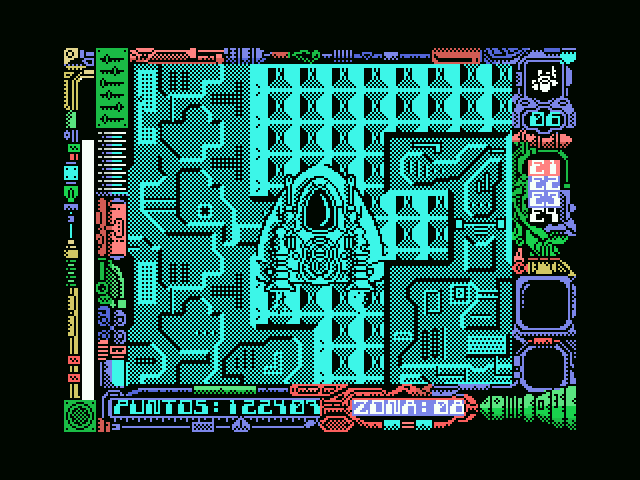
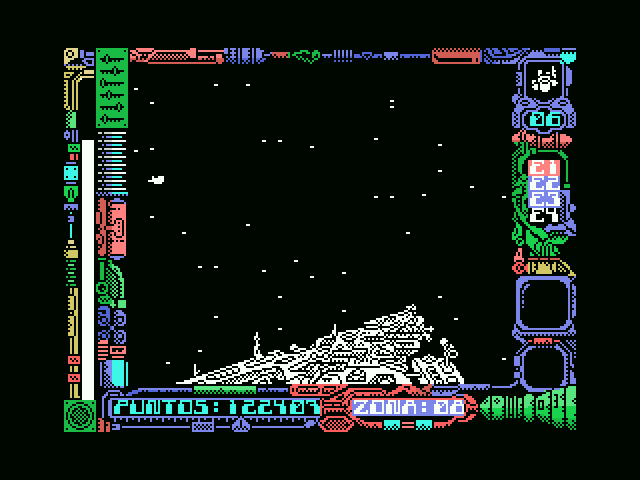
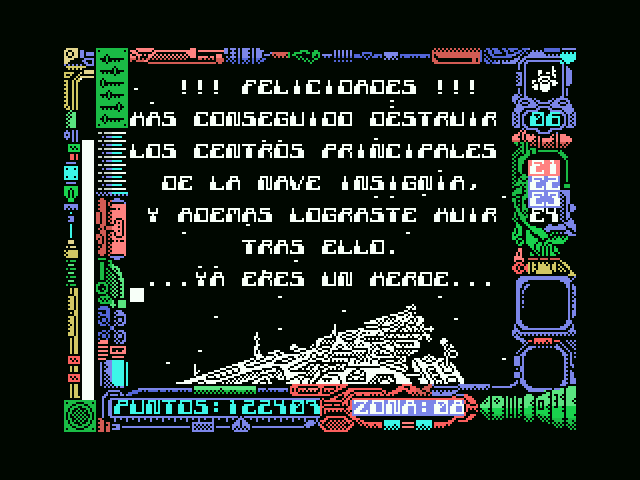
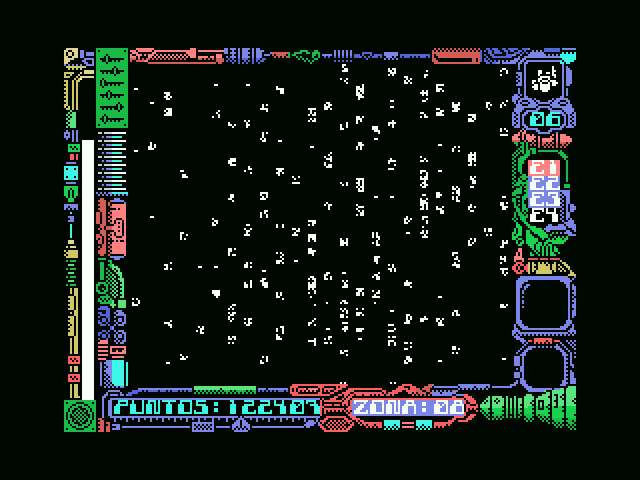
And the bad ending is this exact same one with everything stripped away. On running out of lives — or on the countdown expiring — the game shows no screen of its own at all: it jumps straight to the initial state, and from there to the high-score table. No escape, no explosion, no text of any kind; the bad ending is defined, literally, by everything it's missing.