The sequences
The intro and the ending, whole and at the MSX's pace, painted by the
running cartridge (tools/secuencias.py), and the three demos, recorded in
openMSX.
The cartridge running here carries out the VDP commands instantly while the
MSX waits for them to finish: the story lasts 7,414 frames on the MSX and
1,786 here, and the ending 15,067 and 2,258 here. So each image carries the
time measured in openMSX (tools/omsx_ritmo.tcl): markers both have are
taken (the state and step changes, each frame the main loop processes and, in
the ending, each change in the scripts of the sequence engine's objects,
0xE100) and, between two markers, the measured time is shared out evenly.
The intro has 597 markers in common and the ending 1,499; both last what they
last in openMSX.
The intro
The Konami logo, the title (which rises with register 23, p01:6994) and the
story: the sequence at p03:A65B, with the text at p01:615D (see
The texts) and tune 0x4A. It lasts 2 minutes 27 seconds.

The ending
After the stage 9 boss (0xCA10 = 9): the ship over a planet, the credits
(p03:BDE7) and tune 0x49. When it ends the second round starts: stage 1
again (0xCA04 counts the rounds; with it rises the level that sets how fast
the bullets go, p02:83E7). It lasts 4 minutes 11 seconds.
To get there, stage 9 is started and considered finished (0xCA0F = 1, what
its boss leaves when it dies); the cartridge does the rest.

The demos
After the story three recorded demos are shown (see
Curiosities), one each time: 0xC919 moves from one to the
next and the table p01:7877 gives the stage and starting point of each. They
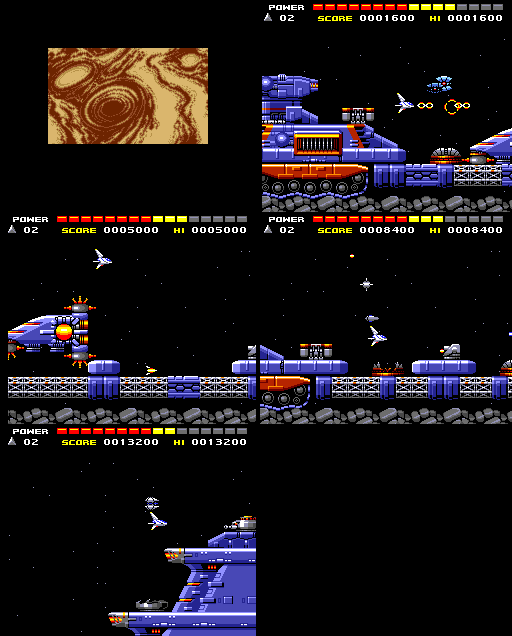
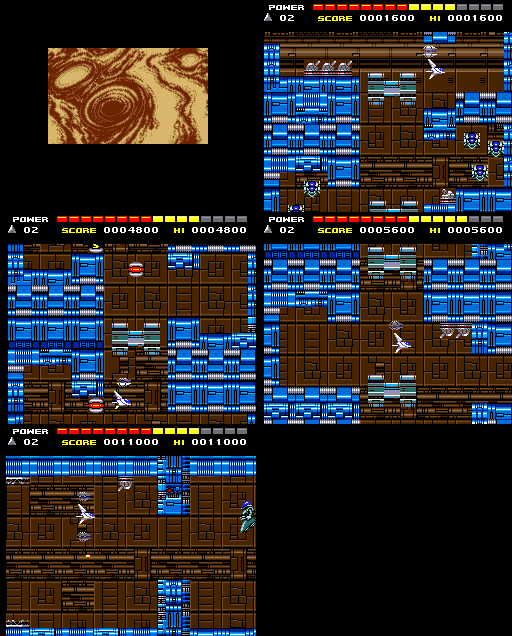
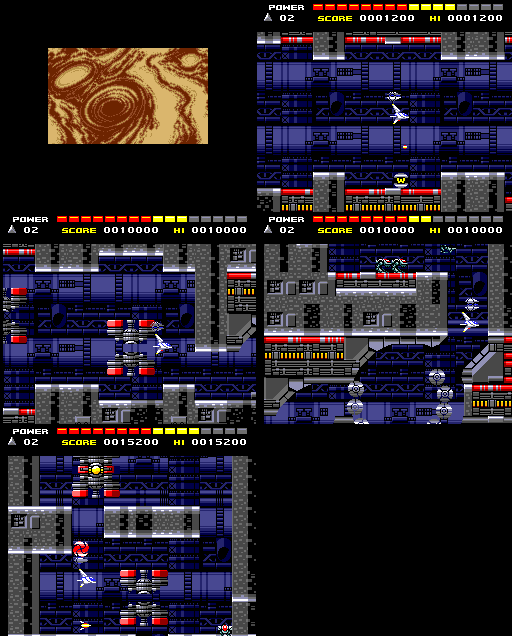
come in this order: stage 1 from its second starting point, stage 2
from the third and stage 4 from the beginning.
These are not painted by the running cartridge (see below why): they are
recorded in openMSX, which replays them as the MSX does
(tools/omsx_graba_demo.tcl, launched with tools/lanza_graba_demo.ps1). On
every VDP frame the VRAM, the palette and the registers of the three bands of
the screen are dumped (the status bar and the two lower parts, which the two
line interrupts change), and tools/demo_omsx.py paints each frame with the
same drawing code as the other GIFs. Each image lasts what it lasts in
openMSX: one VDP frame, 1/60 of a second. To record the second and third
without waiting for them, 0xC919 is written when the title screen comes
up.
The first: stage 1 (1 minute 18 seconds)
The second: stage 2 (1 minute 2 seconds)
The third: stage 4 (1 minute 17 seconds)
How it was checked
- Against openMSX screenshots of three frames (frames 600, 1,500 and
3,000 of the first): 0 different pixels. Getting there took two fixes
to the drawing code, which also apply to the other GIFs on this site (redone
with them): register 18's horizontal adjust moves the sprites too, not
only the background; and the line interrupts' registers arrive late: the
otirends 4.36 lines after the first interrupt and 3.2-3.4 after the second (measured in openMSX,tools/omsx_lineas.tcl), so six black lines are left under the status bar. - Against the running cartridge, the first 68 game frames of the first
demo (
tools/coteja_demo_omsx.py), the image of the last VDP frame of each: 35 come out the same pixel for pixel. From frame 6 on the VRAM only differs in the tables that alternate with the interrupt (0xC09B): the name tables (0xC000-0xC7FF) and the sprite tables (0xF000-0xFFFF). On screen it shows in the POWER bar and in a turret of the battleship, and also in the palette fade (frames 8 to 17) and in the frame where the screen is loaded (frame 5). It is what the interrupt was already known to drive (see below).
Why the running cartridge does not paint them
With the same recorded inputs, in openMSX the first one reaches its end (1,285 game frames) and here the ship dies at frame 667.
Where they part is measured (tools/coteja_demo.py, with openMSX's RAM at the
start of every game frame, p01:6256): up to frame 67 the game is the
same in both. The only differences are what the interrupt moves: the sound
engine and its queue (0xC600-0xC8A2), the palette fade (0xEF00) and the
alternation of the sprite and line tables and of the character page
(0xC09B-0xC0B5). In frame 68 a shot hits an enemy on the MSX (0xCF04 =
3) and here it keeps flying (0xCC40), and from there each game goes its own
way.
On the MSX each game frame lasts 3 or 4 VDP frames (measured in openMSX),
and here, counting by instructions and with instantaneous VDP commands,
nearly always 3. But the pace is not the cause, measured: with the VDP
commands taking their time (--tiempos) and then with the Z80 counted in
clock cycles, with the MSX's M1 wait and the line interrupts on their line
(--ciclos, tools/ciclos.py), game frames last 3, 4, 5 or 6 VDP frames and
the game parts at the same frame 68 and with the same bytes. Something
else decides it, and it is still an open question.