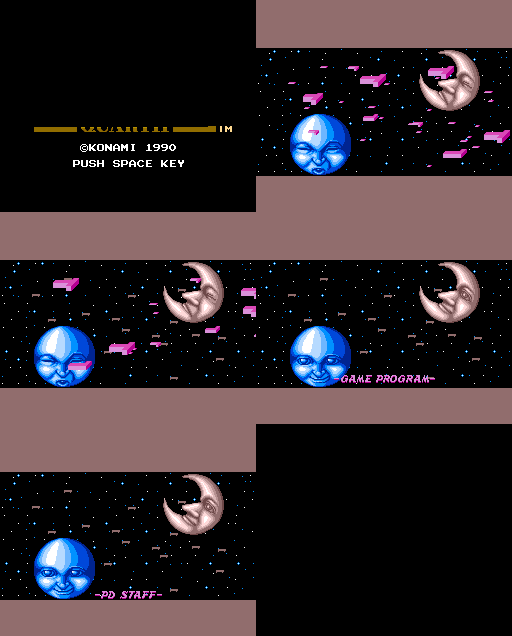
The sequences
What comes up without playing, whole and at the MSX's own pace: the
cartridge running in openMSX, with the VRAM, the palette and the VDP
registers logged on every frame and painted by tools/pinta_omsx.py (see
Under the hood). Each picture lasts 1/60 of a second.
tools/secuencias.py puts them together.
The program goes by states (0xC700): 0 the logo, 1 the title, 2 the menu,
3 the game (the demo too), 4 the ending and 5 getting the demo ready.
The logo
State 0 (p01:6015): the screen off, sound 1 (two frames that make no
sound) and the Konami logo. 3 seconds.

The title
State 1 (p01:62B2). If nothing is pressed, a few seconds later it moves on
to the intro; with the space bar, to the menu.

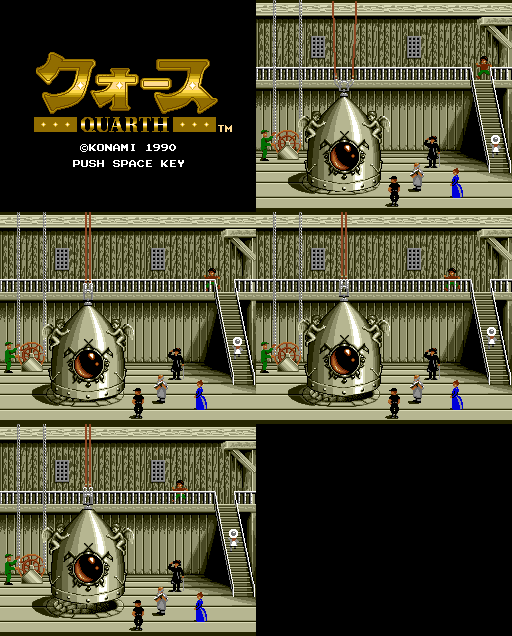
The intro
The other screen of state 1 (p01:6DB2, with 0xDB90 from 4 onwards): the
hangar, with tune 0x04 (p01:6323). Then the demo. 7 seconds.
The demos
There are three and they come up one each time, in turn (0xC734: 1, 2, 3,
1..., p00:43BA). Each one is a real game with recorded controls: the table
at p01:6C98 says where each player's are, and p01:6CF9 the mode and the
configuration (8 bytes per demo). So that the same formations always come
out, the random numbers are replaced by a fixed list (p01:6CA4 for the
first, p01:6CB3 for the other two). A real key press ends it (p01:6D4C).
The first: 1P MODE, stage 1 (43 seconds)

The second: 2P MODE 1, stage 4, SPEED 2 (58 seconds)
Both players in the same field, both with PLAYER 1.

The third: 2P MODE 2, stage 1 (48 seconds)
Each in their own field, with PLAYER 2 and 3 and LEBEL 5 and 2 (72 and 36 filled cells).

The ending
State 4 (p01:7219): after stage 10, p02:81A3 moves the game to step 13
and p02:824D clears the VRAM and sets state 4. A blue face and a moon in
the starry sky, the credits (see The texts) and tune 0x07;
when it is over, back to the logo. 2 minutes and 7 seconds.
To record it without playing the ten stages, state 4 is set from its step 0
at the title (0xC700 = 4, 0xC701 = 0), the same thing p02:824D does
(tools/guiones/guion_final.tcl); the cartridge does the rest.