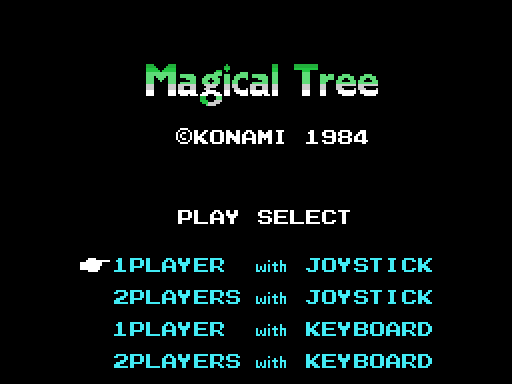
The cartridge
16 KB in page 1 (0x4000-0x7FFF), an AB header with INIT at 0x4077 and no BASIC. The screen is SCREEN 2.
VRAM, the other way round
The eight registers are loaded by 0x44EE from 0x44FF: 02 E2 0E 7F 07 76 03 E1. In SCREEN 2, R3 and R4 are base and mask, so the colour table is at 0x0000 and the patterns at 0x2000.
| area | what is there |
|---|---|
0x0000 | the colour table |
0x1800 | the sprite patterns |
0x2000 | the patterns |
0x3800 | the name table |
0x3B00 | the sprite attributes |
0x3B80 | the stage script: between 723 and 918 bytes |
RAM
The game's whole RAM is 1 KB: 0xE000-0xE3FF, cleared by INIT. The stack is at 0xE400.
| area | what is there |
|---|---|
0xE000 | the current scene |
0xE003 | the frame counter |
0xE005 | the interrupt lock, one bit |
0xE010 | the three sound voices, eleven bytes each |
0xE050 | the player in turn, 32 bytes; the other one at 0xE080 |
0xE051 | the stage number, in BCD |
0xE05C / 0xE05D | the stage counted from zero and its colour mask |
0xE0B0 | the sprite buffer |
0xE132 | the forty objects: row, column and type |
0xE1DE | the three spiders, nine bytes each |
The BIOS
It uses eight routines: RDVDP, RDVRM, SETRD, SETWRT, WRTVDP, WRTPSG, RDPSG and SNSMAT.
The two menu screens
Both are drawn from the ROM and checked against openMSX down to 0 bytes.