What the cartridge draws
Under each picture is where it comes from and what is on it.
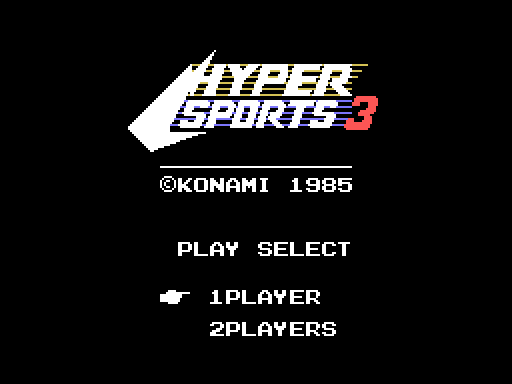
The title screen, built step by step the way the cartridge builds it. The big lettering is not a picture stored on its own: it is three compressed blocks decompressed into the pattern table with a strip of consecutive tiles laid over them. Checked against openMSX's VRAM: zero bytes different in colour, patterns and sprite patterns.
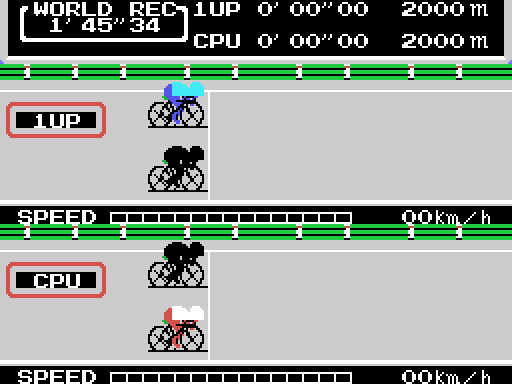
Cycling, event 0, at the instant the race starts. It is the only screen in the cartridge that closes at zero bytes different across all four tables AND the sprite attributes: 15,104 bytes of VRAM and 128 of sprites, identical to the emulator's. Each cyclist is four tiles plus five sprites; the circuit is not in VRAM at all but in two RAM windows.
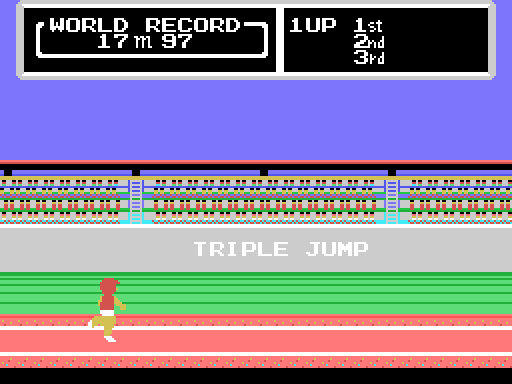
The triple jump, event 1, with the athlete on the mark. The scoreboard up top shows the world record -17.97 m- and the player's own. The runway is stored twice, in place and shifted four pixels, and the athlete is up to seven 16x16 sprites whose patterns are decompressed into VRAM on every single frame.
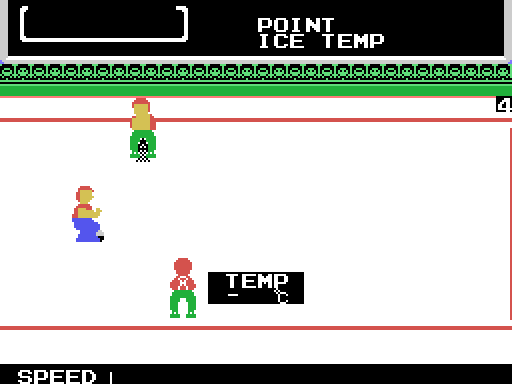
Curling, event 2, just built. The right half of the ice is stored nowhere: it is mirrored by hand, bit by bit, as the screen is put together. The house rings are drawn by a clipped-rectangle routine, and at the start they fall outside the view.
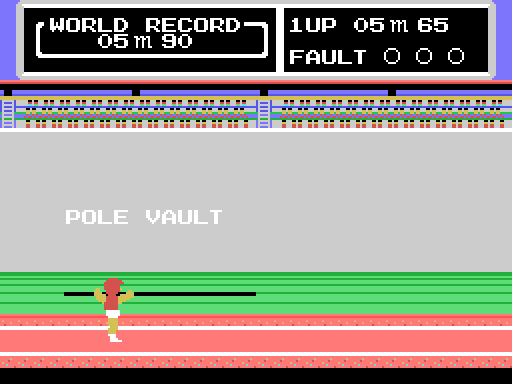
The pole vault, event 3, on the first frame of the run-up. The athlete does not come out of a figure table: he is composed from TWO blocks -three pieces from 0x6E15 and the ones at 0x6B6A- plus the sprite for the tip and the twelve tiles of the pole itself. All six sprites and their patterns are byte-for-byte identical to the emulator's.
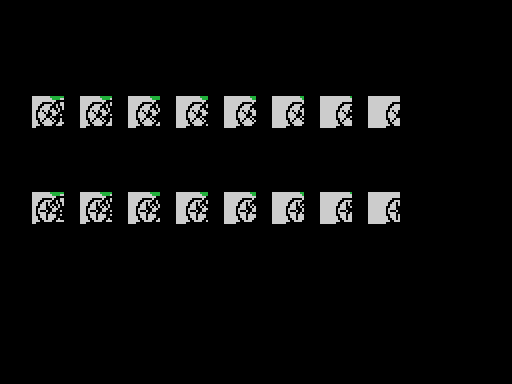
The sixteen versions of the cyclist, drawn from the ROM: two 16x16 drawings and, from each, eight copies shifted one pixel. They are not stored: 0x9CC7 generates them when the event starts, rotating the bits and feeding ones in from the left to get the mask for free. That is how a tile-based cyclist moves pixel by pixel.
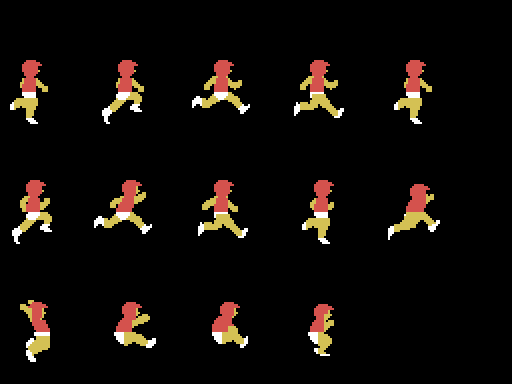
The fourteen figures of the triple jump athlete, taken from the table at 0x6BD9. Each figure is two to seven five-byte pieces -relative row and column, pattern pointer and colour- closed by an 0x80. The pattern is not sitting there beforehand: it is decompressed into VRAM on the spot.
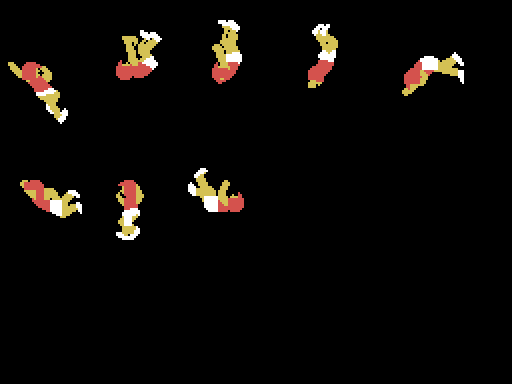
The eight figures in the table at 0x6E33, the one for the vault itself. The run-up does not use them: that one is composed from two other blocks. And one of them has a piece with colour 0 -transparent- off the screen, still unexplained.
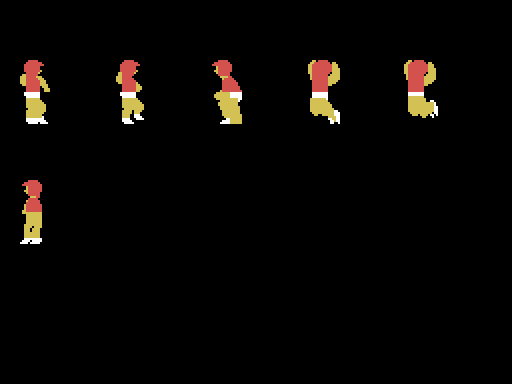
The six celebration figures at 0x6D5C, the ones that come out when the jump counts. They are the only athlete figures never drawn during the event itself.
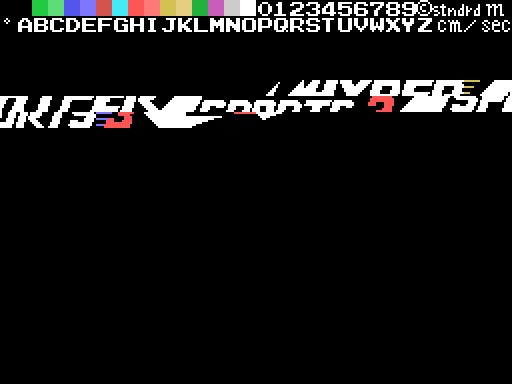
The cartridge's font, drawn from its own patterns. It is not ASCII: 0x00 is the space, the digits run from 0x10 to 0x19 and the letters start at 0x21. That is why the game's labels read as a string of odd bytes until you translate them.