Findings
Konami's hidden mark is here
Behind the filler at the end of the ROM, Konami hid in many cartridges its catalogue number and the title in katakana. The find is not ours: Manuel Pazos (@ManuelPazosMSX) uncovered it and explained the format. In Hyper Rally the last eleven bytes, from 0x7FF5, are the title reversed, its length (8), the 18 of RC-718 in BCD, and the 0xAA that closes the mark. tools/marca_konami.py reads it.
The accelerator is NOT disabled on a crash: it is copy protection
At 0x79C8, at the end of the routine that rolls the next rival's speed, there is a write that this project used to comment as "disables the accelerator after a crash". It does not, and what it said in passing was wrong too.
ld a,0c9h        ;79c6
ld (06957h),a    ;79c8
The comment assumed 0x6957 was a ret. It is not: 0x6957 is the first byte of ACELERA, and what sits there is ld a,(0e00ah). What the write does is put a 0xC9 —a ret— over that first byte, which would turn ACELERA into a bare ret and leave the car unable to accelerate for the rest of the game.
Would. The cartridge runs from ROM, and ROM does not take writes: on real hardware that instruction changes nothing. After a crash the accelerator works exactly as before.
So what is it for? The same thing as the one RC-720 carries over the ret of its interrupt handler: it is copy protection. A pirated cartridge is a copy loaded into RAM, and in RAM the write does land. The copy boots fine, lets you choose, lets you play — and on the first crash the car loses its accelerator. By then whoever copied it has already signed it off.
It is not a one-off idea in this cartridge: the same trick, always aimed at an instruction inside the cartridge itself, turns up in thirteen cartridges of the series, this one included. Manuel Pazos identified it in his disassembly of RC-727, which has two.
The whole game is one interrupt
INIT falls into a dead jr at 0x404F and never returns. Every frame the interrupt reads the state at 0xE000 and jumps through the nine-handler table at 0x40AA; inside each handler the sub-state at 0xE001 drives a djnz chain. It is a compact way to run a sequence of screens and phases with two bytes of state.
The road is a lookup, not geometry
0x68D0 turns the curvature at 0xE074 into an index into the shape table at 0x767C. The stripes move by scrolling a buffer (0x707A) at the speed's pace, and the depth scaling of roadside objects comes from the tables at 0x6CD5. No multiplies, no divides: everything the road needs is precomputed in tables.
Twelve stages from eight composers
0xE060 (1..0x0C) selects, through the table at 0x481A, the routine that composes a stage's background — and several share one, so eight routines cover the twelve. 0xE061 (table at 0x4372) is not a terrain code but a bit field of what each stage does differently: bit 1 makes the car skid and softens the wheel (0x65C7 and 0x6658, the snow), 0x01 is the tunnel, 0x10 the storm, 0x08 the night. The two tables agree exactly — same composer, same 0xE061 — and that agreement is what proves the reading:
| Stage | Composer | 0xE061 | What you see |
|---|---|---|---|
| 1, 6 | 0x51B8 | 0x00 | day: cyan sky, green hills |
| 2, 10 | 0x586C | 0x01 | tunnel: black, lights along both walls |
| 3, 9 | 0x5A44 | 0x02 | snow: white ground, mountains behind |
| 4 | 0x5B22 | 0x06 | snow under a banded red sky |
| 5 | 0x5B68 | 0x08 | night: black sky, magenta stars |
| 7 | 0x5D5B | 0x10 | storm: grey sky and a grey border |
| 8 | 0x51B8 | 0x40 | stage 1 plus a snowy mountain range |
| 11 | 0x5D86 | 0x20 | desert: ochre ground, and three pyramids that rise near the end |
| 12 | 0x5E94 | 0x08 | night: dark blue sky, white stars |
0x51B8 is the generic composer: inside it, at 0x51DA, it tests for 0x40 and only then adds the mountains, which is how stage 8 can share it. And stage 12's composer calls stage 5's — the other night stage.
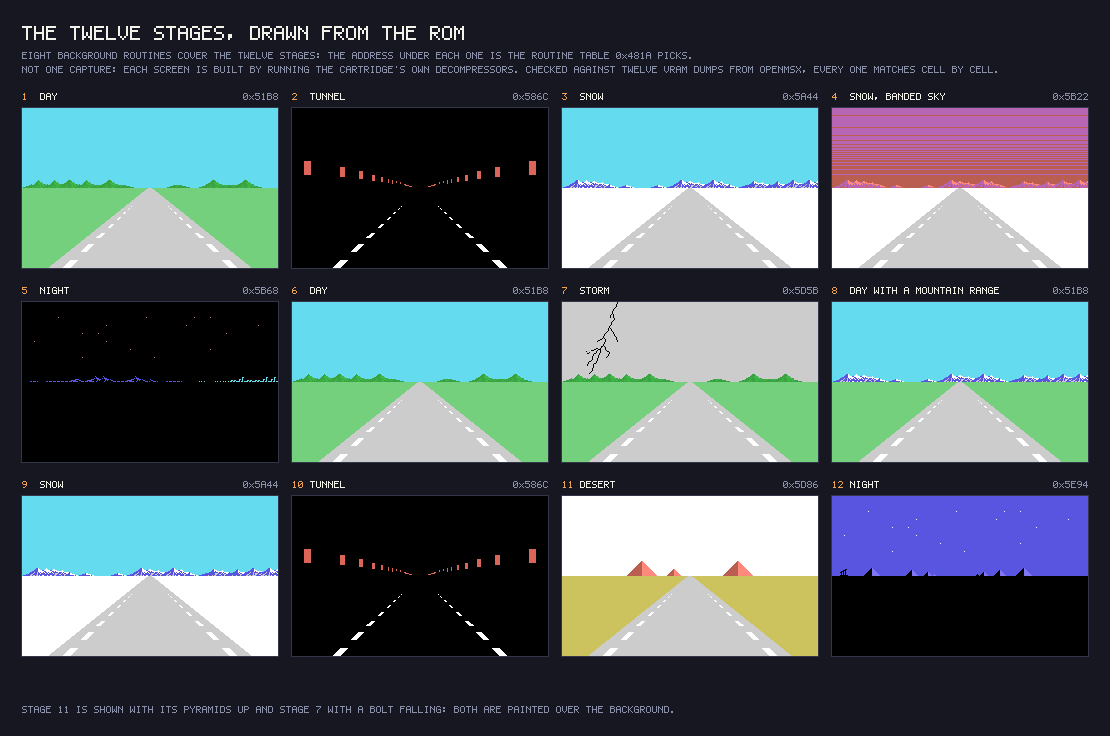
The twelve backgrounds above are not captures: each one is built by running in Python the composer that stage gets, with the cartridge's own DESC_DOBLE (0x44B0) and PINTA_TIRA (0x4529), plus the horizon, scenery and road routines. And there is a control: checked against twelve dumps of the VRAM openMSX had in front of it, all twelve match. The only thing left out of the comparison is what the game repaints every frame —the READY sign, the centre line of the road, the scoreboard strip and the odometer tiles— and that is written into the test itself.
The hashes also confirm the split: 1 and 6, 2 and 10 and 3 and 9 come out byte for byte identical, because they share a composer and an 0xE061. 1 and 8 share a composer but not the parameter, and they look nothing alike: 8 is the one with the mountain range, because with 0xE061 = 0x40 FONDO_ETAPA_1 itself diverts into the tail of FONDO_ETAPA_3 (0x51DA).
There is no water stage: it is a starfield
An earlier version of this page said that 0xE061 = 8 meant the stage was run on water. It does not, and Hyper Rally has no water stage; theNestruo pointed it out. 0xE061 = 8 marks the two night stages, 5 and 12, and 0x71AC does not animate a surface — it scrolls the sky.
The routine writes into sixteen cells of the name table (0x3884 to 0x3930, rows 4 to 9, the strip of sky), listed at 0x7229 next to their two counters. Tiles 0xF3 to 0xFA are a single pixel walking the bottom row of the character (0x80, 0x40, 0x20, 0x10, 0x08, 0x04, 0x02, 0x01) and 0xFB erases it: eight sub-positions inside one cell, so each star scrolls at pixel precision, and when the cycle closes the cell itself steps one column. The delay between steps comes from the car's speed (table at 0x7215, index = speed >> 5): seventeen frames stopped, ten flat out. Bit 2 of 0xE075 flips the direction.
The pyramids rise one row at a time
Stage 11 is the one whose background theNestruo remembered as appearing line by line, and that is exactly how it is drawn. In every other stage 0x707A scrolls the road stripes; when bit 5 of 0xE061 is set — the desert — it jumps to 0x731D instead.
That routine keeps a row counter at 0xE06B and does nothing at all until 0xE071, what is left of the stage, hits exactly the threshold the table at 0x7371 holds for the current row: 34 2C 26 20 1C 18 14 10 0E 0C 0A 08 07 06 05 04. The gaps close as you get nearer, so the pyramids grow faster the closer the finish is.
Each time one fires, sixteen bytes are copied into the pattern table from a sliding window over 0x7351 that advances one byte per row. What it slides over is sixteen zeros followed by 01 03 07 0F 1F 3F 7F FF and then solid FF: starting inside the zeros and sliding into the triangle is what makes the shape climb a row at a time. The left half is block-copied; the right half is written byte by byte through INVIERTE_BITS, so it is the same triangle mirrored — and two mirrored triangles are a pyramid.
Driven through its sixteen steps in openMSX, the four tiles end up exactly as the ROM predicts: 0xB3 = 01 03 07 0F 1F 3F 7F FF, 0xB4 solid, 0xB5 = 80 C0 E0 F0 F8 FC FE FF (0xB3 with its bits reversed) and 0xB6 solid.
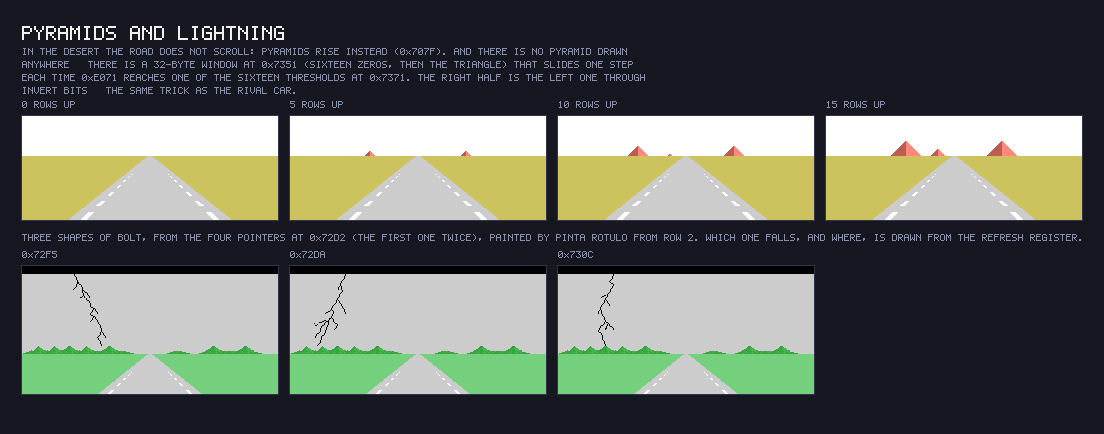
Drawn from the ROM, rising step by step. And it shows the other effect painted over the background: the storm's lightning bolt, drawn with the cartridge's third drawing routine —PINTA_ROTULO (0x455A), the one copied to 0xE1C0 that runs in RAM— from row 2. The four pointers at 0x72D2 give three distinct shapes: the first one is repeated.
Close up, a rival stops being sprites
Three rivals, with three-byte records at 0xE090, 0xE093 and 0xE096. 0x79D8 sorts each one into three levels of closeness — it adds 0x10 to the record and compares against 0x26 and 0x38 — and leaves the level at 0xE09E. 0x7C34 picks the nearest of the three.
Those three levels are drawing methods, not sizes: forcing every rival through the same branch puts a big car and a small one on screen at once, so the size comes from a scaled index inside each branch (0x7A10 shifts and offsets it, and indexes the shadow table at 0x7F47 by the animation phase).
What happens when a rival draws level with you is that 0x7B21 writes 0xE0 into the Y of its four sprites — it switches them off. Watched while playing: eight consecutive passes through it as one rival's record climbed from 0x29 to 0x45 and its level went from 1 to 2, with that car large and right alongside on screen. So the near rival is not made of those sprites, which is what theNestruo described as sprites first and tiles when closer.
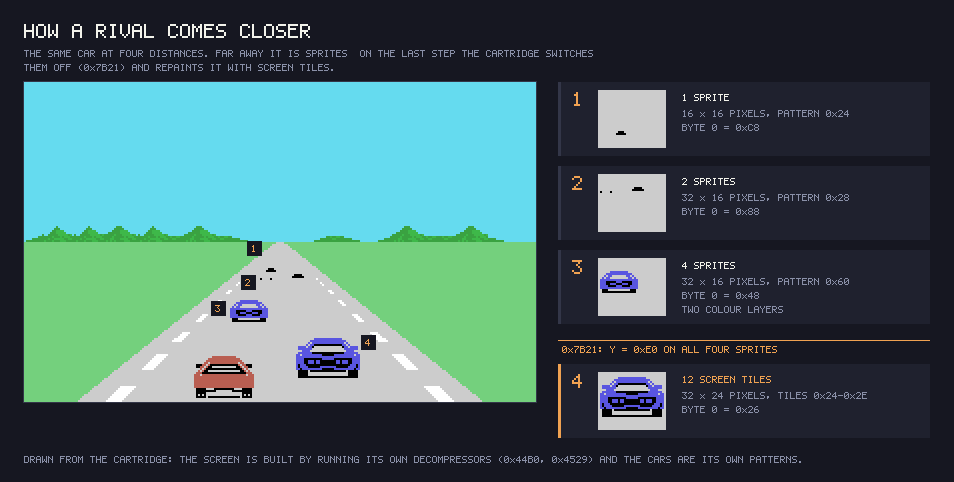
The scene above is not a capture: the race screen is built by running the cartridge's own decompressors in Python — DESC_DOBLE (0x44B0) for the background, PINTA_TIRA (0x4529) for the road — and the cars are painted with the patterns those decompressors leave in VRAM. The sprite patterns come from the script at 0x488A, and compared against a VRAM dump from the emulator they come out identical byte for byte, all 1632 of them.
The twenty steps, and why four sprites and not two
The index that comes out of 0x7A19 — byte 0 divided by eight, in two ranges — indexes the table at 0x7D94, which gives two bytes per step: the base pattern and the Y on screen. The two low bits of that pattern are not part of the number: 0x7A73 and 0x7A81 read them to switch off the spare sprites.
| low bits | sprites | size |
|---|---|---|
00 | 4 | 32 × 16, in two colour layers |
01 | 2 | 32 × 16, single colour |
11 | 1 | 16 × 16 |
The four sprites are not a 32 × 32 car: they are two overlaid pairs, the second one with patterns base + 8 and base + 12 and with the colour at 0xE09A instead of the one at 0xE09B. An MSX1 sprite only takes one colour; this is how a two-colour car is painted out of two layers, which is what you see up close and not far away.
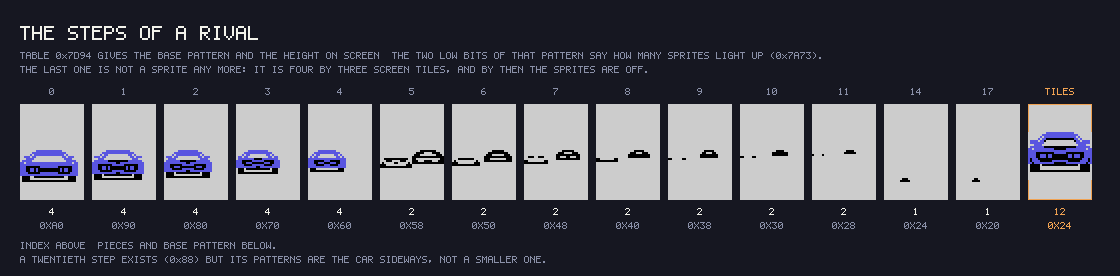
The twentieth step (pattern 0x88) is deliberately left out of the drawing: its patterns are not a smaller car but the car sideways, and it needs a byte 0 of 0xF0 or more, which is exactly the value MUEVE_RIVAL compares against at 0x7CA2. What lights it up is unmeasured.
The near rival is twelve tiles, and only six are in the ROM
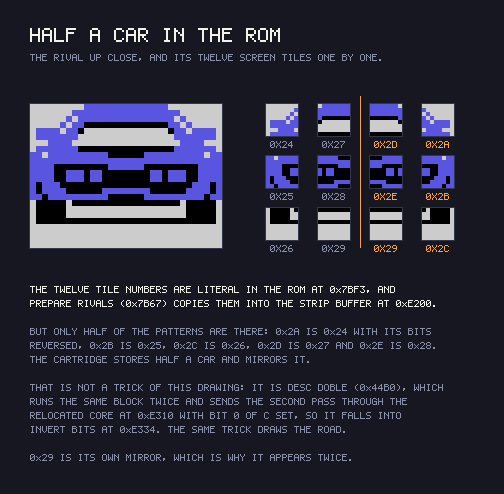
When byte 0 drops below 0x28 the branch is RIVAL_MEDIO (0x7AD1) and the car is drawn into the name table: four tiles wide by three tall, 32 × 24 pixels. The twelve numbers are literal in the ROM at 0x7BF3, and PREPARA_RIVALES (0x7B67) copies them into the strip buffer at 0xE200, interleaving the control codes PINTA_TIRA understands — the 0x20 that jumps a row and the 0x00 that closes:
24 27 2D 2A 20 | 25 28 2E 2B 20 | 26 29 29 2C 20 | FD FD FD FD 00But of the eleven distinct patterns, the cartridge only stores six: 0x2A is 0x24 with its bits reversed, 0x2B is 0x25, 0x2C is 0x26, 0x2D is 0x27 and 0x2E is 0x28. The other half is put there by DESC_DOBLE (0x44B0), which runs the same block twice and sends the second pass through the relocated core at 0xE310, which with bit 0 of C set falls into INVIERTE_BITS. And 0x29 is its own mirror, which is why it appears twice in the bottom row.
Where the next one appears is 0x7F65, and only on phase 0 of 0xE003: half the time (from the refresh register) the X is 0x1F, and otherwise it comes from (stage − 1) mod 4 — 0x7F, 0x5F, 0x3F, 0x1F. It cycles every four stages rather than growing with the stage. Measured on all twelve, the appearance X is exactly what that arithmetic predicts, with no exception.
An opponent has no path of its own
The three-byte record is settled by putting a write watchpoint on each byte and only recording program counters (tools/omsx_recorrido.tcl). Over 45 seconds of racing, each byte has exactly one writer and nothing else touches it:
| byte | written by | times |
|---|---|---|
| 0xE090 | 0x7CE6 | 425 |
| 0xE091 | 0x7D17 | 270 |
| 0xE092 | 0x79D5 | 682 |
Byte 0 is the position relative to you — it wraps the whole way round. Byte 1 is which way the opponent crosses you. And byte 2 is not a property of the opponent at all: it is byte 0 as it was on the previous frame.
0x7CCB is not an impact. The listing called it that and said it braked hard on the collision speed, and it does not touch your speed at all. The only thing it writes is byte 0:
ld a,(0e085h) / sub c / rrca x4 / and 00fh    ; (with neg on both sides)
ld a,(hl) / sub c / ld (hl),a
that is, byte 0 += (opponent's speed − yours) / 16. It is the whole engine of the approach, and there is no other write to byte 0 anywhere in the cartridge. In a 45-second race with zero collisions — 0x7FAC, where a hit is taken as real, fired 0 times, and so did the shake at 0x7D32 — it ran 1329 times in that same pass.
The formula was checked without any sampling in between, reading the player's speed and the opponent's on entry to 0x7CCB and the register A the Z80 had worked out on the way out (tools/omsx_paso_rival.tcl). Redone in Python it reproduces 102 of 102 distinct cases over those 1329 passes (tools/control_recorrido.py, and make control runs it).
0xE09C is not a colour, it is the opponent's speed
The listing said 0x79A9 "picks the next opponent's random colour". That byte never reaches the VRAM: the only place that reads it is 0x7C65, inside the subtraction above. Forcing it settles it — same pilot, same 45 seconds:
| 0xE09C | byte 0 goes up | goes down | net |
|---|---|---|---|
| forced to 0x00 | never | 1535 | −9788 |
| forced to 0xFF | 1357 | never | +13298 |
| left alone | 1327 | 0 | +5989 |
With the opponent "stopped" you eat all of them; with it flat out they all get away. The sign flips entirely. A colour would change nothing.
0x79A9 rolls it as base + (R & 3) × 8, and the base comes from the stage: 0xA0, or 0x88 when bit 2 of 0xE060 is set. So stages 4-7 and 12 are the ones that can produce opponents slower than you (0x88 = 136 against a measured top speed of 143), and those are the ones you catch from behind.
Byte 1 is where YOU were, not which lane it came from
0x7D02 writes it from 0xE121, the X of the first sprite of the player's car, in four bands. With the pilot sweeping the road side to side, 975 passes through the ld (hl),e at 0x7D17:
| byte 1 | X measured | band in the code |
|---|---|---|
| 0 | 44..88 | < 0x59 |
| 3 | 90..112 | 0x59..0x70 |
| 4 | 114..152 | 0x71..0x98 |
| 1 | 154..195 | ≥ 0x99 |
975 out of 975 inside their own band, no exceptions. (89 never shows up because the car's X moves two at a time.)
The write at 0x7CFF is one byte over, and it can never fire
An earlier answer on issue #3 said 0x7CFF was a second writer of byte 0, gated by cp 0f0h / ret c on byte 1, and that it never fired in 45 seconds. Two of those three were wrong, and the third was measured on a game that was not running.
RIVAL_COLISION (0x7A00) does inc hl at 0x7A02 before the call, so inside DETECTA_CHOQUE (0x7CE8) HL is already sitting on byte 1. That shifts everything along one:
- the gate reads byte 2 — the opponent's byte 0 from the previous frame, the same pairing the rank counter at 0x6B7D uses
- what 0x7CFF writes is byte 1
Measured in openMSX with breakpoints on the whole chain — 0x7A00, the call at 0x7A15, 0x7CE8 and 0x7CFF — across three runs (45 s and 90 s of stage 1, 120 s of stage 5):
| calls into DETECTA_CHOQUE | 5,804 |
| times the gate opened | 0 |
| highest byte 2 seen at the gate | 0xEE |
And it cannot be opened by driving. To reach the call at all, RIVAL_COLISION needs byte 0 between 0x28 and 0xEF: from 0xF0 up, the add a,010h wraps and the flow leaves through RIVAL_REPARTE. So the gate needs byte 0 to jump from 0xF0..0xFF straight to 0x28 or more within a single frame — an advance of at least +0x29. Over 4,368 frame-records the largest advance seen was +0x0B.
As for "it never fired in 45 seconds": that came from a probe that set the stage number in 0xE060 and never actually started the race, so the game sat on the attract screen where none of these routines run. Every counter in that probe read zero, which was the tell.
0x6B7D does not write to the VRAM: it is the RANK counter
It was called COLOCA_RIVALES_VRAM and it does not write a single cell. What it does is compare byte 0 against byte 2 — where the opponent is now against where it was last frame — over the 0x17 threshold, and when one crosses it, move the three-digit BCD number at 0xE05B/0xE05C: up through 0x6BB5, down through 0x6BC0, and that one also pays SUMA_PUNTOS 0x0250. It leaves through a pop hl, so it moves at most one place per frame.
That number is the RANK in the bottom right of the dashboard, and you start the race 680th: 0x435A loads HL with 0x8006 and drops it into 0xE05B, which is 0680 in BCD. So an opponent passing you costs you a place and one you pass gains you one, plus 250 points.
Measured over 45 seconds with the accelerator held down and never steering, the rank went from 0680 to 0704 — 24 places lost — and the up branch fired exactly 24 times, the down branch 0. Which is what should happen: every opponent in that stage is faster than a car pinned at 143.
Are there more crossing cars in the later stages?
Not at the same driving, no. Twelve runs, one per stage, same pilot with the accelerator held down, 40 seconds each (tools/omsx_cruces_etapa.tcl):
| stage | bit 2 | crossings | opponent speeds | appearance X |
|---|---|---|---|---|
| 1 | 0 | 18 | A0 A8 B0 B8 | 1F, 7F |
| 2 | 0 | 17 | A0 A8 B0 B8 | 1F, 5F |
| 3 | 0 | 17 | A0 A8 B0 B8 | 1F, 3F |
| 4 | 1 | 15 | 88 90 98 + A0 A8 B0 B8 | 1F |
| 5 | 1 | 15 | 88 90 98 + A0 A8 B0 B8 | 1F, 7F |
| 6 | 1 | 15 | 88 90 98 + A0 A8 B0 B8 | 1F, 5F |
| 7 | 1 | 15 | 88 90 98 + A0 A8 B0 B8 | 1F, 3F |
| 8 | 0 | 18 | A0 A8 B0 B8 | 1F |
| 9 | 0 | 17 | A0 A8 B0 B8 | 1F, 7F |
| 10 | 0 | 17 | A0 A8 B0 B8 | 1F, 5F |
| 11 | 0 | 18 | A0 A8 B0 B8 | 1F, 3F |
| 12 | 1 | 14 | 88 90 98 + A0 A8 B0 B8 | 1F |
The crossings do not grow with the stage — 14 to 18 across all twelve — and the stages with bit 2 set have fewer, not more. What the stage does change is the other two columns: the appearance X cycles every four, and stages 4-7 and 12 put slower opponents on the road. A slower opponent is one you come up behind and sit next to instead of one that flashes past, which stays on screen far longer.
The pilot in these runs never steers and always tops out at 143, so the numbers compare stages against each other — which is the question — and are not an absolute count for a real race.
The storm stage throws lightning
0x724B runs only when 0xE061 is 0x10 — stage 7, the one with the grey sky and, because 0x418E writes 0xEE into VDP register 7, a grey border as well. After a random wait (0x18, 0x38, 0x58 or 0x78 frames: half a second to two and a half) it picks one of the four scripts at 0x72D2 — three distinct shapes — drops it into row 2 of the name table, plays sound 0x43, flashes the border to 0xEF at 0x7276 and puts it back to 0xEE about a tenth of a second later. It is a lightning bolt, not the fireworks at the finish line this page used to claim.
It shares the sound player, little else
Measured with the sixteen-bit operands zeroed, Hyper Rally shares the Konami three-channel sound player and the VDP helpers with the house's other MSX cartridges, but it is its own program: the state machine, the road engine and the collisions were read here, from this ROM.