Curiosities
Findings
What the code hides. Each item carries the address where it is and how it is known: measured in openMSX (with RAM or VRAM dumps) or from the code (read, not played).
With King Kong 2 next to it, it boots King Kong 2 and saves its game
At power-on, p00:5DFF reads the other slots with RDSLT looking for three
signatures (p00:5E78): six bytes at 0x7FFA (the Game Master, RC-735), the
header 'CD' 07 45 FF at 0x4010 (King Kong 2, RC-745) and six bytes at
0xBFFA (Q*bert, RC-746). With King Kong 2, 0xC110 = 2 and INIT goes
to p09:B880:
- it reads King Kong 2's INIT from the other slot (its word at
0x4002) and copies 256 bytes from there to0xF120; - it copies 170 bytes of its own (
p09:B925) to0xF220and putsjp 0xF220on the interrupt hook; - it jumps to
0xF120: King Kong 2 boots.
Every frame, the hook checks whether King Kong 2 is being played (its
0xC100 = 5) and the keys: with F4, it puts Hinotori in pages 1 and 2
(ENASLT) and calls its save code (p09:B9CF); with F5, the load
code (p09:BA9C). Both use the BIOS tape routines (TAPOON, TAPOUT,
TAPION, TAPIN) and ask for a file name.
Measured in openMSX with Hinotori in slot A and King Kong 2 in slot B:
King Kong 2 boots (the PC runs at 0xF1xx, 0xFD9F = jp 0xF220), and
pressing F4 while playing sets 0xF106 = 1 and 0xF107 = 1 and «SAVE MODE /
INPUT FILE NAME» appears on its screen.
With Q*bert or the Game Master, a menu and the STOP key
With either of the other two, 0xC110 = 1. Pressing SPACE on the title,
p00:46B1 goes to state 9 instead of starting: a menu with START GAME, MODIFY
STAGE NUMBER and MODIFY PLAYER NUMBER, where the stage (0xC115) and the
lives (0xC117) are typed with the number keys. Measured in openMSX with
Q*bert in slot B: the menu, built here from the ROM, gives 0 bytes different.
And the interrupt, with 0xC110 not 0, watches the STOP key
(p00:4124): the game freezes and the PSG goes quiet until the next press.
From the code.
The cheat passwords
F1 pauses; HOME shows the game's password and HOME again lets you
type one. p06:B85E compares it with the 17 strings at p06:B8A0; each
string is followed by the code it runs, which is jumped to with jp (hl)
(p06:B89A), and each works once per game (0xC600 + n). It is accepted
with «CORRECT». The other passwords are the real ones: they carry the state
of the game and a check (p06:B7EE: the XOR of all the characters has to be
0).
| password | what the code does | measured |
|---|---|---|
| GAOOOOOOOOOOH | lives + 10 (0xC160, in BCD) |
2 → 12 |
| ILOVEHINOTORI | 0xC4E2 = 1: invulnerable every frame (p02:8600) |
yes |
| NANDANANDANANDA | 0xC4E0 = 1: a lost life is given back (p00:441A) |
yes |
| METALSLAVE | energy (0xC845) to 200, the maximum |
from the code |
| HANEYOKAGAYAKE | 0xC4E3 = 1: what gives 1 energy gives 10 (p03:AC8F) |
yes |
| FULLITEMDAYOON | 1 in every byte of items 1-15 | yes |
| KINOOOIHITODANE | 1 in every byte of items 16-33 | yes |
| SUPERBALL | 1 in items 36-40 | yes |
| TURBO | item 1 to 3 | yes |
| HAYAME | the weapon (0xC85C, item 4) to 3 |
yes |
| AUTOSHOT | the weapon to 3 and 0xC4E1 = 1: weapon 4 every frame (p02:8F56) |
yes |
| ULTRABOX | item 9 to 9 | yes |
| KOKOWADOKO | item 10 to 6 | yes |
| DOKODEMOMAP | item 11 to 6 | yes |
| HOIHOIHOINOHOI | item 14, the stage jumper, to 9 | yes |
| ENDDEMOGAMITAINA | 0xC4DA = 0x000C: on returning, state 12, the ending |
yes |
| aaaaa | items to 3 and invulnerable (0xC4D1) |
cannot be typed |
«aaaaa» is in lower case, and p06:B5AB turns everything typed into capitals
before storing it: it can never match. «Measured» means it was typed in
openMSX (tools/omsx_guion.tcl) and the change was seen in RAM.
The stages wrap round, and the only way out is a torii
The columns of a stage are joined at the sides: leaving column 2 on the right
you come into column 0, and leaving 0 on the left, into 2 (p01:6522,
p01:653A). At the top, each column's map ends in 0xFF 0x0000: back to row
0 (p00:580E). The only way out is the stage's torii. From the tables and
the code.
18 gates, and a route that is not straight
The table at p09:A269 has 18 six-byte gates. 0-5 are the stages' torii and
lead to their room; 6-13, the rooms', lead to the next stage, except that
room 3 has another one back to stage 1, room 5 another back to stage
2, and room 6's leads to stage 4. Gates 14-17 lead to area 0x18,
which does not exist: no list of things uses them. The whole route is in
The game. From the tables.
The stage jump
F5 opens a map of the six stages (p02:8555). Carrying item 14 (0xC884),
the cursor keys choose one (0xC887) and SPACE jumps there, using one up
(p02:859F); you arrive through column 1 (p01:65CF). From the code.
Another version of five bosses, never used
From p07:7457 to p08:82B3 there are 18 strips in a row in the sprite RLE
(p00:4A8D), and right behind them, up to 0x85B3, 768 bytes of sprites that
are not compressed. Nothing loads them: the RLE is only opened by the lists of
each area (p00:4AD5) and by the loader of the 41 sets (p00:56C7), and no
entry names them; the openMSX read probe does not read them either.
Read like the sprites that are used (two patterns in a row are the two layers
of a 16 × 16 sprite, and a figure's sprites go by columns), they are seven
figures, and five of them are bosses of the game drawn another way: the
same creatures as the sets the rooms load (p07:6000, areas 18 to 23), with
not a single sprite in common, not even swapping the layers or comparing only
the outline.
| strips | figure | the boss the game loads |
|---|---|---|
| 0-2, read in a row | a hunched beast, 32 × 32, three frames | set 25 |
| 3-7 and 12 | the one-eyed monster, 32 × 32, six poses (one sinking) | set 26, four poses |
| 8-9 | the face, 32 × 32, two frames | set 27 |
| 13-15, read in a row | the demon, 32 × 48, two frames | set 28 |
p08:82B3, not compressed |
the warrior with several arms, 32 × 48, two frames | set 29 |
| 10-11 | something rising from the ground with two claws, 32 × 32 | none |
| 16-17 | a small warrior with a headband, 16 × 32, two frames | none |
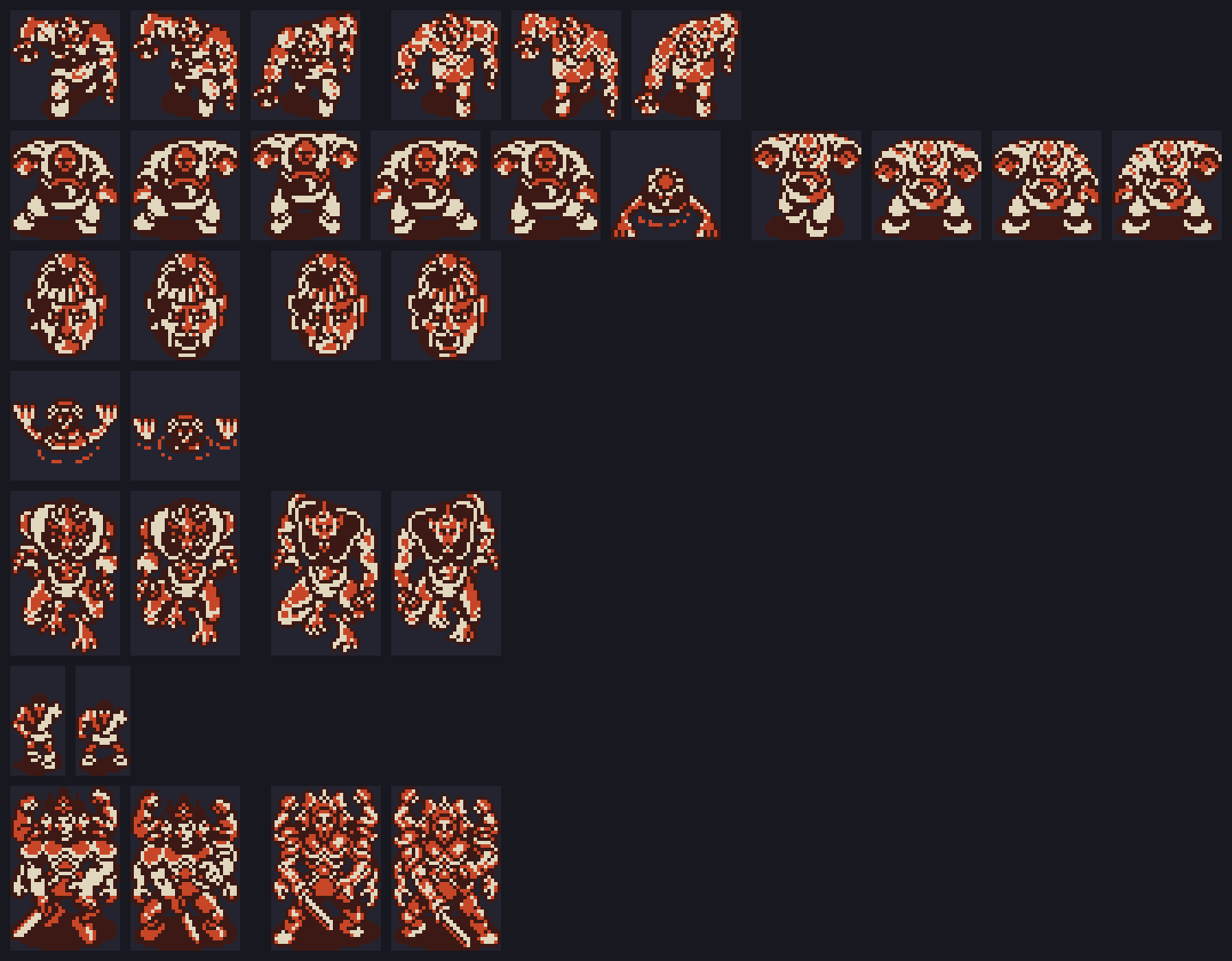
On each row, the unused version and, after a gap, the one the game loads. In
two tones, like the enemies: the colour is set by each enemy's code.
Measured in the ROM (tools/figuras.py huerfanas).
And measured in openMSX: going into each room (the gate written to
0xC486 and bit 7 of 0xC485, the same as p01:607C does when you cross a
torii), the VRAM holds the whole sprite set of its boss —room 1, set 25;
room 2, 26; room 3, 27; room 5, 28; room 6, 29— and not one sprite of these
figures. The stage-4 room has no boss: it only loads set 35 and the flame
(tools/figuras.py coteja_salas).
The phoenix in the last room asks for five jewels
In the stage-6 room, a few seconds after going in, the game goes to state 18
(0xC100 = 0x12) and the phoenix appears in a window with this message,
transcribed from the screen:
ガおうよ、怒鬼とたたかうためには、こころのたまが いつつひつようです。 さあ、おゆきなさい。
"Gaou, to fight Doki (怒鬼, the raging demon) you need five kokoro no tama (heart jewels). Now, go." Measured in openMSX, going in with none.
Corrected on 30 September 2026: the first version of this finding said these were figures nobody uses. The data is not used, but five of them are bosses that do appear, in another drawing.
The header for other cartridges
At 0x4010: 'C', 'D' and a list of addresses in this game's RAM. No code
in Hinotori reads it. King Kong 2 carries another one like it in the same
place, and that is what Hinotori looks for in it to know it is there.
The ending credits, and a cheat named after a designer
The ending scrolls the credits up from the bottom of the screen line by line
(p06:AF12, with the pointer list at p06:AB23). Transcribed from the ROM,
as they are:
| PROGRAMMER | ULTRAMAN ADACHI · ADDE EDA · YOSHIMOTO OHTA · DARENANDA SUZUKI · 27INCH NAGAE |
| DESIGNER | SHU IWAMOTO · KI MIZUTANI · HAAAA MAKITANI · METALSLAVE NAOKI |
| SOUND | MOAI SASAKI · SG FURUKAWA |
| SPECIAL THANKS TO | PAKEMI KAMIO · ROOM 1013 · AND YOU |
| PRESENTED BY KONAMI · © KONAMI 1987 |
METALSLAVE, the nickname of one of the designers, is also one of the cheat passwords: the one that fills up the energy. Measured in the ROM.
A comparison for Gao that can never match
When looking at Gao's token (p02:86F7), the code keeps the high nibble (and
0xF0) and compares with 0x28 (p02:86FC): it can never be equal, because the
low nibble is always 0. It makes no difference: both paths go to the same place
(p02:8703) and the next comparison (with 0x20) covers tokens 0x20 to 0x2F.
It comes from the code; no effect in the game.
Open questions
What is not solved, said as it is.
- The route has not been walked. The gates come from the table at
p09:A269and from the lists of things; we have not gone through a torii in openMSX. - Area
0x18. Gates 14-17 lead to it, and it is in none of the 24-area tables. No list of things places those gates. - How the game ends. The stage-6 room asks for five heart jewels (see
Findings): where they are and what happens when you carry them has not
been measured. Rooms 3, 5 and 6 send you back to stages already
crossed; what decides the ending has not been read yet (state 12 is set by
0xC4DA, written by ENDDEMOGAMITAINA and by someone else). - METALSLAVE: it was typed while Gao was dying and could not be measured;
the code (
p06:B92E) sets energy0xC845to 200. - The STOP key with Q*bert or the Game Master next to it: from the code, not tried.
- The enemies' colour. The sprites of the sets are in two tones: the colour is set by the code of each type and has not been worked out type by type.
- The unused version of five bosses (
p07:7457,p08:82B3): whether it is an earlier drawing, and what the other two figures were. - Items 18 to 32 are drawn with nearly empty icons from the sheet of the dumped stages; their icons may be uploaded at another moment.