The game
Gao, the sculptor of Tezuka's story, crosses six stages from bottom to top until he reaches the torii, the gates that lead to each stage's room. The map scrolls up as you go and the sides never end.
Every picture on this page is drawn from the bytes of the ROM with the tools in tools/, which follow the cartridge's own steps. Under each one it says which table it comes from and how it was checked against openMSX (MSX2, C-BIOS_MSX2_JP).
The logo and the title

The logo is 52 one-bit letters in bank 9 (p09:AB3C, ABA4 and AC0C) that p00:4ED7 uploads to page 1 in three colours, and that p01:6710 puts together with the list at p01:675E; then p01:66F0 uncovers it from the top with HMMM. Checked against openMSX: 0 bytes different.
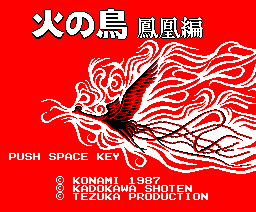
The title is a tile sheet (the lists at p04:6443, 6458 and 6468) painted with the maps at p13:7640 and p13:79A0 (32 × 18) and the 火の鳥 鳳凰編 lettering (p13:7D00 and 7D30) on top with colour 0 transparent; the texts, with the sheet's font (p00:4F87). Checked: 0 bytes different and the 16 colours at p00:5BE9.
The six stages and their gates
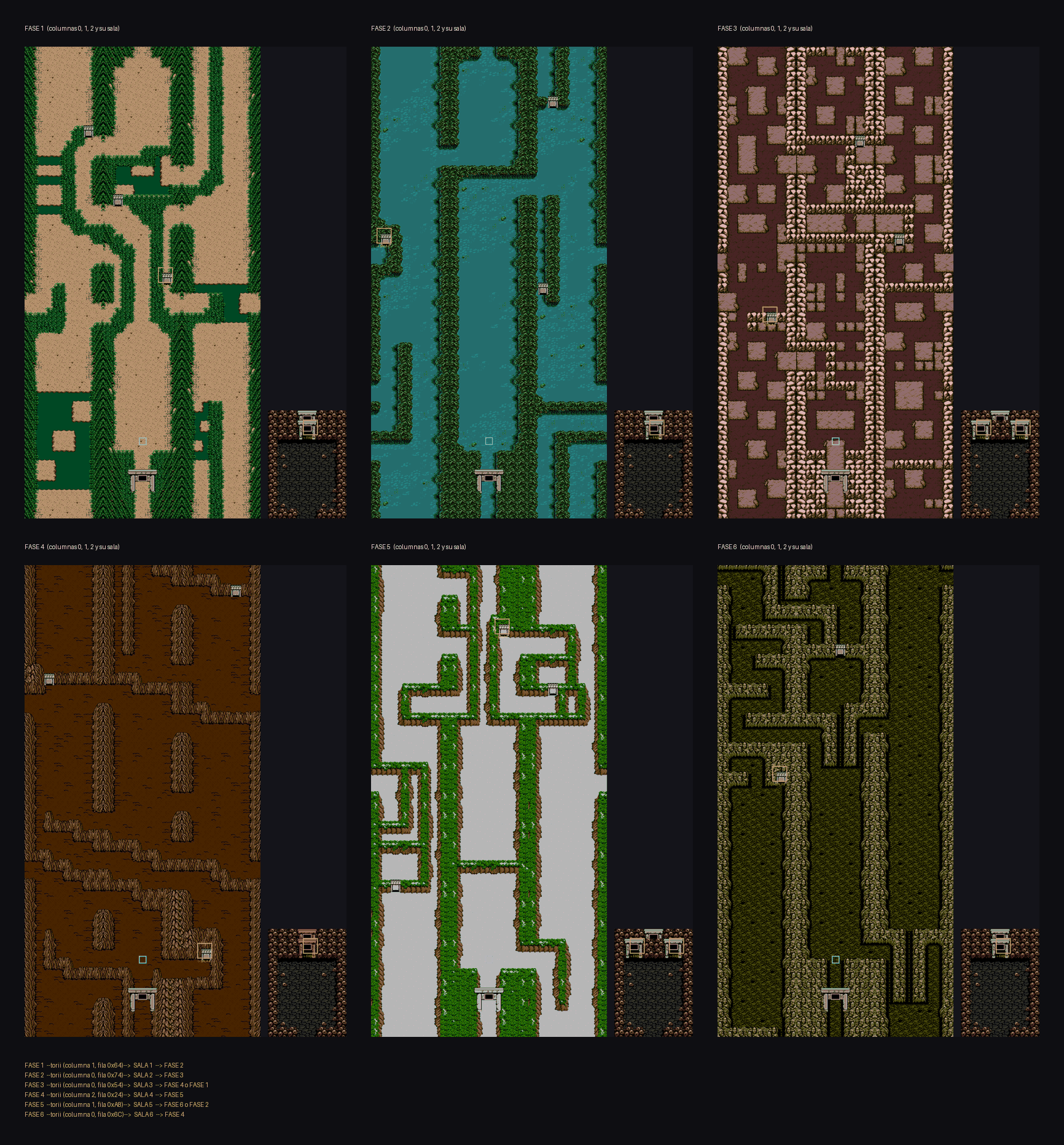
Every stage is three columns of 256 × 1,536 pixels, side by side, plus a room. At the sides, the columns wrap round (p01:653A: from 2 you go to 0 and back); at the top, the map starts again. The 24 areas (0xC480) are 3 × 6 columns and 6 rooms, and the table at p01:660B gives the stage, the tile set and the column of each.
A map is a list of superrows (one per 32 pixels of height, p00:597B); each superrow is eight blocks of 4 × 4 tiles (p00:594B, p00:593B); and each tile is one of the 256 in the sheet on page 1 of the VRAM, uploaded by the bank-4 lists in eight formats (4 bits as they are, 1, 2 or 3 bits with a palette, and the four mirrored, p00:54CC).
The gates are things on the way: type 4 is each stage's torii and type 5 the room's exit. Both carry a number, and p01:607C reads the gate from p09:A269: the area, the row and the arrival point. The route that comes out of the table:
| from | through | to |
|---|---|---|
| stage 1 | torii in column 1, row 0x64 | room 1 |
| room 1 | its torii | stage 2 |
| stage 2 | torii in column 0, row 0x74 | room 2 |
| room 2 | its torii | stage 3 |
| stage 3 | torii in column 0, row 0x54 | room 3 |
| room 3 | left torii / right torii | stage 4 / stage 1 |
| stage 4 | torii in column 2, row 0x24 | room 4 |
| room 4 | its torii | stage 5 |
| stage 5 | torii in column 1, row 0xA8 | room 5 |
| room 5 | left torii / right torii | stage 6 / stage 2 |
| stage 6 | torii in column 0, row 0x6C | room 6 |
| room 6 | its torii | stage 4 |
You always come in through column 1, on row 0x1F. It comes from the tables; we have not walked it. One plate per stage, full size:
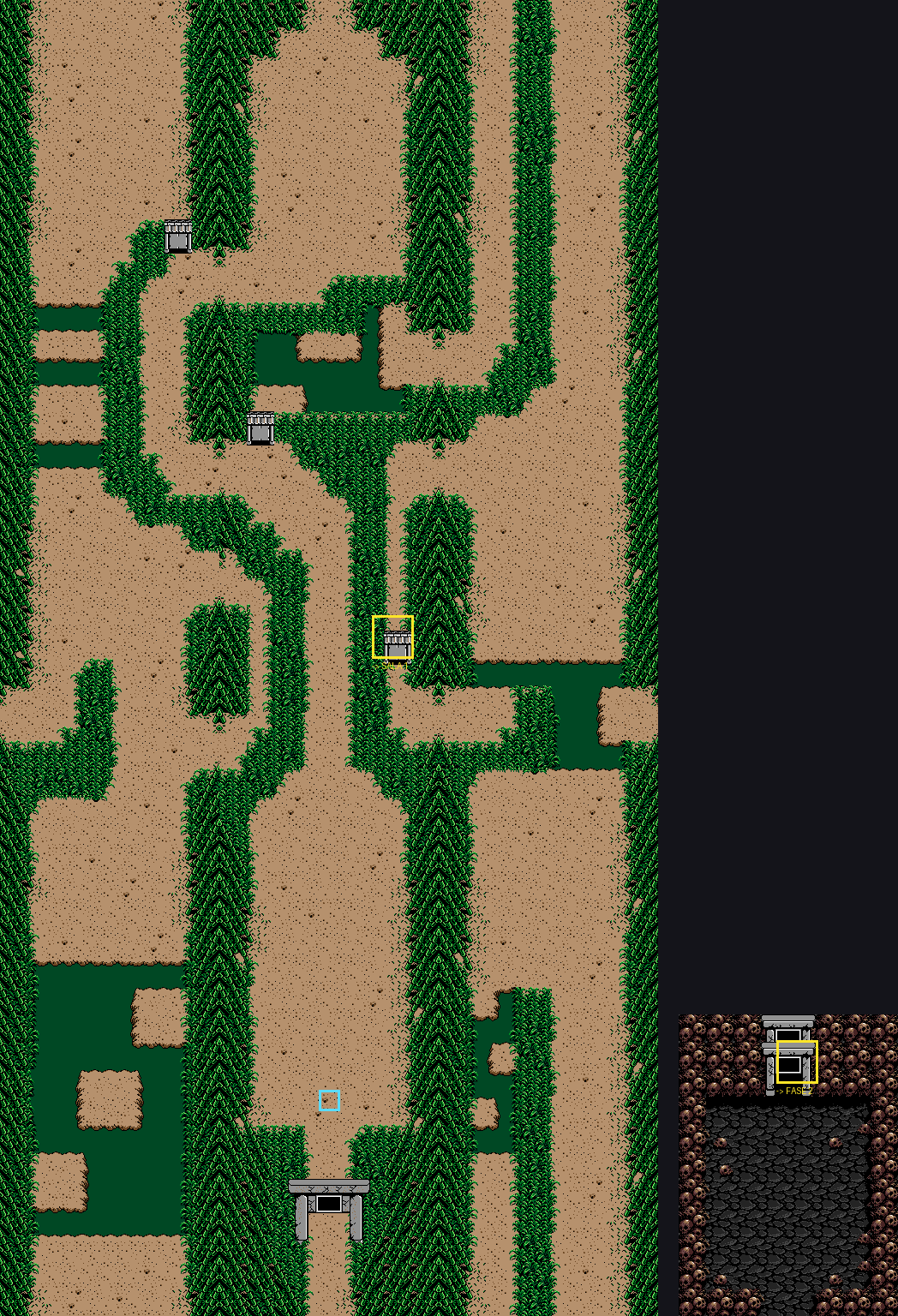
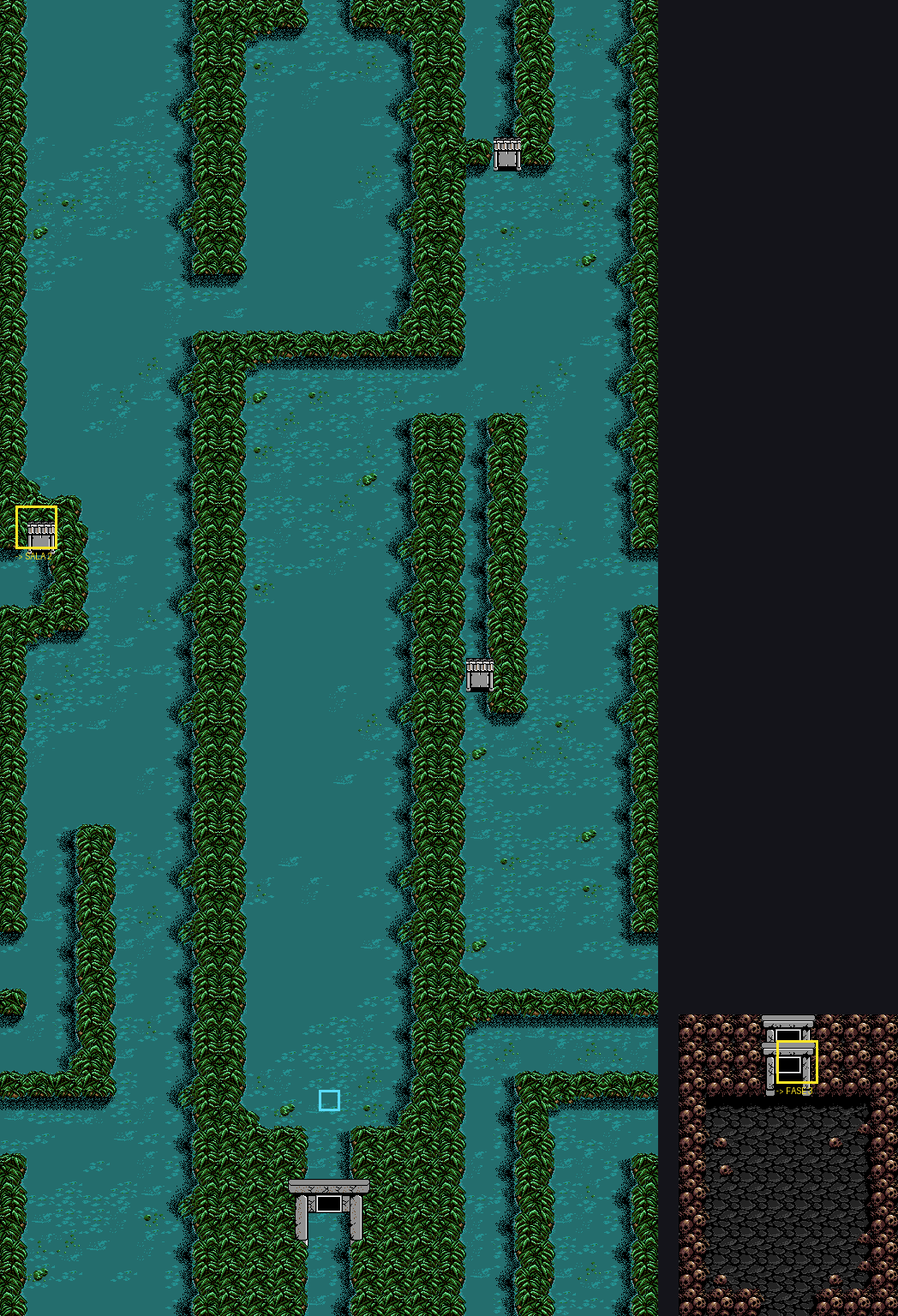
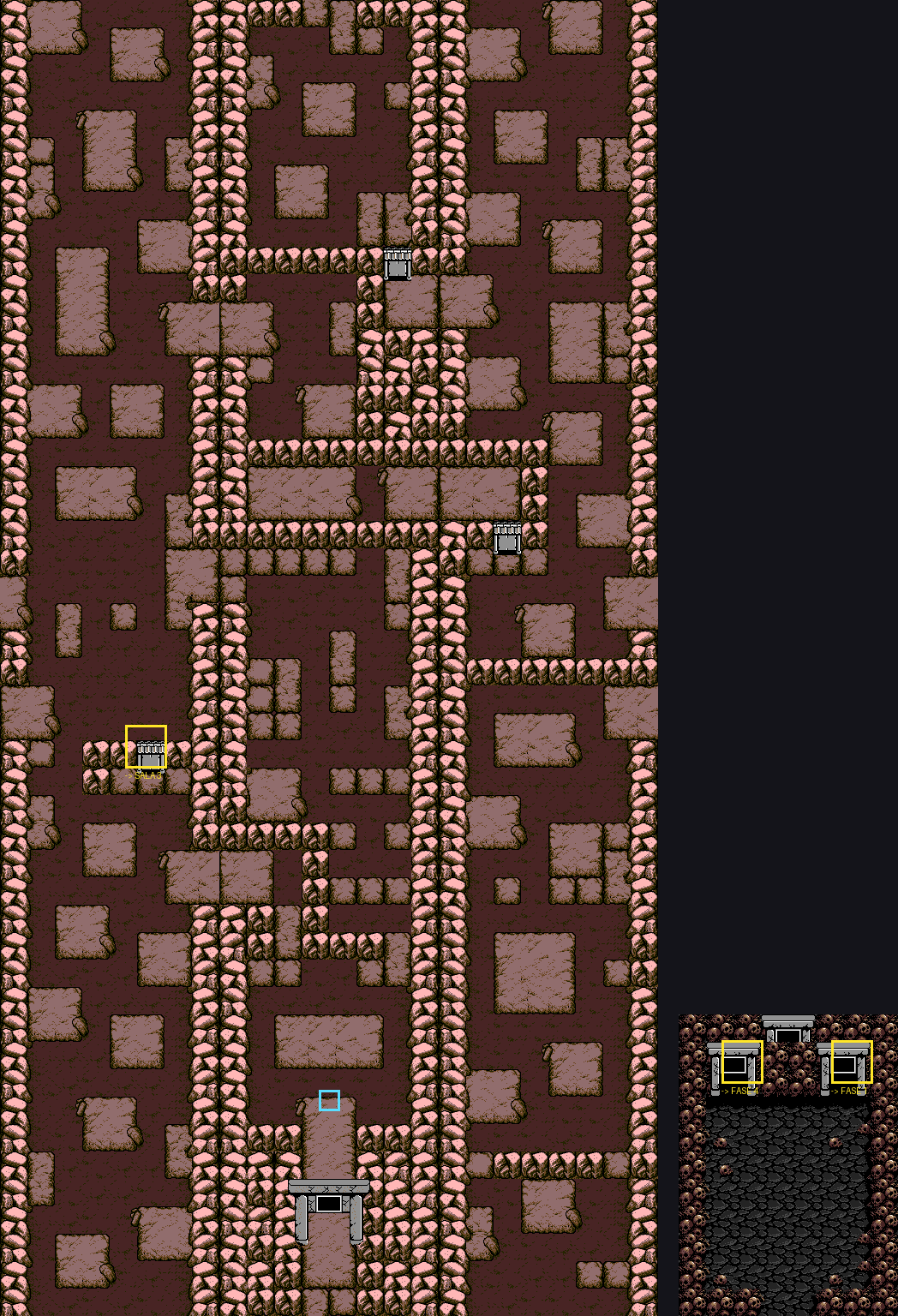
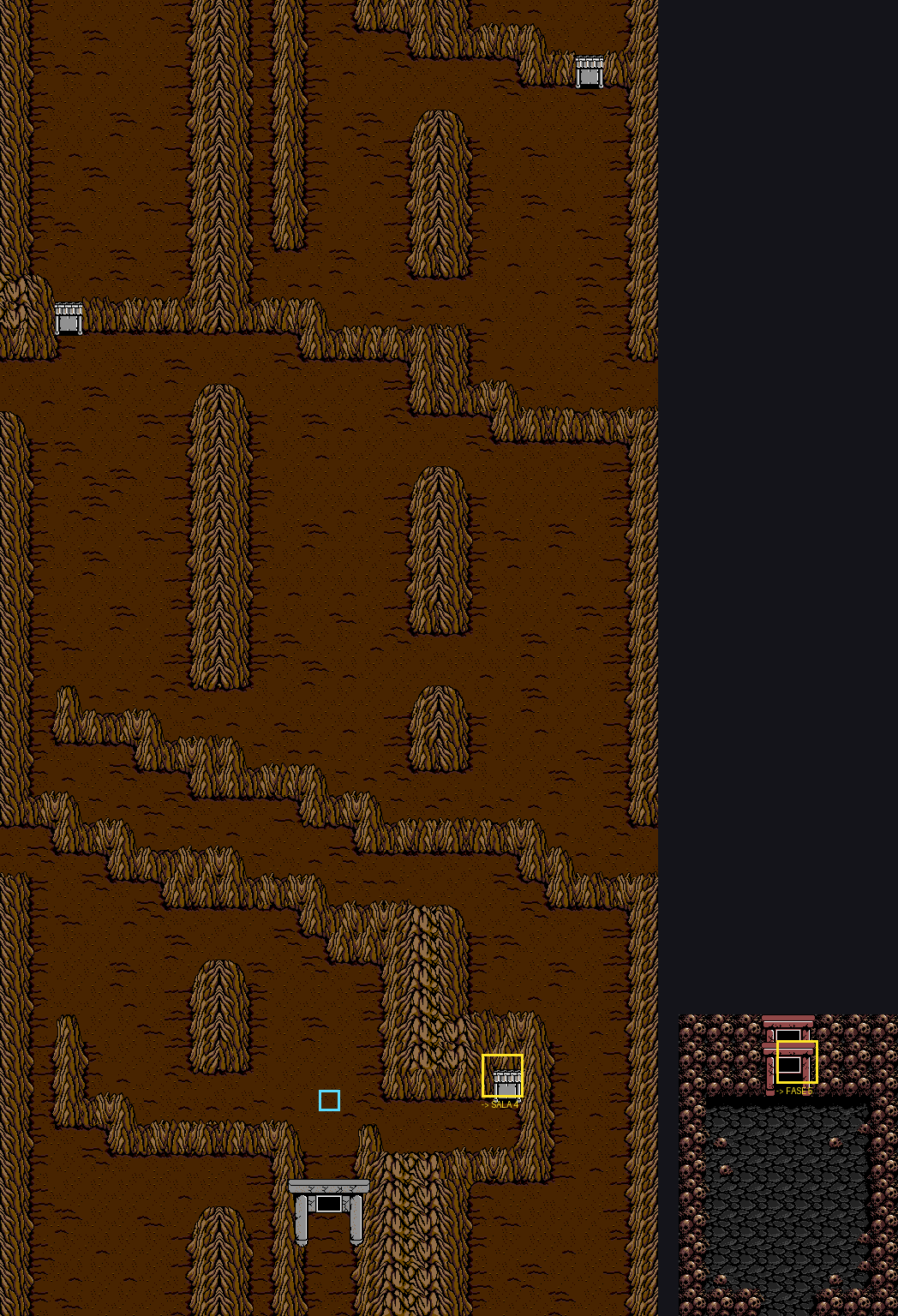
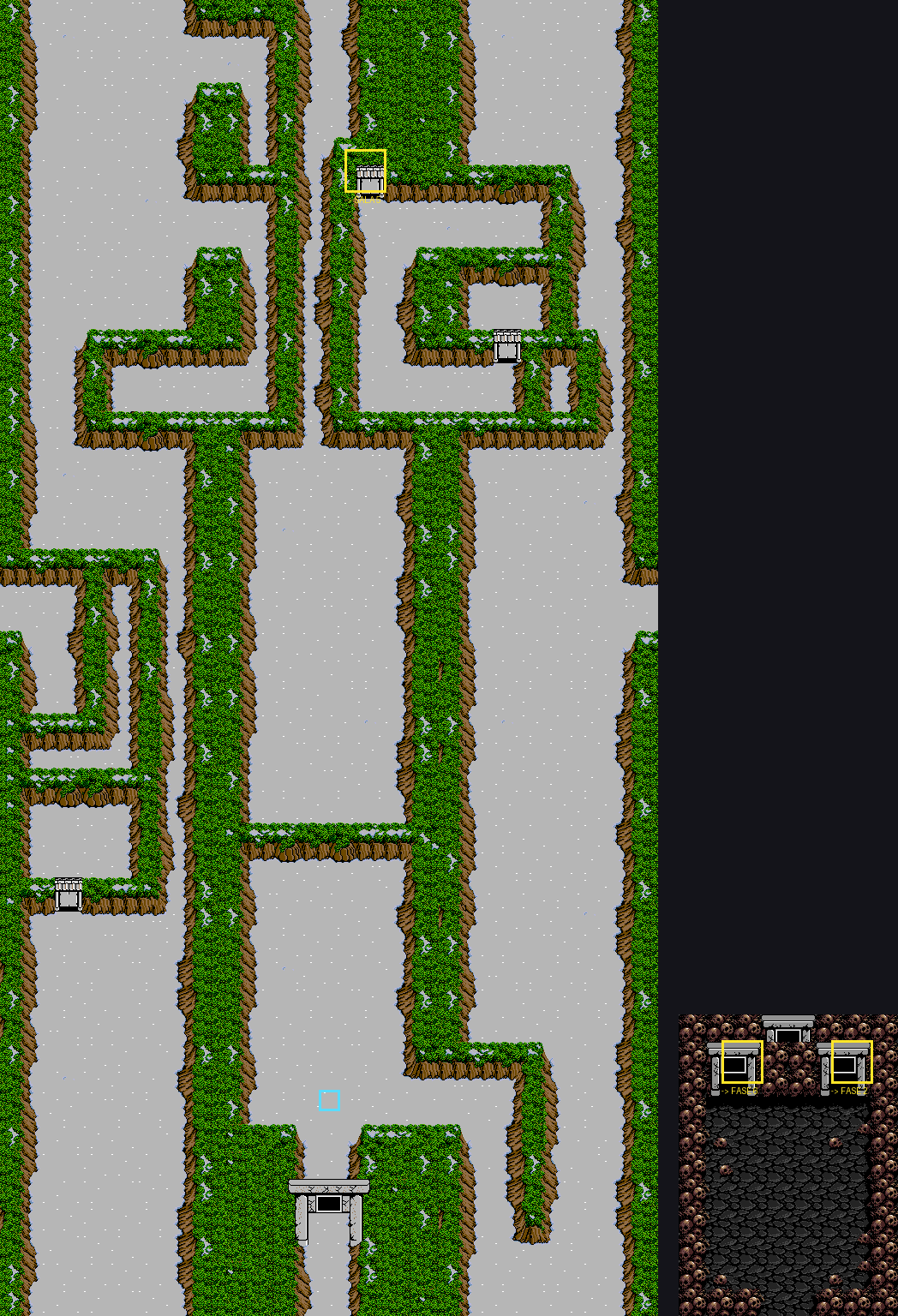
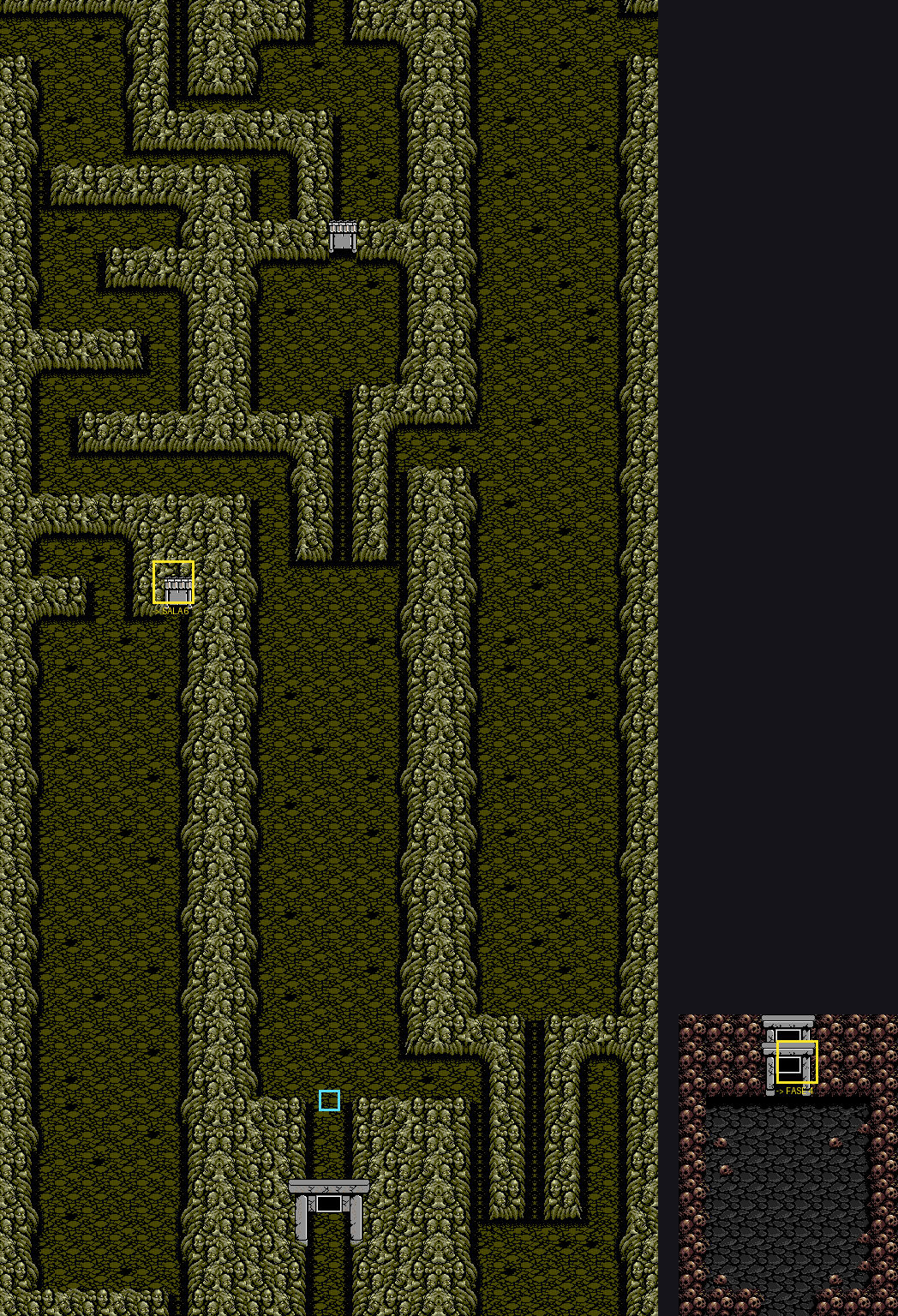
Checking: the tile sheet and the palette of areas 0 and 1, dumped in openMSX when they have just been built (p00:5D6E), are identical: 189 and 225 tiles, 0 different, and the 16 colours. On screen, in three dumps of three areas, each row of page 0 has been looked for by its pixels in the drawn map: going down the screen, the map goes down one row at a time (25 of 25, 31 of 31 and 31 of 31 rows in a row).
Corrected on 30 September 2026: the first version of these maps had the four rows of each 32-pixel block upside down. The check back then only looked at whether each row was on the screen, not in what order; now it looks at the order.
Gao
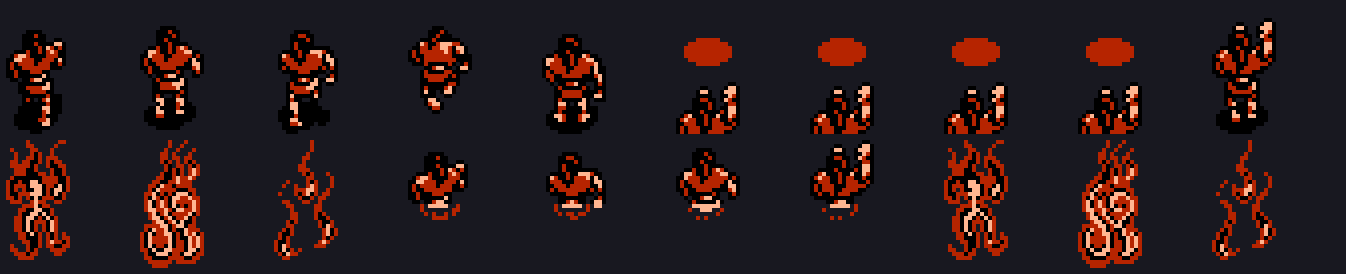
Every pose is two 16 × 16 sprites (top and bottom), and each one two patterns laid one over the other with the V9938's OR mixing: colours 13 and 14 and, where they meet, 15. p02:93D6 uploads the two of pose 0xC81C from p06:A0BB.
What appears in each area
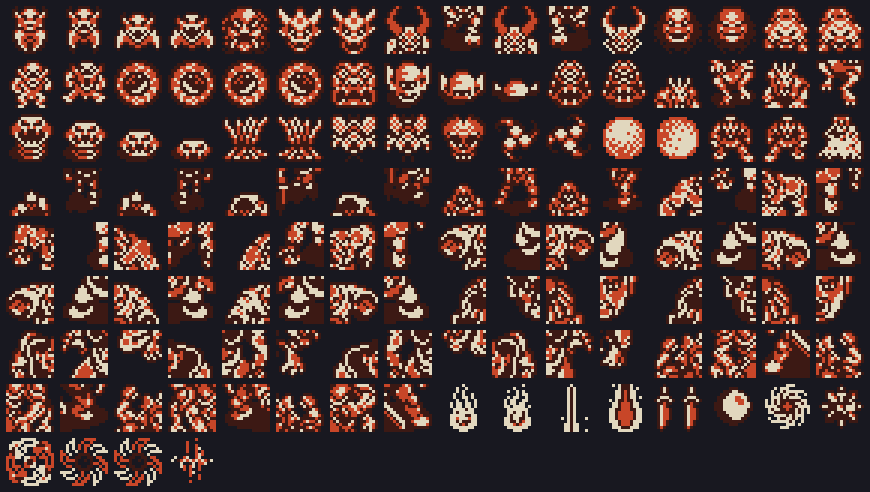
Every area loads into the sprite patterns the sets it is going to use (p07:6000 + 2 × area, [set][slot] pairs); the 41 sets at p07:6173 are RLE or plain bytes. Here are the 132 two-layer sprites: the enemies, the bosses in pieces and what they throw. The colour is set by each enemy as it moves, so they are in two tones.
Which enemy appears and when is up to bank 9: p09:A162 gives each area's list ([row][type][data], p01:6CFC) and p09:A186, which types appear in each stretch of 32 rows. There are 58 enemy types, each with its birth routine (p01:6E80) and its movement routine (p01:6875).
The items
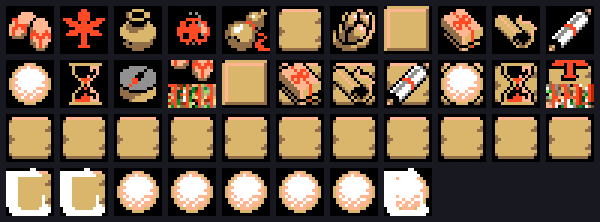
There are 41, with their count at 0xC850 + 4 × (item − 1). The ITEM INFORMATION window (F3, p06:BAC2) draws them with p01:7B60: 16 × 16 icons from the sheet; from 16 on, an icon over a background. F5 shows the map of the stages and, with item 14, lets you jump to another (p02:8555).
The secret menu
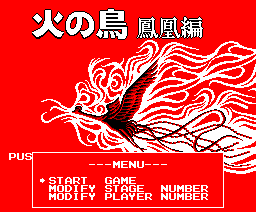
With Q*bert or the Game Master in another slot, SPACE on the title opens this menu (p00:4705): START GAME, MODIFY STAGE NUMBER and MODIFY PLAYER NUMBER. Seen in openMSX with Q*bert and built from the ROM: 0 bytes different.
The sound
p14:9C47 has 120 entries, one per sound and channel; pieces with several channels take several in a row. The tracks are in banks 14 and 15, with notes, octave, tempo, volume, vibrato and repeat commands (p14:94FA).