Curiosities
Findings
The four rooms of a level are not a column: they are a plan
Found by theNestruo, in issue #1. This page used to publish the hundred rooms one by one, with no plan, and he was the one who said that in the game they are grouped per level and in different shapes - citing levels 1, 2, 3, 8 and 11 as examples. Every one of them proves him right. What follows is only the job of finding in the bytes what he already knew.
empieza_el_nivel (0x4F82) takes one byte per level from 0x9D67 and leaves
it in (0xE06A). That byte picks one of nineteen rows at 0x52DB, four
bytes, one per room.
In each byte the low nibble is another room (0xF: none) and the high one
is THE POSITION of this one in the plan: the top two bits are THE ROW and
the next two THE COLUMN.
This went out the other way round on 2026-09-09, and theNestruo caught it. What settles it is not an argument but the scenery itself, counted tile by tile along every internal seam of all 25 levels:
| reading | last row against the first row below | last column against the first column beside |
|---|---|---|
| the right one | 77.8 % | 56.6 % |
| axes swapped | 0.4 % | 0.0 % |
| baseline: rooms from ANOTHER level | 10.8 % | 7.2 % |
The reading that was published matches below chance. There is a test that demands this, and that also requires the swapped reading to fail.
And it fits the two transition tables, measured over their 38 entries each: the
room 0x52DB gives is always directly above, and the one 0x5327 gives
always directly below. Room n+1 - the dec b at 0x529A and the two
inc b at 0x52A2 - is the one to the right, wrapping to the start of the
next row when the current one runs out, the way text is read.
The twenty-five arrangements, counted off those bytes:
| shape | levels |
|---|---|
| a row of four | 1, 10, 15 |
| a column of four | 2, 19 |
| 2x2 | 3, 9, 13, 17, 24, 25 |
| two columns by three rows | 4, 6, 8, 11, 14, 21 |
| three columns by two rows | 5, 7, 12, 16, 18, 20, 22, 23 |
The proof that the arrangement is right is in the picture: put together like this, platforms and ladders carry on from one room into the next, and the water at the bottom runs through.
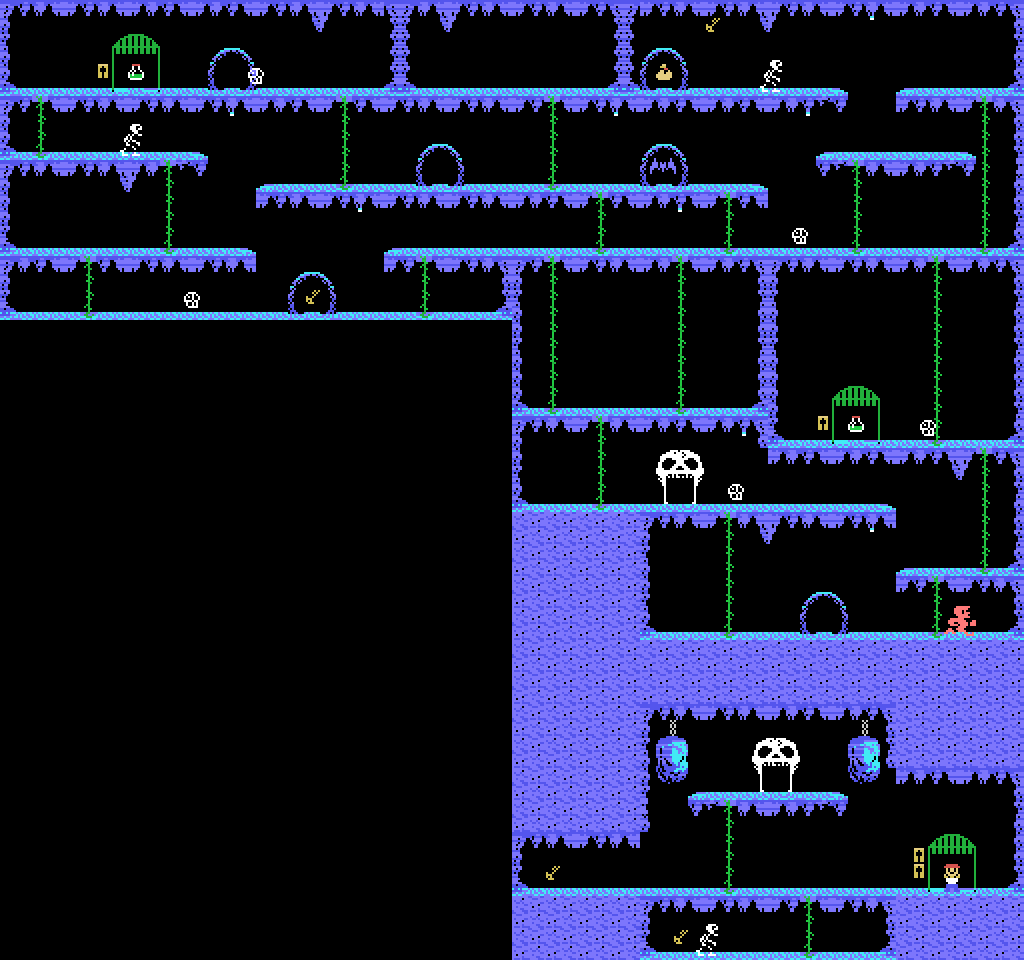
All twenty-five maps in The map are redrawn with it.
The cartridge defends itself: copy protection
Two instructions in the start-up write inside the cartridge itself:
- 0x4022 puts a
pop hland aretover thedjnzat 0x411C. It loads0xC9E1into HL and drops it in one go: in memory those two bytes areE1 C9, which read aspop hlandret. - 0x4050 leaves a zero at 0x4129, which is not data: it is the operand of
the
jpat 0x4128. In memory that turns it intojp 00000h, a dead reset.
Neither of them does anything here. The cartridge runs from ROM, and ROM takes no writes: that is why they look like dead code. They are not. A pirated cartridge is a copy loaded into RAM, and there the write does land and breaks the game. Doing nothing on the original is exactly the point.
This is no one-off idea in this cartridge: the same pair —a write over a djnz
and another over the operand of a jp— turns up in nine cartridges of this series, always in the same two start-up routines, and the second one alone in one more. Manuel Pazos identified
them in his disassembly of RC-727, where he named them ReadKeys_AC and
VRAM_writeAC.
All 64 skull doors pair up without a single exception
Also theNestruo, in the same issue: he asked for a minimap per round with the doors joined by lines. There was no way to draw one without knowing which door goes with which, and going after that is what turned this up.
Each skull door is three bytes, and out of the third 0x8DA8 takes two
things: the low six bits are the level it leads to and the top two the
ENTRANCE, which is the number of the door you come out of over there.
That turns the doors into checkable pairs: if door j of level A says (B, k), then door k of level B has to say (A, j). All 64 in the cartridge do, without one exception, and on top of that none leaves its round: the 25 levels are five closed groups of five.
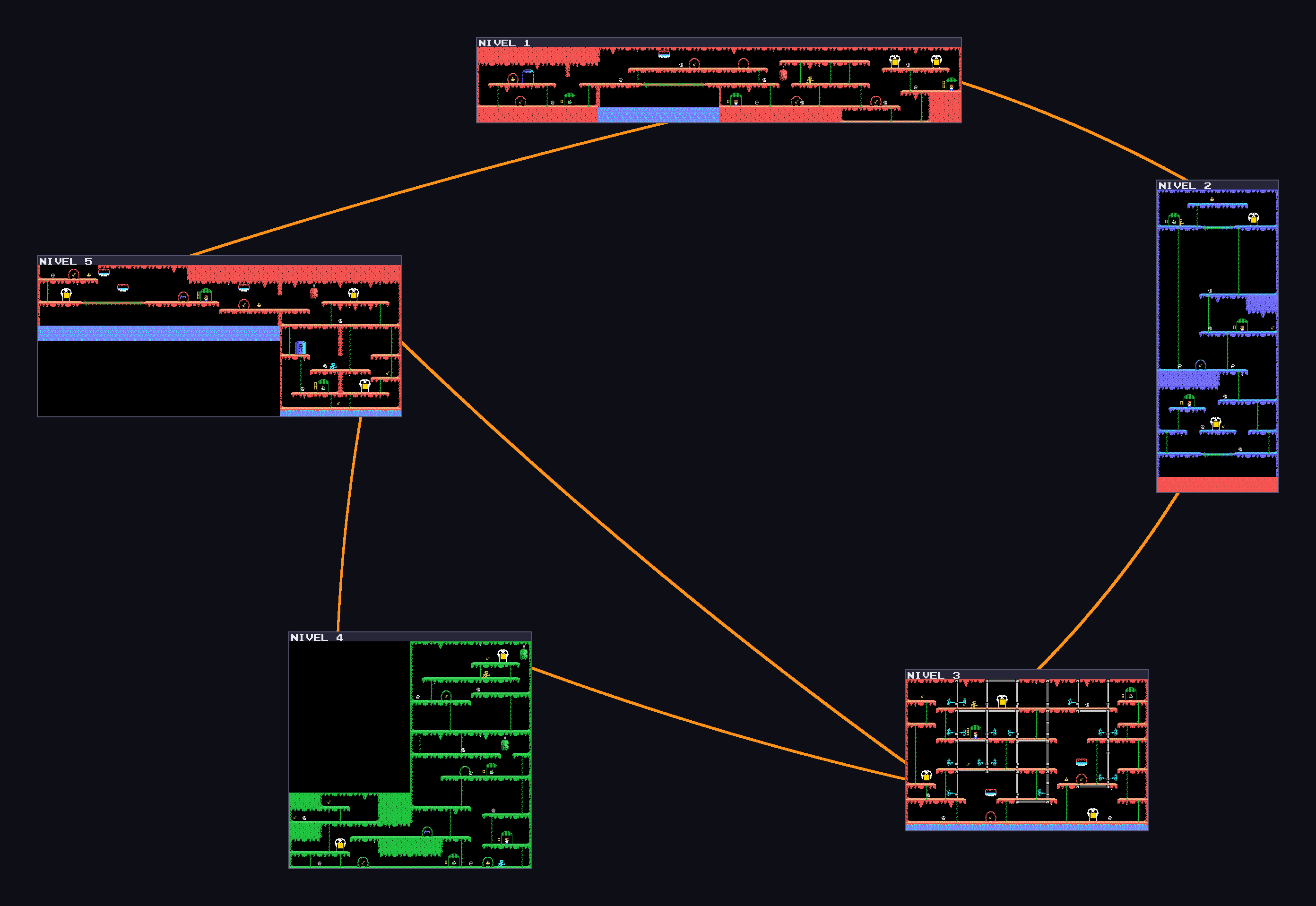
Every line on that minimap joins two doors that really pair up. There is one per round in The map.
The name of the round is its password
You can type on the title screen. 0x53C8 reads the keyboard with SNSMAT and
piles what you type into 0xE4C0 — up to sixteen letters, with the index in
(0xE074) — and on release it calls 0x5444, which matches those sixteen bytes
against five names, from 0x546E onwards and nineteen bytes apart.
If one matches, 0x5421 uses which it was as an index into the table at
0x543A:
| password | level | round |
|---|---|---|
| MR SLOTH | 6 | 2 |
| GOON DOCKS | 11 | 3 |
| DOUBLOON | 16 | 4 |
| ONE EYED WILLY | 21 | 5 |
| GOONIES | 1 | 1 |
And here is the detail: those very bytes are also the caption painted on
screen. Each of the five is a complete literal script — VRAM address, sixteen
tiles and the closing 0xFF — and the comparison enters two bytes further in,
skipping the address. There are not two tables: there is one.
That is why 0x53A7 shows you the password when you clear a round, under the
KEYWORD caption: it is showing you the name of the round you have just left.
The names for rounds 2 to 5 have their pointers at 0x53C0, indexed by
(0xE06C)-2. The fifth, ONE EYED WILLY, is the only one without a closing
0xFF, and that fits: it is the round you reach, never one that gets
announced.
Sixty-four thousand tiles in 2,983 bytes
A hundred rooms of 32x20, all of them different, in under three thousand bytes: twenty-one tiles per byte. It is taken apart in The code — 8x4 blocks, the mirror bit and the shared tails — and the result is on show in The 100 rooms.
The twenty-seven ways to uncover a hidden item
The longest table in the cartridge is the one at 0x6DBD: twenty-seven
entries. Each is a condition that uncovers one of the hidden items.
Hit the same spot twice in a row. Kick once to each side. Stand still for
0x60 frames. Keep both bars above 0x28. Kick the boulder, or the flame.
Nearly all of them lean on (0xE126) and (0xE127), which hold the player's
last two hits, kept up to date frame by frame by 0x8005.
And none is spare. Walking the lists of all twenty-five levels turns up twenty-seven hidden items with twenty-seven distinct indices, 0 to 26: each condition is used exactly once. Twenty-three levels carry one and two carry two, levels 5 and 16.
All twenty-seven, mind you, look exactly alike: a single tile, 0x91, blinking.
That is 0x6E14.
Items are shields with charges
The list at 0x7D9B is eight bytes, one per hazard, and it says which
inventory item stops each one — or 0xFF if none does. Carrying it, the hit
does not take energy: it spends one charge of (0xE150+item), and when they
run out 0x8B37 drops the item from the inventory.
The seven hazards and their bit, which 0x7A9E leaves in (ix+00Ah) — also
where the player's colour comes from:
| hazard | bit |
|---|---|
| water jet | 0x01 |
| stalactite | 0x02 |
| drip | 0x04 |
| flame | 0x08 |
| rising column | 0x10 |
| pipe leak | 0x20 |
| boulder | 0x40 |
The energy bar is sixteen bits — (0xE063) the fraction and (0xE064) what you
see — and it is drawn to one eighth of a tile.
There are twenty-three items, and the table at 0x5576 says which level each is
in: twenty-three distinct values between 0 and 24, and 5 and 14 are exactly
the ones missing. Levels 6 and 15 are the only two with no item.
The demo is a recorded game
0x51D5 simulates nobody: it plays back a tape. 0x472D starts by reading
the joystick and keyboard with 0x4742, but 0x5206 jumps in at 0x4730,
which is the very next byte, with a already loaded from a table. So the input
routine runs from halfway through and hands back whatever it was fed.
Two parallel tables, both indexed by (0xE00B): at 0x520E, 34 joystick
states and the closing 0xFF; at 0x5231, how many frames each lasts.
When (0xE00C) reaches the duration, on to the next. The 0xFF closes the
recording and clears (0xE066).
This is what makes it possible to check VRAM by booting the cartridge from cold: the intro, the title and the demo come up on their own, always the same, with no savestates and no breakpoints.
The chaser counts tiles to pick a rope
When the chaser wants to change height, 0x756D and 0x7577 walk its row
tile by tile in both directions, counting how many there are until they hit
0x41 — the foot of a rope — or 0x53 — the head — and it heads for the
shorter count.
And bit 0 of (ix+00Fh) decides which side is tried first, consumed by
rotating it on each query. That is why two identical chasers on the same row do
not both make for the same rope.
The green ropes are the same for everyone. 0x66E4 says so: the player climbs
0x41 pressing up and goes down 0x53 pressing down.
The water keeps a notebook of what it covers
The water jet runs down the room standing on tiles. So it can retract without
leaving holes, whenever it meets an occupied tile it writes down at 0xE1D0
the row and the three tiles that were there, and puts them back on the way
out. The map is never touched: the map is read-only.
The current, on the other hand, moves nothing. 0x854E rewrites three
patterns — tiles 0x6D, 0xCF and 0xF1 — across all three banks, swapping
two sixteen-byte batches with bit 2 of the frame counter. The water appears
to flow and not one tile on screen has changed.
Each record in those batches is four bytes of pattern and two of jump to the next tile. The third jump is read and then not used: that is why each batch takes sixteen bytes and not eighteen.
Half the artwork is manufactured at boot
Of the 42 16x16 sprite patterns the cartridge carries (0x927F), 22 are not
drawn: 0x4CDF manufactures them by mirroring the others. Same with tiles: 34
are made by reversing the eight bits of another 34.
Mirroring a 16x16 sprite is not just flipping bits: you have to swap its two
columns, because a 16x16 pattern is two columns of sixteen bytes laid one behind
the other. The cartridge does it by entering with the destination pointing at
the second half (0x1D50, not 0x1D40) and with the inc e / sub 020h dance
on the low byte of the address, at 0x46E6.
Getting that wrong gives you figures split down the middle, and the VRAM check says so plainly: with the fix, 0 bytes different out of the 2,048 of sprite patterns.
The table at 0x6996 confirms it too: the mirrored drawing is painted twelve
pixels to the left and the normal one four.
The geometry is upside down, and so is the RLE
The eight bytes at 0x4720 put colour low and patterns high, which is the
opposite of what nearly everyone does. It is in The
cartridge.
And the decompressor at 0x46A6 runs backwards from what it looks like too:
bit 7 set means literal and clear means run. It is decided by where the
djnz jumps back to.
The title screen and the ending are the same screen
0x558D builds a single scene, with nine characters walking, and both come out
of it: it only differs on (0xE06C)==6, that is after you finish the game. The
THE GOONIES lettering is painted on top of that scenery and is not erased
when you enter it, because between scenes the cartridge only clears the name
table.
A sprite is switched off with a 0xC0 in the row
At 0x6576, a sprite is removed by putting 0xC0 in its row byte, which is
the VDP convention. Not in the pattern byte — and 0xC0 is a perfectly valid
pattern number too. Checking the wrong byte eats good sprites: the player's
seventh pose came out with no body.
The caption says 1986
No outside catalogue entry needed: the title-screen caption, drawn from the ROM, reads © KONAMI 1986, with the 1985 Warner Bros. trademark notice below it. The film is from 1985; the cartridge, from 1986.
The house's hidden mark
It is covered in The cartridge. The finding is Manuel Pazos's, and this cartridge pins down a character that was still unconfirmed.
Open questions
All 32,768 bytes are explained and the listing reproduces the ROM byte for byte. What follows are not gaps in the disassembly: they are things the cartridge does whose why has not been measured.
The two levels with two hidden items
The twenty-seven conditions at 0x6DBD are all used, once each. Twenty-three
levels carry one hidden item and two carry two: 5 and 16. Why those two and
not others has not been measured.
Levels 6 and 15
The table at 0x5576 leaves exactly those two without an item, and that much is
measured. What is not measured is whether it is deliberate — one rest level per
round — or whether two items fell out of a plan for twenty-five.
The three empty voices
The last three entries in the voice table are 0xBFEE, which is where the
0xFF padding starts. They are empty voices, and it is not known whether they
are reserved room or the trace of three pieces that got dropped.
How much of it is actually played
All hundred rooms are drawn and none repeats, but how many of the hundred you actually walk through in a game has not been measured. The link between rooms goes through two 19x4 tables and depends on which side you leave by, so there may be rooms you can only reach from one direction.
The many-legged creature
It shows up in few levels and always alone. It is understood — it lies hidden in
an 8x8 box until it is stepped on, and item 0x13 stops it waking — but why it
is in those levels and not others has not been measured.
The second header
The Konami Game Master header is there, and so are its eleven pointer bytes. This cartridge never reads them. Exactly what each of those eleven bytes is could not be settled without the cheat cartridge to hand: the layout of that space changes from one game to the next.
The hidden mark's characters
Of the house's katakana code, indices 0 to 44 are confirmed — the gojūon in order — plus five more: 51, 53, 55, 56 and 58, which this cartridge closes. The rest remain unchecked, and will only be settled with more cartridges.