Under the hood
Getting started
This repository holds the commented disassembly of Konami's Circus Charlie for the MSX (RC-712, 1984). It does not hold the cartridge: the ROM image is not distributed.
What you need
pasmo— the assembler that rebuilds the ROMz80dasm— the disassembler that generates the listingpython3— the tools intools/make- Your own copy of the cartridge, in the root, named
circus.rom
It is exactly 16,384 bytes and its fingerprint is:
sha256 89e1badac10e65886590d55e735ed794e5ca3c41142e6637b3e7ac6b25d042c0
To check it:
make comprueba
Rebuilding all of it
| command | what it does | what it proves |
|---|---|---|
make listado |
traces the flow and generates src/circus.asm with the notes |
that the listing comes from the cartridge and src/circus.notes, not hand edits |
make verify |
reassembles with pasmo and compares |
that the listing IS the ROM, byte for byte |
make sanity |
splits the 16,384 bytes into code and data | that not one byte is left unassigned |
make test |
49 tests | that the numbers on this site are the listing's |
make imagenes |
draws everything in docs/imagenes/ from the ROM |
that the formats are read right |
make coteja_montaje / make coteja_arranque / make coteja_pista |
compare against openMSX dumps | zero bytes different |
All three comparisons need the emulator dumps first: tools/omsx_montaje.tcl
and tools/omsx_arranque.tcl (the ring one uses the same dumps as the start),
each with its usage line in the header. See
In the emulator.
The cartridge
16 KB in page 1 (0x4000-0x7FFF), an AB header with INIT at 0x407B and no
BASIC. The screen is SCREEN 2.
The RAM
The game's whole RAM is 1 KB: 0xE000-0xE3FF, cleared by INIT with the
ldir over itself. The stack sits at 0xE500.
| area | what is there |
|---|---|
0xE000 |
the current scene |
0xE003 |
the frame counter |
0xE005 |
the interrupt re-entry lock |
0xE052 |
the act type, 0 to 4 |
0xE0B0 |
the buffer for the 32 sprites, copied whole to 0x3B00 every frame |
0xE130 |
the player: position, position and pose |
0xE150 / 0xE170 / 0xE1B0 |
the moving objects, the pick-ups and the loose one |
0xE280 |
the second decompressor's buffer |
The BIOS
It uses seven routines: RDVDP, SETRD, SETWRT, WRTVDP, WRTPSG, RDPSG and SNSMAT.
And it reads two bytes of its table, (0x0006) and (0x0007), which are the
VDP ports.
The two menu screens
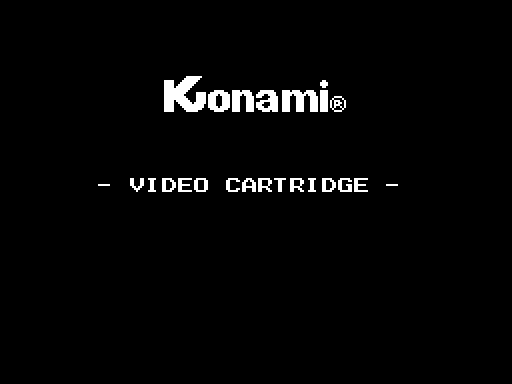
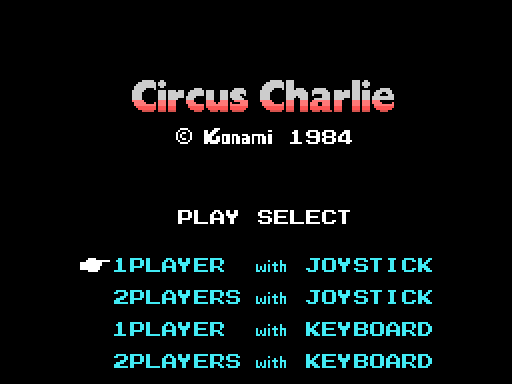
They are not the same one: the company screen (the KONAMI logo and "- VIDEO CARTRIDGE -") and the title screen. They share their scenery byte for byte; only the name table changes. Both are drawn from the ROM and checked down to zero bytes.
The code
The whole game lives inside the interrupt
INIT sets mode 1, hooks H.KEYI (0xFD9A) with a jp 0x402C, clears the RAM
and then sits forever on the jr $ at 0x40A9. Everything else happens in the
hook, once per frame: sound first, then the controls, then the scene. The lock
at 0xE005 counts overlapping interrupts: if a frame runs long, the next one
is served on the way out, without going back through the stack.
Tables sit right behind the call
despacha_por_tabla (0x404E) takes its own return address with pop hl,
and that is where the table starts. That is how the scenes are dispatched, and
the five set-ups (0x5FEF), the five starts (0x60B6) and the five frames
(0x4C93).
Three data machines
Rewritten in Python in tools/:
rle.py, the decompressor at0x45C9:0nnnnnnn brepeats and1nnnnnnn b…copies;0x80changes the destination and0x00ends. A second decompressor with the same language writes to RAM (0x6A51→0xE280), and a third one (0x7567) reads the bits backwards.guiones.py, the text-script interpreter at0x4062:[destination] [indices…],0xFEjumps and0xFFends. With the mask at0x00, the same script erases what it drew.escenas.py: decompresses into the buffer and copies it out through eight-bit masks, one bit per pattern, so it can repaint half the screen without touching the other half.0x4647mirrors the patterns and0x467Bmakes three copies shifted by 2, 4 and 6 pixels.
And the ring, from the tables
tools/pista.py is the game frame routine by routine: it starts from the
state left by 0x604C and each act's start-up (0x60B6), and every frame it
moves and draws what the game moves and draws. Against 43 openMSX dumps: 0
bytes different (make coteja_pista). tools/corre_circus.py, which runs
the cartridge on the Z80 in tools/z80run.py, stays as a second check (make
coteja_arranque), not as the source of the pictures.
In the emulator
With openMSX and the Philips_VG_8020 machine:
openmsx -machine Philips_VG_8020 -cart circus.rom -script tools/omsx_montaje.tcl
There are three scripts:
omsx_montaje.tcldumps the VRAM at0x4C3C, with the scenery just built. It forces the type at0x4C39before the first set-up, because forcing it later leaves remains of the previous act behind.omsx_arranque.tclcarries on and dumps VRAM and RAM at frames 1 to 200, with a breakpoint at0x4CA9, the sprite copy.omsx_cuadro.tcl, the burst of frames around a picture, becausescreenshotdoes not give the frame at the instant the VRAM was read.
The whole game happens in the hook at 0x402C: a breakpoint there stops once
per frame.
Code shared with other Konami cartridges
This disassembly has been compared, instruction by instruction, with
every other Konami one in the series. A block counts when the same
instructions, at least six of them from a label to its ret or its
unconditional jump, are in both cartridges; the addresses are left
aside, because they change from one cartridge to the next. Of the
other 57, 46 have at least one block in common with this one;
these are the ones that share the most:
| Cartridge | Blocks | Instructions | For example (here = there) |
|---|---|---|---|
| Magical Tree | 41 | 565 | atiende_el_menu (0x477D) |
| Comic Bakery | 27 | 392 | atiende_el_menu (0x477D) |
| Cabbage Patch Kids | 23 | 255 | lee_el_teclado (0x4758) = LEE_EL_TECLADO |
| Hyper Sports 1 | 21 | 276 | atiende_el_menu (0x477D) = MANEJADOR_DEMO |
| Konami’s Mahjong Dojo | 19 | 183 | limpia_la_pantalla (0x4558) = limpia_la_pantalla_entera |
| Super Cobra | 18 | 242 | mira_la_vida_extra (0x4416) = MIRA_VIDA_EXTRA |
| Athletic Land | 10 | 87 | copia_vram_a_vram (0x458F) = COPIA_VRAM_A_VRAM |
| Konami's Ping Pong | 8 | 102 | lee_el_teclado (0x4758) = lee_teclado_1 |
| Yie Ar Kung-Fu | 8 | 120 | lee_el_teclado (0x4758) |
| Konami’s Billiards | 7 | 67 | pinta_rotulo (0x4066) = pinta_lista_formato_a |
The whole matrix, the 58 cartridges against each other, is on The routines in the series database, along with the method and the program that measures it.