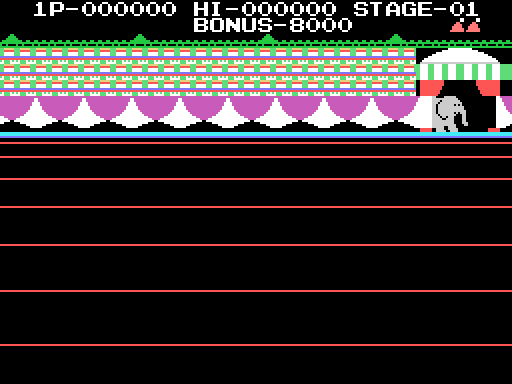
The game

Charlie the clown has to cross the ring in five circus acts. Each act is a stage type, the byte (0xE052), and the cartridge dispatches on it for everything that changes: the scenery, the start, the moving objects and the frame. The first act is the lion, measured by running the cartridge without forcing anything.
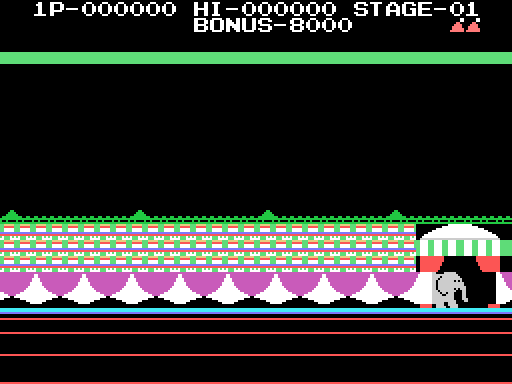
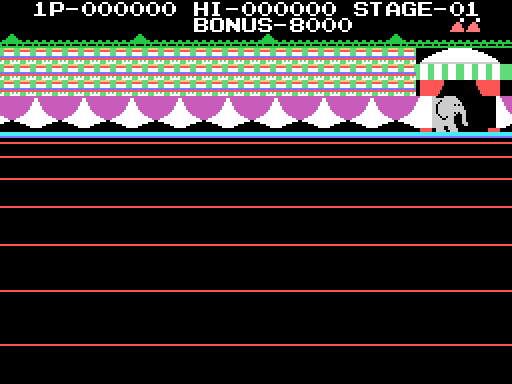
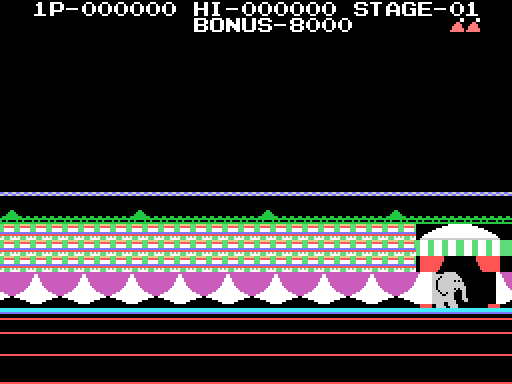
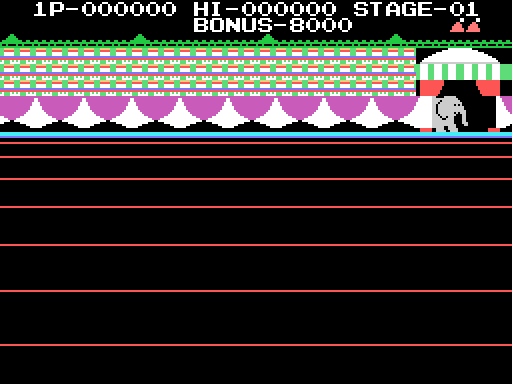
The five pictures below are neither captures nor the cartridge running: they are the game frame written in Python from the cartridge's tables (tools/pista.py), without touching the controls, at frame 100 (200 for the balls). Checked against openMSX at the same frames, they have zero bytes of RAM and VRAM different.
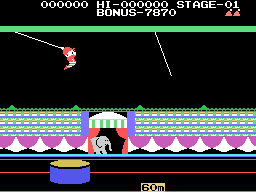
0 · The trapeze
Charlie jumps from one trapeze to the other, with the trampoline below. The two trapezes swing each to its own rhythm: four rhythm bytes set by hand at 0x6161 and a single duration table, 0x5F61, for both. It is the busiest frame in the cartridge: six calls at 0x4CC2.
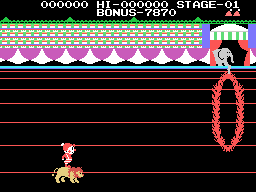
1 · The lion
Charlie rides the lion and jumps through the rings of fire. Charlie is four sprites, and here the same routine, 0x5087, adds three more for the lion; that is why this act's pose table (0x5116) spends seven bytes per pose and the others' four. The rings are four moving objects starting on row 0x48, and the ring is drawn with background tiles, not sprites.
2 · The tightrope
The monkeys come along the rope. The loose one lives at 0xE1B0 and comes in at (0xD0, 0x50).
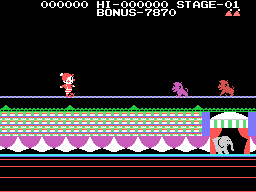
3 · The balls
Charlie balancing on a ball, with the others rolling towards him: they are the pick-ups at 0xE170.
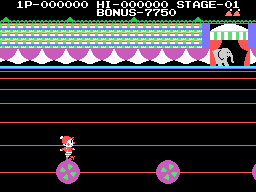
4 · The horse
Charlie on horseback, with what has to be jumped coming in through a script of its own (0x5C8E). The horse is three sprites, with a step that changes every four frames (0x50D8).
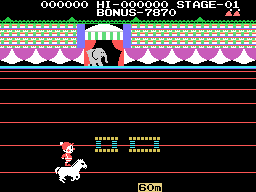
The BONUS
It starts at 8000, in BCD (0x42F8), and goes down every eight frames.
The five sceneries
As they stand when the set-up ends, before the game puts anyone in the ring. They come from the chain at 0x5FD6, rewritten in tools/graficos.py, and are checked against openMSX at 0x4C3C: zero bytes.