Under the hood
Getting started
This repository does not ship the cartridge. It ships the commented listing,
the tools that generate it and the checks that hold it up. With the ROM dump
next to it, everything is reproducible with make.
What you need
- Python 3, nothing installed on top.
- pasmo, to reassemble and check that the listing gives the ROM back.
- openMSX, only for the two measurements taken on the machine itself.
- The dump, under this name and with this sha256:
bomberman.rom
eab39bab547089facf9df3021e729b65fba2b263c505325d034ed1b6e3df8eea
8192 bytes
make comprueba verifies the sha before anything else.
The one command
make all
It chains four steps, and the order matters:
| step | what it does |
|---|---|
make listado |
traces the flow from INIT and generates src/bomberman.asm |
make verify |
reassembles with pasmo and compares the sha256 with the original |
make sanity |
checks that not one byte of the cartridge is left unexplained |
make test |
the 64 checks on the listing and on what it claims |
make verify is the one that decides whether the disassembly is trustworthy:
if the 8192 reassembled bytes do not give the same sha256, the listing is
lying somewhere.
The other commands
make densidad     # how many instructions carry a comment, routine by routine
make imagenes     # draws docs/imagenes from the ROM, capturing nothing
make cotejo       # boots openMSX, dumps its VRAM and subtracts ours from it
make alcance      # measures on the machine how far a blast breaks bricks
How it is laid out
src/bomberman.asm       the listing, generated
src/bomberman.notes     the comments, anchored to addresses
src/bomberman.entries   the entry points the tracer cannot work out
src/bomberman.nocode    the ranges that are NOT code, with the reason
tools/                  the tracer, the generator and the checks
tests/                  64 checks that do not need the cartridge
docs/                   this site, in both languages
The listing is not edited by hand. The comments live in
src/bomberman.notes, each one anchored to an address, and they survive a
re-trace: if the tracer changes its mind about where a routine starts, the
comments still land where they should. make listado glues them on.
Why there are three annotation files and not one
Because each answers a different question, and keeping them apart puts in writing what is known and how it is known:
.entriesare the addresses the tracer cannot reach on its own, each with its justification. This cartridge has eight: INIT, the three continuations of the inline sound tables, and the four pieces of code nobody calls..nocodeare the three stretches that look like code and are data, with the reason next to them..notesis everything else: labels, line comments, block headers and data ranges.
The cartridge
8 KB in page 1 (0x4000–0x5FFF), MSX1. It is the smallest cartridge in the
series, and the first Hudson Soft one.
The header is code
An MSX cartridge starts with AB, the INIT address, and then STATEMENT,
DEVICE, TEXT and six reserved bytes. Here INIT is 0x4004, which is exactly
where those fields should begin. Read as instructions:
4000  41 42        "AB"
4002  04 40        INIT = 0x4004
4004  31 00 F0     ld sp,0F000h
4007  CD D1 4F     call 4FD1h        the RAM's starting values
400A  CD 62 50     call 5062h        the VDP
400D  CD 4E 40     call 404Eh        the PSG, with its table right behind
Only the first four bytes of the cartridge are really a header. The other nine are the first four instructions, and there is not one byte left for STATEMENT, DEVICE or TEXT.
The memory map
| where | what |
|---|---|
0x4000–0x5FFF |
the cartridge |
0xE000–0xE2FF |
the screen, 768 bytes: what is seen |
0xE300–0xE389 |
the variables |
0xE38A–0xE689 |
the board, another 768 bytes: what stays |
0xF000 |
the stack |
The two RAM screens are what organises the whole game, and they are explained in The code.
The VDP
The eight registers come from the table at 0x5144 and monta_el_vdp
(0x5062) writes them out:
| register | value | what it says |
|---|---|---|
| R0 | 0x02 |
SCREEN 2 |
| R1 | 0xC2 |
16 KB, display on, 16×16 sprites |
| R2 | 0x06 |
name table at 0x1800 |
| R3 | 0x7F |
colour at 0x0000, three banks of 0x800 |
| R4 | 0x07 |
patterns at 0x2000, three banks |
| R5 | 0x38 |
sprite attributes at 0x1C00 |
| R6 | 0x07 |
sprite patterns at 0x3800 |
| R7 | 0xF0 |
white ink on transparent background |
The sprite registers are declared and never used. Right after writing
them, 0x507C puts a 0xD0 into the first attribute — the "no more sprites"
marker — and the cartridge never touches the list again. Everything that
moves in this game is a name-table tile.
No interrupt and no sync
monta_el_vdp puts a ret into H.TIMI (0xFD9F): the BIOS stops interfering
on every interrupt. And the game does not wait for the display sweep: the
pace is set by an empty loop of 0x500 turns at the end of cierra_el_cuadro
(0x46C8). The screen is dumped when it is due, not when the VDP is safe.
The three graphics blocks
The format used by carga_los_graficos_en_los_tres_tercios (0x5088) is:
2 bytes   destination in VRAM; the third is added to the high byte
1 byte    how many tiles, and ZERO means 256
n*8       the patterns, which LDIRVM dumps in one go
pairs     (colour, how many tiles) for FILVRM, closed by 0xFF
It is called three times with A = 0, 8 and 0x10, which added to the
destination's high byte give the three thirds of SCREEN 2.
| block | destination | tiles | what it brings |
|---|---|---|---|
0x514C |
0x0000 |
256 | the whole title screen |
0x5B26 |
0x0080 |
10 | the letters of SCORE and BONUS |
0x5B7C |
0x0100 |
64 | the digits, the monsters and the bomber |
The three tile without a gap: 0x514C ends at 0x5B26, which ends at
0x5B7C, which ends at 0x5E38. That is what proves the format is read
correctly: if the tile count or the colour-run count were off by one byte, the
next block would not start where it starts.
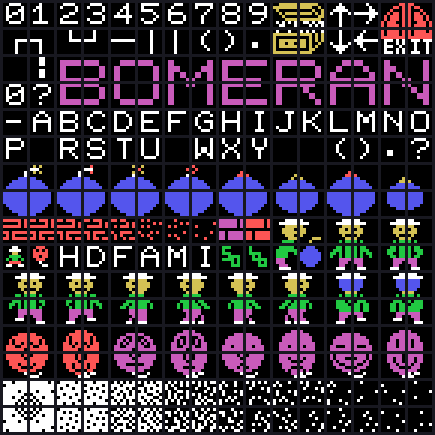
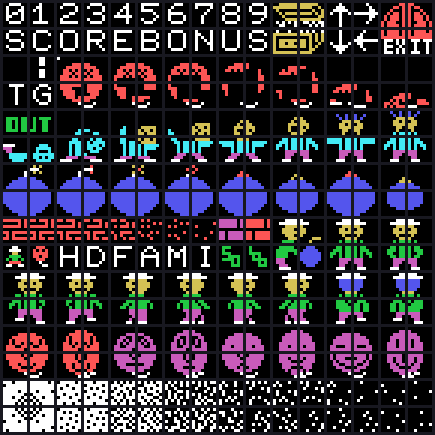
The font changes halfway through
The big block loads the title screen's 256 tiles. When the game starts,
0x4074 and 0x407A load the two small ones on top: where the title
screen has the big BOMBER MAN wordmark, the game puts the monsters.
Everything from tile 0x90 up is never overwritten, and that is where the
H, D, F, A, M and I needed by the bottom label come from. So the in-game
caption is written with tiles from three different blocks, and that is why
there is no way to read a text out of this cartridge without drawing it.
The sound
Two formats, both made of (register, value) pairs closed by 0xFF.
The short one is embedded right behind the call.
vuelca_la_tabla_del_psg (0x404E) starts with a pop hl: it does not pick
up a datum, it picks up the return address, which is where the table
starts because the table is glued behind the call. When it is done it does
push hl / ret and carries on executing after it. There are three such
places, and they are the three ranges in .nocode.
The long one is kept with one pointer per voice, at (0xE305) and
(0xE307), and sigue_los_dos_guiones_de_sonido (0x4025) advances it one
frame per turn. Here each 0xFF closes the frame, not the script: the script
ends with a double 0xFF. There are five: the door fanfare, the prize picked
up, the enemy blowing up, the bomber's death and the footstep.
The code
3,557 bytes of code and 4,635 of data, 200 routines, and one idea that explains everything: the game has no map data structure. It reads the tile number.
Two screens in RAM, not one
| where | what |
|---|---|
0xE000–0xE2FF |
the screen: what is seen. Every frame it is dumped whole to VRAM with an LDIRVM and left blank |
0xE38A–0xE689 |
the board: what stays. The bricks, the flames while they last, the prize and the door once uncovered |
Both have the same shape — 24 rows of 32 tiles — and the same cursor
arithmetic: pon_el_cursor (0x5128) gives the address in the screen and
pon_el_cursor_en_el_tablero (0x4F6F) the same tile in the board, by adding
0x38A.
That is where it comes from that the wall and the pillars cannot be broken:
they only exist in the screen, pinta_el_tablero (0x4DB7) repaints them
every frame, and they are not where the flames write. And the bricks only exist
in the board.
What each tile means
| tiles | what they are |
|---|---|
0x00–0x09 |
the digits |
0x0A, 0x0E |
the prize and the door, two by two |
0x10–0x19 |
the letters of SCORE and BONUS |
0x20 |
empty tile |
0x22–0x2F |
the enemy blowing up, seven frames |
0x60–0x7B |
the bomb: four sizes times two of blink |
0x80–0x87 |
the brick crumbling, eight frames |
0x88, 0x89 |
the border wall and the fixed pillar |
0x8A–0x8D |
the bomber standing |
0xA0–0xBF |
the bomber walking: four directions times two steps |
0xC0–0xCF |
the enemy alive, four frames |
0xE0–0xEF |
the flame |
And out of that come the three comparisons that repeat all over the listing:
cp 020h— "it is free"cp 0e0h— "there is a flame"cp 0c0h— "there is something that kills", which covers flames and monsters because they are laid out next to each other on purpose
The main loop is the game's index
bucle_principal (0x40CC): twenty calls in a row, one per system, in the
order in which they paint over one another.
cierra_el_cuadro                 the counters, the dump and the sound
copia_el_tablero_a_la_pantalla   the board on top of the screen
pinta_el_tablero                 the frame and the pillars
avanzan_las_bombas               the countdown
pinta_las_bombas_y_las_llamas
pon_una_bomba                    reads the trigger
avanza_el_bombero                walks, or dies
mueve_los_enemigos
pinta_el_premio / pinta_la_puerta
pinta_los_enemigos
descubre_el_premio / descubre_la_puerta
pinta_al_bombero                 on top of everything
saca_los_enemigos_de_castigo
pisa_la_puerta_o_el_premio
descuenta_el_bonus
pinta_el_marcador
pinta_el_aviso_de_bomba_automatica
And three exits, which are the three ways a life ends: dead (0xE37B), door
stepped on (0xE316) or stage cleared (0xE318).
The order is the logic. Each thing leaves its trace in the tiles for the next one to read, and that is why the bomber is painted before checking whether he has been killed: as he writes over the tile, he reads what was there.
There are two cut-down versions of the same loop: un_cuadro_sin_mando
(0x4231), without anything that attends to the player, and
un_cuadro_de_adorno (0x4253), without enemies. They are used in the
celebrations and at game over: everything is still seen moving, but you are no
longer in charge.
Everything is two by two
pinta_cuatro_casillas (0x4B7B) writes A, A+1 on top and A+0x10, A+0x11
below. The 0x1F in the middle is 32 minus the inc bc already done, and the
0x0F is 0x10 minus the inc a.
That is how the bomber, the monster, the bomb, the flame, the prize, the door, the brick and the pillar are painted: all of them. And the real board, in two-by-two cells, is 15 columns by 11 rows inside a 32-by-24 screen.
How a stage is sown
siembra_la_fase (0x4E35) keeps no map: it writes the bricks into the board
and there they stay. The only thing noted separately is where the first one
fell — hiding the prize — and where the last one fell — hiding the door —
because 0x4EB1 only saves the prize the first time and the door is noted
every time.
The rules of the draw, in order:
- two or more cells away from the bomber's spot
- of the two coordinates, one odd and one even. With both odd it would land on a pillar; with both even, on the cells the game always leaves clear
- none of the eight in the table at
0x4EDF, which are the neighbours of the four corners the enemies come out of
It does not check whether there is already a brick there, so two can land on the same cell and fewer than thirty-five come out. In the emulator dump there were 29.
The counter with a ceiling
It is how all the game's time is measured. avanza_un_contador (0x46BE)
takes a pointer to a (count, ceiling) pair: it adds one and on reaching the
ceiling goes back to zero. There are six pairs in a row from 0xE36F, and
anyone who wants to do something "now and then" checks whether their count is
zero.
| pair | ceiling | what it measures |
|---|---|---|
0xE36F |
4 | the bomber's step |
0xE371 |
4 | his death throes |
0xE373 |
7 | the enemy blowing up |
0xE375 |
5 | the enemies' step |
0xE377 |
3 | the bomb and the crumbling brick |
0xE379 |
50 | the bonus |
All six ceilings come from the starting-values table at 0x4FDD and are
never touched again. That is the speed of the whole game.
The two lists
Enemies at 0xE31C: eight seven-byte records, closed by the 0xFF at
0xE354.
+0  what it is doing: 0 free, 1 alive, 2..9 blowing up, 0xFF end of list
+1  column       +2  row
+3  drawing frame, counting 3, 2, 1, 0 and round again
+4  countdown to the next frame
+5  where it is heading: 0 left, 1 right, 2 up, 3 down
+6  unused
The +3 does two things at once: it picks the drawing and it decides the
behaviour. When it is zero the enemy goes after the bomber, and that is
precisely the red frame.
Bombs at 0xE359: five four-byte records.
+0  0 free, 1..4 the fuse, 5..12 the blast, 13 put it out
+1  column       +2  row       +3  count to the next frame
There is no other limit: the game has no "bombs remaining".
The blast, and the unrolled loop
pinta_la_explosion (0x4A8C) paints the centre without asking and walks the
four arms with the table at 0x4F8D: eight strips of four tiles, one per
side and per each of the two rows — or columns — it occupies. Four screen tiles
per side are two board cells.
The loop is unrolled on purpose, one copy per tile, because each stops on something different:
| tile | stops on | which routine it uses |
|---|---|---|
| 1st | the wall only | pinta_una_llama_y_gasta_el_ladrillo |
| 2nd | brick, wall or pillar | pinta_una_llama_y_gasta_el_ladrillo |
| 3rd | brick, wall or pillar | pinta_una_llama_sin_gastar |
| 4th | brick, wall or pillar | pinta_una_llama_sin_gastar |
The difference that matters: the first two wear the brick down — adding one to its drawing every three frames until it disappears — and the last two return without writing if what they find is a brick. Since the first two are the board cell right next to the bomb and the last two the one after, the result is that the blast reaches two cells but only breaks the bricks in the first.
It is measured on the machine, not deduced: In the emulator.
A register trick worth keeping
si_toca_gasta_el_ladrillo (0x4B4E) has to add one to A and has not one
register free. It solves it like this:
push af           A onto the stack
ex (sp),hl        and from the stack into H, which is where A now is
ld a,(0e377h)     the three-frame count
or a
jr nz,...
inc h             one more frame of crumbling
ex (sp),hl        H back onto the stack
pop af            and from there into A, already changed
The randomness
numero_al_azar (0x4EF9) feeds back (0xE384) with sixteen bits and mixes in
the Z80's R register. It returns the low byte.
That mixing is not a decoration: if R advanced by the same amount between two draws, the series of cells collapses into three to five values and repeats. A test in the repository checks it with four different steps. On the machine that does not happen, because between two draws a varying number of instructions runs depending on how many times the draw had to be repeated.
In the emulator
Three measurements, all of them on the machine and all reproducible with
make. No image in this repository comes from the emulator: the captures are
for checking, not for publishing.
Booting it
openmsx -machine Philips_VG_8020 -cart bomberman.rom
The VG-8020's BIOS takes more than five seconds to call INIT. Before that the cartridge has not even copied the starting values into RAM, and a dump taken at three seconds is worthless.
The VRAM comparison
make cotejo
It boots openMSX with no window, lets the title screen run, presses space
through the keyboard matrix (row 8, bit 0, which is what GTTRIG reads on
input 0) and dumps the VDP's 16 KB twice, plus 1,792 bytes of RAM. Then
tools/coteja_vram.py subtracts them from the VRAM that tools/vram.py
builds.
==================================================================
 LA PORTADA, contra el volcado de t=8
==================================================================
  color                         0 de  6144  ok
  patrones                      0 de  6144  ok
  tabla de nombres              0 de   768  ok
==================================================================
 LA PARTIDA, contra el volcado de t=18
==================================================================
  color                         0 de  6144  ok
  patrones                      0 de  6144  ok
  marco y pilares               0 de   184  ok
  ladrillos que rompen la regla      0 de    29  ok
  premio y puerta bajo ladrillo      0 de     2  ok
==================================================================
 0 diferencias en todo lo que no decide el azar.
Each line says something different:
- Colour and patterns come whole from the three graphics blocks, so they
have to be zero. If not, the format at
0x5088is misread. - The title screen's name table is deterministic too: the nineteen labels, the big wordmark and the sample row.
- The in-game screen cannot be compared tile by tile, because the deal is
left to the R register. What is checked is everything else: that the frame
and the thirty-five pillars are exactly where
0x4DB7puts them, that every brick on the board obeys the rules of0x4E35, and that the prize and the door are underneath one.
And a trap that cost a round trip. Comparing the VRAM's name table with the
RAM screen says nothing: vuelca_la_pantalla (0x510E) dumps it and leaves
it blank, so at any instant the RAM is half-built while the VRAM holds the
last complete frame. The frame and the pillars have to be looked at in the name
table.
The twenty differences that turned up on the title screen the first time were all explained, and two of them were findings:
- Six tiles of the score and six of the record, which the build was not writing.
- The monster's and the bomb's blink, which in VRAM is the one from the frame before the dump.
- The sample bomb in state 4 instead of 1, which is the chain reaction set off by untouched RAM. It is told in Findings.
Measuring the blast's reach
make alcance
The listing says the flame reaches two board cells per side but only wears down the bricks in the first. That can be read, but it can also be measured.
tools/omsx_alcance.tcl gets into a game, dumps the board, writes two bomb
records by hand into the list at 0xE359 — state 1, column, row and count
zero, which is exactly what pon_una_bomba leaves — and dumps the board again
eight seconds later.
The two cells were picked by reading the board from an earlier dump: emulation is deterministic, so the same timings give the same deal.
  ladrillos antes  : 29
  ladrillos despues: 27
  bomb A: brick 1 cell  to the right in ( 5, 0) -> FALLS
  bomb A: brick 1 cell  below         in ( 4, 1) -> FALLS
  bomb B: brick 2 cells to the left   in (11, 0) -> STILL STANDING
Checking the auto-bomb mode
make fase4
It forces the stage to 4 by writing (0xE310) and dumps the name table four
times in a row, to catch the bottom label in both halves of its blink. This
comes out:
a row 23: '#                           @:3#'
b row 23: '#                           @:3#'
c row 23: '#  BOMB AUTO SETTING STAGE  @:3#'
d row 23: '#  BOMB AUTO SETTING STAGE  @:3#'
On every other stage that row carries the signature ` BOMBERMAN HUDSONSOFT 1983` and does not blink.
Tricks for looking inside
Seeing the board, which is where the real map is:
debug read_block memory 0xE38A 768
Skipping stages, which is what make fase4 does:
debug write memory 0xE310 4
Seeing who is hunting: byte +3 of the first enemy record.
debug read memory 0xE31F
When it is zero, that monster is coming for you — and it turns red.
And the golden rule for any dump of this cartridge: the RAM screen
(0xE000) is always half-built. What has to be read is the VRAM name table
(0x1800), which holds the last complete frame.