Curiosities
Findings
The game checks Yie Ar Kung-Fu (RC-725) in the second slot
The heading of this section is theNestruo's, word for word: the old one was worse and he said so. And what follows - what the cartridge combination actually gives you - was measured because he asked: it was an open question in this repository. His recollection was that what came round more often was the soup, and it is not: it is a separate item. But the half that mattered - that the combination does something and this page never said what - was right.
The very first thing INIT does, before it even installs the interrupt hook, is
call 0xBF6C. There sits a slot scan: it walks the four primary slots from
0xFCC1, descends into subslots when bit 7 asks for it, switches page 1 of
each with ENASLT and takes two 16-byte sums, one from 0x5300 and one
from 0x6700.
It compares them against the two pairs written at 0xBFD9:
5A 47   Yie Ar Kung-Fu (RC-725), the easy build
23 70   Yie Ar Kung-Fu (RC-725), the hard build
It recognises the two builds separately. Running those same two sums over the other ROMs in this series matches none of them, so the identification is not a guess.
If it finds it, (0xE450) = 1. The only place in the game that reads that
flag is 0x74A3, and it also demands level 3 or later (0xE053), a
single player (bit 5 of 0xE002, tested at 0x732F) and phase 3.
And what it gives is now known. It shows up when both energy bars are
nearly empty -the player's below 9 and the rival's below 13, out of 0x24
full-: a 4x3 tile sign (0x7525, row 6 column 14) and a drink that comes
down, the sprite from the four bytes at 0x74F1.

Taking it jumps to 0x738C with B = 1: 0x10 rest frames and, when they run
out, 0x7356 puts the player's bar back to 0x24. The rival's is left
alone, and since (0xE266) is 1 nobody loses a life. Measured in openMSX: the
bars go from (0x08, 0x0C) to (0x24, 0x0C).
And it has nothing to do with the soup: they are two separate items in two
separate attributes -0xE250 for the soup, 0xE254 for the drink- and the
neighbour flag does not appear anywhere along the soup's path.
This is not the Game Master header: that is a cartridge reading a cheat
device. This is a game looking for another game. If Konami did it once it
may be in more places, and the trail is a very early call out of INIT that
touches 0xFCC1 and ENASLT.
The cartridge defends itself: copy protection
Two instructions in the start-up write inside the cartridge itself:
- 0x4028 puts a
pop hland aretover thedjnzat 0x410D. It loads0xC9E1into HL and drops it in one go: in memory those two bytes areE1 C9, which read aspop hlandret. - 0x4056 leaves a zero at 0x4119, which is not data: it is the operand of
the
jpat 0x4118. In memory that turns it intojp 00000h, a dead reset.
Neither of them does anything here. The cartridge runs from ROM, and ROM takes no writes: that is why they look like dead code. They are not. A pirated cartridge is a copy loaded into RAM, and there the write does land and breaks the game. Doing nothing on the original is exactly the point.
This is no one-off idea in this cartridge: the same pair —a write over a djnz
and another over the operand of a jp— turns up in nine cartridges of this series, always in the same two start-up routines, and the second one alone in one more. Manuel Pazos identified
them in his disassembly of RC-727, where he named them ReadKeys_AC and
VRAM_writeAC.
The soup: you must STRIKE a different spot in every round
Asked by theNestruo in
issue #1, where
he said from memory that it took a particular movement at a particular point,
different in each stage. That is exactly what it turned out to be, down to the
word "movement": what gets compared is the STRIKE box. This disassembly had the
table at 0x507A in front of it all along, with a note saying nobody knew what
it was for. Without his question it would still be sitting there.
The steaming bowl that makes you invulnerable for a while does not come out at random, and the spot is not the same in every round.

At the start of a round 0x5027 copies into 0xE300 the pair that belongs to
it from a table of eight at 0x507A, two bytes per round: row and
column. That table was already in the listing, with nobody knowing what it
was for.
round 1   (0x7E, 0x80)      round 5   (0x9E, 0x90)
round 2   (0x8E, 0xE0)      round 6   (0x68, 0x10)
round 3   (0x68, 0xD8)      round 7   (0x68, 0x80)
round 4   (0x8E, 0x03)      round 8   (0x8E, 0x80)
Then, one frame in two, 0x73FD asks whether the player is there. But it does
not look at where the figure is: it looks at 0xE12C, the fourth of the
four boxes built by 0x684A -the strike box, the very one 0x53B3 uses to
decide whether the player reaches the rival-. It has to fall inside an 11x11
window starting two beyond that pair.
And that fourth box does not exist in every frame:
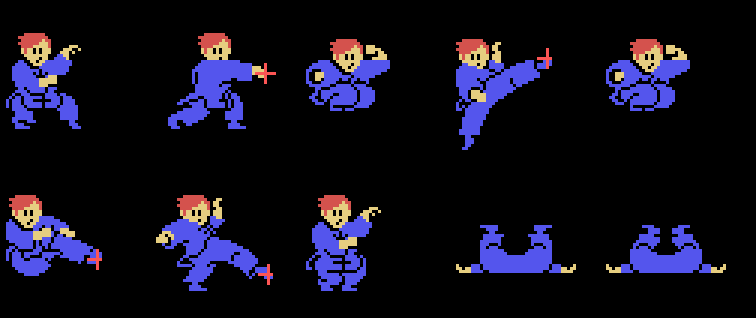
Of the ten drawings at 0x6C83 only 1, 3, 5 and 6 carry it, and those are the
four attacks. In the other six the script has 0x80, 0x684A leaves the
box at zero and the and a at 0x65C6 knocks it out. So standing on the spot
is not enough: you have to strike there.
On top of that, only in phase 3 of the round -0x733E demands
(0xE107) = 3, which is what the table at 0x508A gives for (0xE060) = 3-
and with a single player (0x732F).
What it gives. (0xE29E) = 0xA8, counting down by one every other frame:
six and a half seconds at 50 Hz. While it is not zero:
| where | what stops happening |
|---|---|
0x53F4 |
the player's blow does not count |
0x5588 |
the rival throws nothing |
0x566F |
whatever was already flying gets caught instead of hitting |
0x7734 |
the slots cannot be broken |
0x798C |
nothing touches the player |
0x6C1E |
and the figure blinks |
coge_el_premio also adds 5 to the hundreds byte of the score: 500 points. And
once per round only: when it runs out, 0x7496 sets (0xE261) = 1 and
scene 0 stops asking.
Checked in openMSX. During the demo (0xE300) = (0x7E, 0x80), the first
pair of the table. Moving the spot onto the player -without touching a byte of
the cartridge- makes the bowl drop, and touching it sets 0xE29E to 0xA8,
counting down to zero at 25 a second.
Along the way, the listing had two routines called mira_la_invulnerabilidad
and baja_la_invulnerabilidad that are not that: they read 0xE181, which
is the grab counter. That is why it drops four at a time while the fire
button is held: that is struggling free. They have been renamed.
Half the patterns and a mirror
0x597F builds the fight screen from forty scripts pointed at by forty pointers
spread over six contiguous tables, 0x592F to 0x597E. The mapping is exact
and the twenty pattern/colour pairs dump the same amount of VRAM, all twenty of
them.
Only half of the patterns are stored. 0x5A4D copies three stretches of the
pattern table onto themselves through vuelve_los_bits, so every tile of the
left-hand bands gets a twin with its eight bits reversed. That is why colour
is written twice and the pattern once — the mirror never touches colour — and
the arithmetic checks out on all three bands: 0x0560-0x0260 = 0x300 and the
other two 0x3C0, exactly the offset of each copy.
But the screen is not a mirror image. The name-table scripts at 0x5FFE use
the reversed twins where they want them and plain tiles elsewhere. Measured
pixel by pixel over rows 5 to 23, of the 304 cell pairs (x, 31-x) the ones
that differ are 119 in the backdrop of sceneries 1-2, 102 in 3-4, 40
in 5-6 and 128 in 7-8; the pairs that are true mirror images of each other,
not just solid tiles, are 25, 10, 54 and 14. Sceneries 7-8 use the reversed
tiles the least: 30 cells on the right half against 65 and 67 in 1-2 and 3-4.
Pointed out by theNestruo in issue #2.
Two figure readers that look alike and are not
0x67F5 and 0x67A7 read the same format except for the 0xE0..0xEF order,
and there they differ in both ways at once: the first repeats the byte that
follows and takes two bytes, the second writes zeros and takes one.
Mixing them up does not blow up: it gives a figure that almost fits and overruns by two or three bytes per figure. What proves which is which is that the thirty wave figures fit only the first and the rivals' blocks only the second.
The eight rivals
Each scenery has its own, and they hang off two tables of eight indexed the same
way: 0x6922 for the frames and 0x7FDB for the behaviour. Each block is 22
pointers closing at 44 bytes, and the 168 stretches between consecutive
entries close with no gap and no overlap — all 168 of them.
The odd frame is the even one facing the other way: the bit 0,a at
0x677C follows a two-byte pointer instead of reading a drawing, and the same
bit negates x at 0x686A.
The fighter is eight sprites, and half of him is computed
One LEE YOUNG frame is four HIT BOXES plus up to eight [y][x][pattern]
triples, hanging off the twenty pointers at 0x6C83 — ten drawings in the even
entries and ten two-byte redirections in the odd ones.
Facing one way the eight sprites use patterns 0 to 7, which 0x6BE6 uploads
to 0x1800 following up to fifteen scripts carried by the frame itself; facing
the other, the triples carry pattern numbers landing in the mirrored bank
that espeja_sprites (0x490C) left behind. One drawing, two directions, only
one half stored.
Those four leading entries have a sprite's shape -[y][x] and two more bytes-
and that is what makes them easy to mistake for one, but they are not: they land
in 0xE120, and the RAM sprite attribute table is 0xE080..0xE0FF, the 0x80
bytes that 0x500F parks with 0xE0 in the y. What reads them is the collision
code: se_tocan (0x654F) walks three four-byte boxes -twelve bytes, exactly
what the first three entries take- and adds the third byte to the first and the
fourth to the second to get both edges.
The sprite scripts start two bytes earlier than they look: the word that
reads like a tail belongs in front and is the VRAM destination guion_rle
(0x48E1) consumes. Corrected from 0xA490 to 0xA48E, and confirmed by a
second route — the 34 script pointers carried by the player's frames all land on
script starts computed independently.
A wave screen is four bytes
The strip at 0x5BE8 for that backdrop carries eight nibbles in four bytes;
each one picks one of the thirty figures at 0x5C64, and the eight are painted
in a row four columns apart. The first figure of each pair comes from the high
nibble and the second from the low one: the bit 0,b at 0x5B9F looks at B,
which counts down from 8, and with B even the four rra bring the high nibble
down.
Each figure is a vertical slice of landscape, four tiles wide and up to ten
tall — sky, hills, water, fence, grass — and eight slices side by side make the
screen. Their tiles are the fight screen's own bands: the twelve wave screens
dump the same patterns and colours as the fights, byte for byte, against
openMSX (tools/omsx_oleadas.tcl). Whether the three screens of a backdrop look
like one landscape sliding by depends on the backdrop: sceneries 7-8 do shift
eight columns to the right on each screen, 5-6 read a loop of six slices from a
different point, 3-4 and 1-2 just reorder theirs. Nothing scrolls within a
screen: it is built once (0x50D6) and wiped for the next one by
barre_la_pantalla_desde_la_fila_5 (0x50F6).
Rounds wrap at eight, and the strip has ten
0x44E4 fills 0xE2C0 with ten sceneries, 0 to 9 in order. But 0x430F
increments the round and 0x4311 compares it against 8, wrapping to zero. The
last two entries of the strip are never read.
The lives trick
0x43B8 keeps the first ten key presses since power-on and compares them
against the ten bytes at 0x43ED:
01 04 04 02 02 02 08 08 08 08
With the PSG bit layout that reads up once, left twice, down three times and
right four, a 1-2-3-4. If it matches, (0xE055) goes from 3 lives to 0x95.
Two players: the second pad drives the rival
The five bits of (0xE052) go straight into the table of 32 at 0x7DA2,
exactly the way the player's own go into 0x6990. With one player, 0x7E7E
makes them up.
The seven entries per scenery are distance bands, not states
0x6E1D subtracts the two x positions and sorts the result into seven bands
with six cuts — three fixed and three read from the strip at 0x6E5F. So each
scenery has its own reach, and what looked like a state machine is a
distance table.
One row higher than asked for
pon_la_figura_en_la_pantalla (0x66F1) steps down 32 tiles row - 1
times, because of the dec a at 0x66FB. A figure asked for at row 4 starts at
row 3, and row 0 is the exception because the jr z at 0x66F9 skips the loop.
It is not a curiosity: without it the title logo lands four rows too low and three columns too far left, and the VRAM comparison says so — 165 tiles wrong before, 0 after.
The hidden mark, and the second header
The last fifteen bytes, closing at 0xBFFF, carry RC-737 and the title in
katakana written backwards. It is the mark Manuel Pazos found in Konami's
cartridges, and this one has it.
There is also a second header at 0x4010, "AB" 07 37, for the Konami Game
Master in the other slot. The cartridge never reads it itself.
Code nobody calls
Five routines — 0x47B0, 0x4875, 0x488A, 0x544F and 0x6EB5 — are named
by no call, no jp and no table.
Two captions that were being read wrong
0x447Bsays LEE YOUNG, the fighter you control, and the eight at0x4497are the rivals' names. They had been read as one run of nine scripts, which added up in bytes —0x447B + 94 = 0x44D9— but the second half is not a script: it is the table of eight pointers plus the first name.0x572Ais not the pause caption: it says PERFECT 5000, and it is only painted when the round ends with the bar full (0x5328against0x24).
Open questions
The listing is complete: 32,768 bytes, none unexplained. That does not mean everything about the cartridge is known. What is not, is here.
What the first part actually gets you
CLOSED on 2026-09-09, at theNestruo's request. It is a drink that
refills the player's energy bar when both bars are nearly empty, and the sign at
0x7525 is its announcement. Measured in openMSX with (0xE450) = 1: the bars
go from (0x08, 0x0C) to (0x24, 0x0C). It is in the
findings.
Where the wave screens get their tiles
CLOSED on 2026-09-24, at theNestruo's request (issue #2). From the fight
screen's own bands: the twelve wave screens dump the same patterns and colours
as the fights, byte for byte, in openMSX (tools/omsx_oleadas.tcl). What was
wrong was the reader here — the nibbles backwards, and the curtain at 0x41D1
that wipes the title before a game starts was missing — not the cartridge. The
twelve are in the game.
Is any other Konami cartridge doing the same?
The slot scan at 0xBF6C is a game looking for another game, which is not
the Game Master mechanism. The obvious question is whether it appears anywhere
else in the RC-7xx range. The trail to follow is a very early call out of INIT
that touches 0xFCC1 and ENASLT.
Not checked across the rest of the series yet.
What decides which build of the first part matters
The scan tells the two builds of RC-725 apart, 5A 47 for the easy one and
23 70 for the hard one, and stores the same 1 in (0xE450) either way. So
the cartridge goes to the trouble of recognising two builds separately and then
does not distinguish them. Whether that is a leftover, a second table that was
never used, or something read elsewhere, is not known.
The two unread sceneries
0x44E4 fills the strip at 0xE2C0 with ten sceneries, 0 to 9, but the round
wraps at eight (0x4311). Entries 8 and 9 are never read. Whether that is a
leftover from a longer game or just a round number is not known.
The endings
Scene 6 (0x425E) handles the endings and 0x58F9 holds their captions, which
read as a congratulation. They have not been reached in play here, so what the
sequence looks like end to end is described from the code and not from having
seen it.