How the machine plays
What the computer is really doing while you stare at the map: where it sends its armies, how it fights, and why Gandalf and Aragorn keep vanishing on you.
Everything here was read in the disassembly, not played. Each section ends with the exact routines it came from, in case anyone wants to check.
The short answer
There is no plan. The machine does not know where you are, is not coming for you, defends nothing and never changes its mind. All it does is take an army, look up which road junction it is standing on and toss a coin to pick which of the two exits to follow. Then again. And again, for the whole game.
Everything else — the feeling of being surrounded, of them turning up exactly where you didn't want them, of a hero disappearing without warning — comes out of that coin and three or four very dumb rules.
One piece per turn, and back in the queue
The game keeps a list of 256 pieces: your characters, your armies and Sauron's, all mixed into the same list. Each time round the loop it moves exactly one, the next on the list, and hands over the turn. When it reaches the end it starts again at the first.
No unit moves "faster" for being important: they all get the same turn, and the machine does not choose which one to move. Whoever's turn it is, moves.
In the listing: MUEVE_LA_SIGUIENTE_UNIDAD (0x6719). The piece number lives inside the instruction itself and wraps round on overflow.
Middle Earth has roads, and these are they
When one of the machine's armies gets its turn and has already arrived where it was going, it needs a new destination. It does not choose one: the game ships a network of junctions, and each junction has exactly two places written down that you can go on to. The computer finds the junction it is standing on, tosses the coin and heads for the other one.
There are two separate networks. A large one of 64 junctions covering the whole map, and a small one of 15 that is the central corridor. And the small one is nothing but a slice of the large one, renumbered: its fifteen junctions are fifteen of the sixty-four, with the exits rewritten to point inside the short list.
Which network you get depends only on your number in the list: the armies in the last stretch use the small one, those in the stretch before it the large one, Sauron the large one and Saruman the small one. The named characters use neither, because you move those yourself.
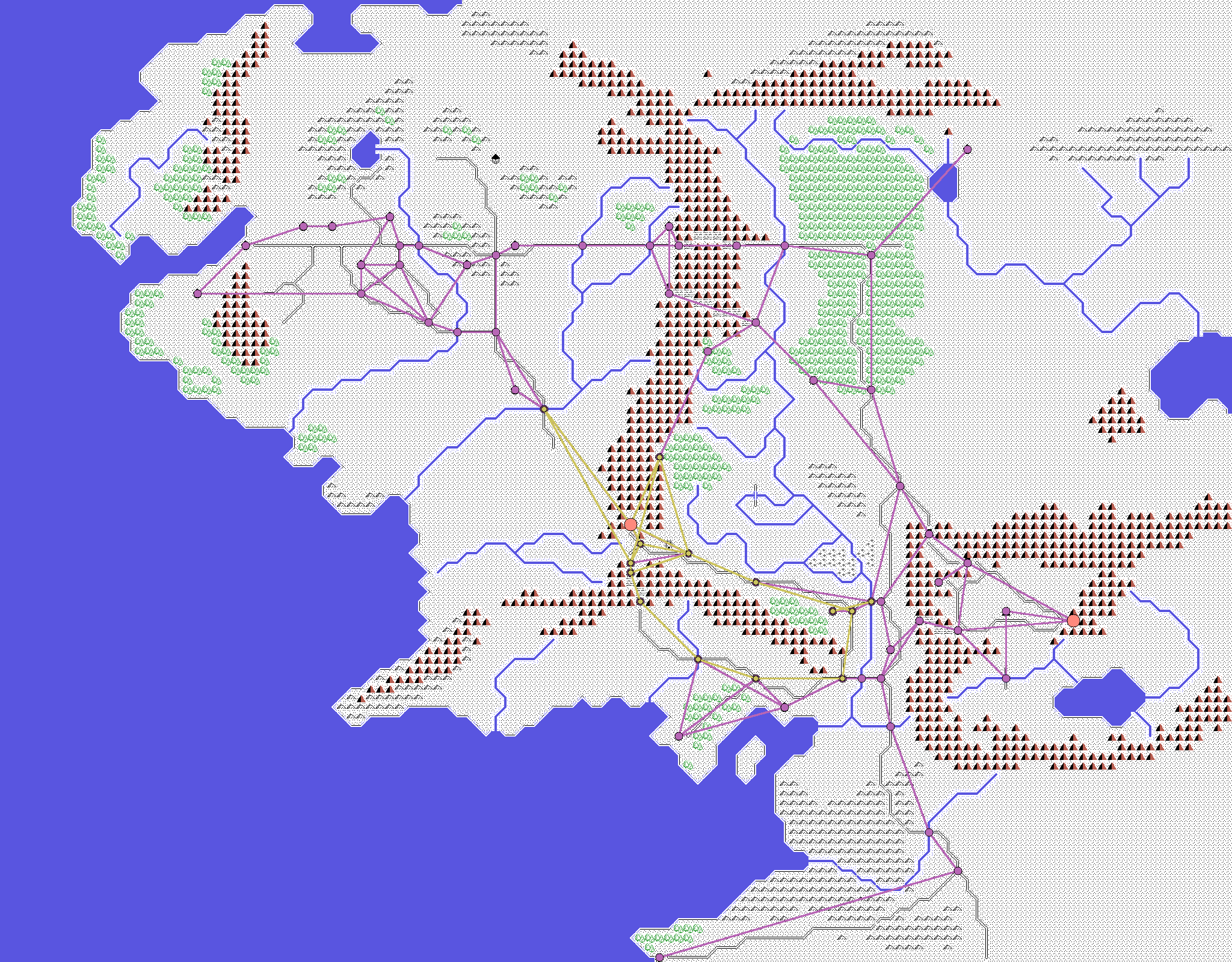
The junctions land right on top of the roads the game draws on its own map: not a coincidence, it is the same network. The straight lines in the picture are only "from this junction to the next one"; the actual path is improvised square by square by the unit.
One look at that picture explains something anyone who has played will have noticed: the dark armies always show up in the same places. They can only show up there.
In the listing:DESTINO_POR_LA_RED_GRANDE(0x69C1), with the 64-point table at 0x6BFB, andDESTINO_POR_LA_RED_CHICA(0x6993), with the 15 at 0x6CFB. Each point is four bytes: column, row and its two exits. The split, inREPARTE_POR_NUMERO(0x6A17).
A step that way, and a swerve
With the destination set, walking is simple: work out which way it lies and take a step that way… almost. Before taking the step the game pulls a random number and adds a swerve to the direction, so sometimes it comes out crooked. That is why the troops don't walk in straight lines and look like they are hesitating.
The swerve is not evenly spread. Out of every sixteen draws, ten go straight, four veer one way and only two the other: the machine leans harder to one side than the other.
If the terrain won't let it through, it tries twice more with another swerve, and failing that it starts working round the obstacle: it looks both ways to see which side gets out sooner and hugs that edge until it is clear. The code that carries on working round on later turns has a bug and always turns the same way, whether or not it pays.
And terrain matters per troop type: each class of unit carries its own little table of sixteen terrains with what each one costs. Two terrains are marked impassable for everyone, and others cost five times what a road costs. That cost is not just time: it is the number of turns the unit stands still before it can move again.
That table, incidentally, has ten entries and not sixteen. The troop types the tape actually uses run from 0 to 9, and the game's code begins right behind the tenth entry.
In the listing:DA_UN_PASO(0x67C5), the sixteen swerves at 0x6B23,TRES_INTENTOS(0x6809), and the detour inBUSCA_HUECO_GIRANDO(0x686E) andSIGUE_RODEANDO(0x68BD), with the bug at 0x68CA. The terrain entries, at 0x6D47.
Walking is tiring, and the tired stop dead
Every unit carries a number that drops each time it moves. When it falls below a floor, the unit stops wherever it is and rests until it recovers; only then does it walk again. Nobody decides that: it is automatic, and it happens to your armies exactly as it happens to Sauron's.
That same number later decides how much life its soldiers have in a battle. Troops that arrive worn out from walking fight worse. It is the closest thing to a tactical idea in the whole game, and it isn't even a decision: it is a subtraction.
In the listing: the counter is at 0xC200+n, decremented at 0x6752, and below 11 it jumps toSE_PLANTA(0x6951).DESCANSA(0x6945) takes it back up to 40.
The deployment isn't computed: it comes on the tape
You would expect the computer to lay out its armies when a game starts. It does nothing of the sort. The positions of all 256 pieces come recorded on the tape, as they are, and starting a new game only sets the clock going. Game one and game one hundred begin exactly the same.
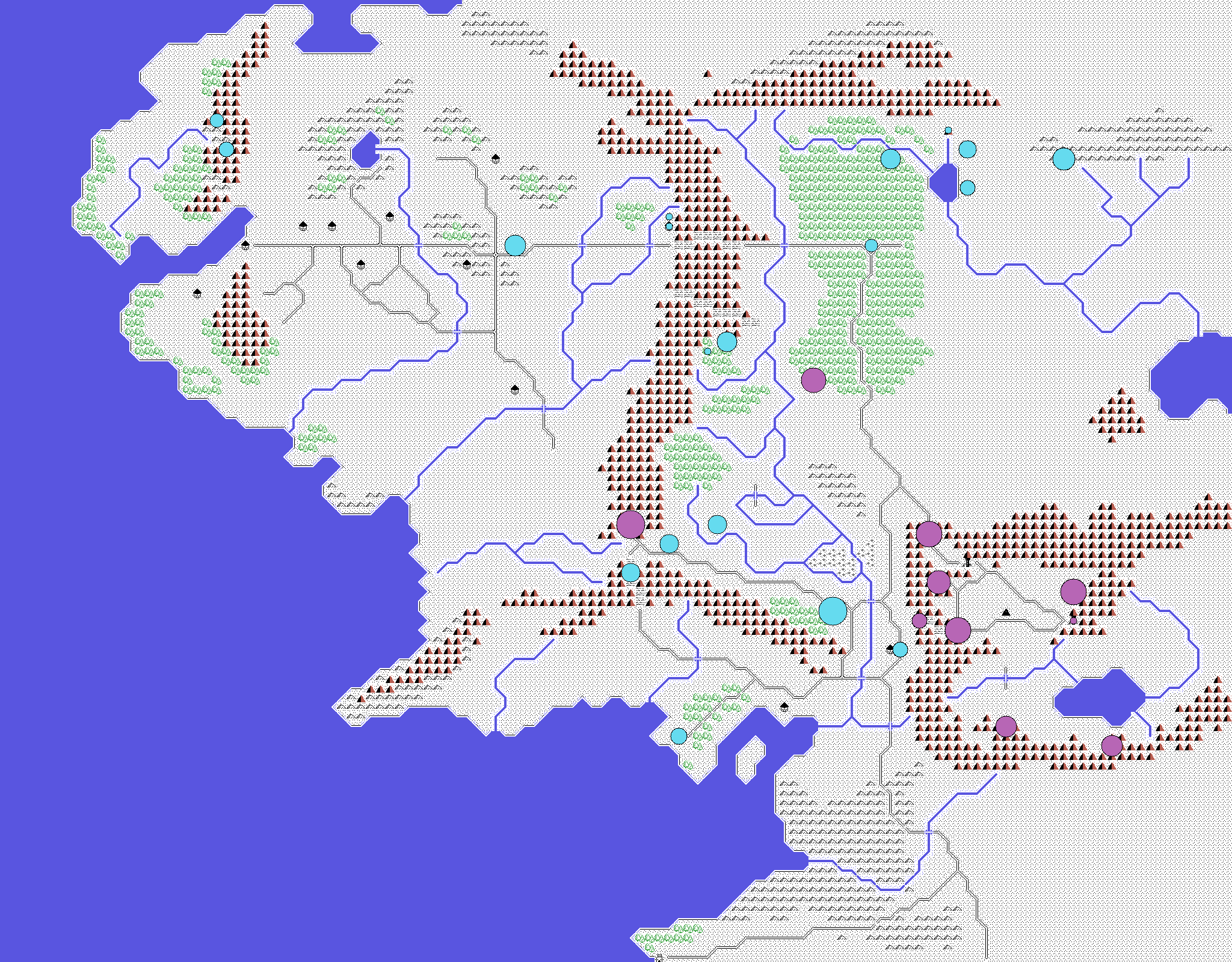
That is everything in the game, in its first second. The named characters start bunched into a single square. Sauron has more troops than you from the start, and has them in fewer, fatter piles.
Sauron, on top of that, never leaves his tower. In the full game measured on the emulator he did not take a single step; and there is a rule saying that if you do manage to destroy his army, he is put back on his square with full strength. He cannot be removed from there.
In the listing: the state strips 0xB900 (column), 0xBA00 (row), 0xBD00 (type) and 0xC500 (troops), which arrive inside the tape's high block.EMPIEZA_PARTIDA_NUEVA(0x7F43) only touches the 0xC600 state. Sauron's restoration, inPON_EL_EJERCITO_16_EN_SU_SITIO(0x922C).
Nobody decides to enter a battle
The battle is not chosen. Every time a piece — any piece — takes a step, the game counts who is on that square; if both sides are there, battle, and no questions asked. All it takes is an orc patrol walking over where you happened to be standing.
What happens then:
- The strength of each side on that square is added up. If they don't all fit on the board it is trimmed with a quota, and those left out sit the fight out.
- The board is laid out as a draughtboard: you only move diagonally, so pieces never change square colour. Fifteen obstacles are thrown at random across the middle.
- Each figure is dropped on a drawn square. The draw is loaded: one side comes out biased towards one edge and the other towards the opposite one, so the fight starts face to face without anyone having ordered it.
In the listing: REPARTE_LOS_QUE_ENTRAN (0x8F70) and the quota at 0x8FD1; the draughtboard and obstacles at 0x9070; the loaded draw, with the band table built at 0x908D and flipped for the second side at 0x90F7.
Every figure is on its own
There is no single command here either. Each figure, on its turn, does this: if something is already touching it, it fights; if not, it looks for the nearest enemy — but only within a distance drawn at that moment. If the draw comes out short, it sees nobody even with someone three squares away.
To walk towards its target it has two ways of picking the diagonal — check one coordinate first, or the other — and it tosses for which one to use. If the square it was heading for is taken, it tries another diagonal, also at random. And if that one is taken too, it stays put.
Turns go round a wheel of four: one pass resolves the blows, the next moves one side, and two of the wheel's four slots are empty and do nothing at all. Hence that odd, lurching rhythm the battle has.
A blow is a die against a number: if the roll comes in under what that figure hits for, it takes life off the other one. At zero it falls. A few troop types get back up as many as four times with full life before going down for good; the rest, never.
In the listing:MUEVE_LAS_UNIDADES(0x897D),BUSCA_A_QUIEN_PERSEGUIR(0x8A86) with the drawn distance at 0x8A8E, the two direction routines (0x8908 and 0x8925) with the toss at 0x89B4, the wheel of four at 0x9163 over the table at 0x94B7, and the blows inRESUELVE_LOS_COMBATES(0x8E95).
And a table the game looks for in the wrong place
Each troop type carries its terrain table, the same one that decides what it costs to walk anywhere. When a battle is set up, the game goes to that table for what this troop type suffers on this terrain, to take it off its figures' life: the idea, clearly, was that troops who move badly over a place should fight worse on it.
None of that happens, and for a bigger reason than a miscalculated sum: the routine is never even given the troop type. What reaches it is how much walk the unit has left — the very number walking spends — which it multiplies by eight and takes to the table. Since the result falls outside it in every direction, it ends up reading whatever is on that page of memory: sometimes a value from the table, sometimes the entry of the last unit that walked on the map, sometimes the road network, sometimes the code that begins right behind it.
We ran it through all 4,096 possible combinations, with the game loaded and the Z80 itself doing the work. A 3 comes back in two cases out of three — the table is full of threes — but ten other values come back too, and the "strength" being subtracted ends up anywhere from 8 to 200 depending on how tired the unit was. The terrain can barely affect it: of that whole number, it only reaches one bit.
The other two places in the game that read this same table do walk it properly, and one of them does exactly what was meant here. Something went astray.
So what anyone would take for granted — that some troops are tougher than others, and that the ground you fight on counts — does not happen. What decides how hard a figure is to put down is its unit's tiredness, twice over: once on purpose and once by accident.
The difficulty level is one single thing
The menu offers "6. Level", 1 to 15, and you would assume that decides how many troops Sauron brings, or how clever he is. It does not. When the game starts, that number is handed out only to the units of one type: the orcs, and the only thing it changes is how often they hit.
The thing is, orcs are nearly all of Sauron's army — 132 units out of his 138, and 2,223 of his 2,235 figures — so the difference tells. And it tells a lot, because the number is multiplied by itself before being used:
| level | an orc hits |
|---|---|
| 1 | 0.4% of blows |
| 5 | 9.8% |
| 10 | 39.1% |
| 15 | 87.9% |
At level 1 they can barely land one; at 15 they hardly miss. What each blow takes off, the figures' life, how many troops there are or how they move about the map: the level touches none of it. Nor does it touch the Ring.
In the listing: REPARTE_EL_NIVEL (0x5E8D) writes the level into the low nibble of 0xC100 for type-5 units. In battle, 0x8D29 multiplies it by itself into 0xE400, which is what the random byte at 0x8ED0 is thrown against.
Why Gandalf and Aragorn disappear
The old explanation — "they run out of army" — does not hold, and anyone who has played a lot is right not to swallow it. The named characters never have an army at all: the slot saying how many troops a piece carries reads zero for all twenty-four, from the moment the tape finishes loading. They travel alone.
And there is the problem. When a figure falls on the board, the game goes to take a soldier off the army it belonged to, but first checks whether any are left. It finds that zero, reads it as "nothing left" and wipes the piece off the map there and then. No wearing down, no warning, no second chance: the character disappears at the first blow that puts his figure down.
Two more things on top of that:
- You don't decide to enter the battle. If an enemy army steps onto the square your hero was on, in he goes.
- When the battle ends, the losing side is wiped off the map entirely. Everyone who went in, whether their figures fell or not. A character can disappear without anyone ever touching him, purely for being on the wrong square when his side loses.
The only thing telling them apart is how many times their figure gets back up before falling: Gandalf is one of the four-times ones and Aragorn gets up not at all. That is why Gandalf lasts half a game and Aragorn goes early, over and over. It isn't bad luck: it's his troop type.
In the listing: the zero read as exhausted, at 0x8F06, which jumps toEJERCITO_DESHECHO(0x8F0D) and on toBORRA_EL_EJERCITO_DEL_MAPA(0x8F1A). The wiping of the losing side, at 0x91B4 and 0x91CE, dealt out by 0x91DB. The four recoveries, inCUATRO_SI_ES_TIPO_0_1_O_7(0x8DC0).
The easiest way to lose, and it gives no warning
There is one square on the map the game watches every time round the loop: Minas Tirith. If no unit of yours is left standing on it and at least one of the enemy's is, the game ends right there. No battle, no message, nothing: the defeat screen.
And there is a catch. When you give an order on a square, it goes to every unit standing there, not to the one you had in mind. Minas Tirith starts with twenty-one: Denethor and twenty armies of Gondor. One order and the whole garrison marches out.
We have watched it happen in a real game. Ninety seconds in, the player gave an order on that square and all twenty-one set off; ten seconds later Minas Tirith was empty. On day 49 of the first month a unit of Sauron's walked up, found the city undefended, and that was the end of the game: not one battle fought.
So the practical rule is short: never empty Minas Tirith. Leaving a single unit inside keeps this from firing.
In the listing:MIRA_QUIEN_ESTA_EN_LA_CASILLA_56_3F(0x92DE) and its jump to defeat at 0x9309. It has two callers, and the one that matters is 0x7F80, inside the game loop. That (0x56,0x3F) is Minas Tirith comes from the game's own table of places, at 0x7A5E. The order that moves the whole square isORDEN_PARA_TODOS(0x7280).
What the machine does not do
Having read the whole program, the list of what is not there is shorter to write than the list of what is:
- It never looks at where the player is. Nowhere in the code is that asked in order to decide a move.
- It never masses troops or sends them at a common objective: each army tosses its own coin at its own junction.
- It defends nothing, does not protect Sauron and does not cut roads.
- It does not learn or shift behaviour as the game goes: the clock exists only so that your time runs out.
- And in battle, no figure knows what its own side is doing.
What there is instead is a huge map, plenty of troops spread over it and a great many coin tosses a second. That is enough to make it feel like somebody is playing against you. And in a way it works better this way: a 1988 machine with a real plan would have been more predictable than this one, which has none.
The pictures on this page
They are not screenshots. The map is decompressed exactly as the game does it at boot and painted square by square repeating what its drawing engine does; the junctions of both networks and the starting positions are then marked on top, straight from the tape's data. tools/render_redes.py makes them, and if any of those ranges were mislabelled the result would be noise instead of Middle Earth.