The game
The Stone of Wisdom (賢者の石, Kenja no Ishi, "the stone of the sage") is a game of rooms seen from above. The hero goes through 58 rooms spread over four scenes, each with its own colour; in every scene there is a stone that gives him a title, and with it the next staircase leads to the next scene. At the end the sage is waiting. The rooms, in The rooms.
Every GIF on this site is the ROM running in openMSX (a Japanese MSX1 with C-BIOS, at 60 frames per second): on
every frame the VRAM, the RAM and the VDP registers are logged, and tools/vdp.py paints them. The game ones are
played by a pilot written for the purpose (tools/guiones/piloto.tcl), which reads the room from RAM and finds its
way to the staircases.
The intro and the title
Two CASIO come in from the sides and, from step 9, two more go down and up until they meet; at step 21, a short tune
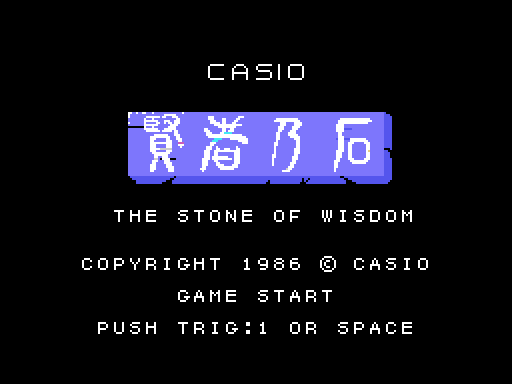
and SOFTWARE underneath (presentacion, 0x9013). On the title the name in kanji appears in twelve layers of colour,
one every 18 frames (titulo_capa, 0x810D); then CASIO, THE STONE OF WISDOM, the copyright, GAME START and PUSH
TRIG:1 OR SPACE. After 240 frames without touching anything the demo starts: scene 1 in room 8, with the controls
from a list (0x7F00, one byte every 16 frames), until the hero falls.



The password
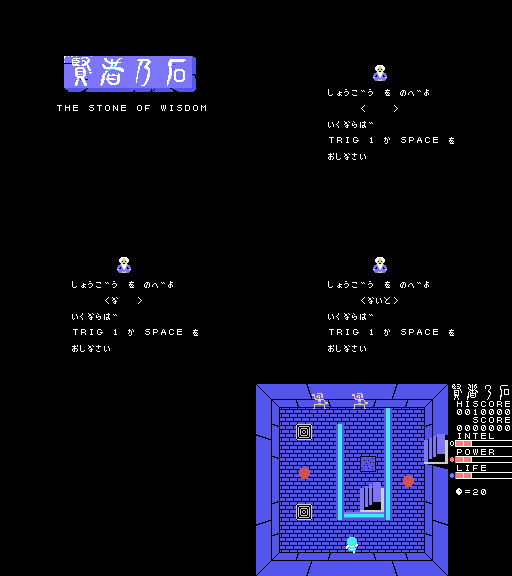
With the button, the game asks "しょうごう を のべよ" (state your title) and lets you type three letters, in kana or
Latin letters, from the keyboard buffer (contrasena, 0x81DE). With the button again, it compares what was typed
with the four passwords at 0x93EC, which are the four titles the game gives: けんし, ないと, たいし and おおい.
Without a password the game starts in scene 0 with INTEL, POWER and LIFE at 4 and no stones; with one, in another
scene and with more of everything (0x91B6):
| password | scene | room | stones | LIFE, POWER and INTEL |
|---|---|---|---|---|
| (none) | 0 | 0x00 | 0 | 4 |
| けんし | 0 | 0x00 | 10 | 8 |
| ないと | 1 | 0x11 | 20 | 16 |
| たいし | 2 | 0x21 | 30 | 24 |
| おおい | 3 | 0x2C | 40 | 32 |
In the GIF ないと is typed (the recording puts the codes of ナ, イ and ト in the buffer, as the BIOS leaves them when typing in katakana) and the game starts in scene 1, in blue.

The controls
| joystick | keyboard | |
|---|---|---|
| walk | joystick 1 | the cursors |
| throw the weapon | button 1 | the space bar |
| buy (in the shops) | button 2 | GRAPH |
| pause | STOP | |
| give up | F1 |
The weapon goes out in the direction the hero faces: four frames at 4 pixels and back one by one, like a
boomerang (ataque, 0x9580). While it flies the hero does not walk.
INTEL, POWER and LIFE
Three bars of seven cells (0 to 55, in eighths; barra_llena, 0x8A81). LIFE goes down with every blow from an
enemy or a trap; if it is at 0 and another blow comes, the hero falls. Some enemies and traps lower POWER and
INTEL. All three go up by beating enemies and opening chests: every three of these additions, one eighth more
(life_suma, 0x8AD2). POWER is needed to open some doors with blows (6 per scene) and to break the blocks (8);
INTEL, for others (48).
The stones
The stones (◆ on the scoreboard) are picked up in the rooms (50 points each) and in some chests, and are spent in the shops, where hieroglyphs that protect or help are bought (see The rooms).
The game starts
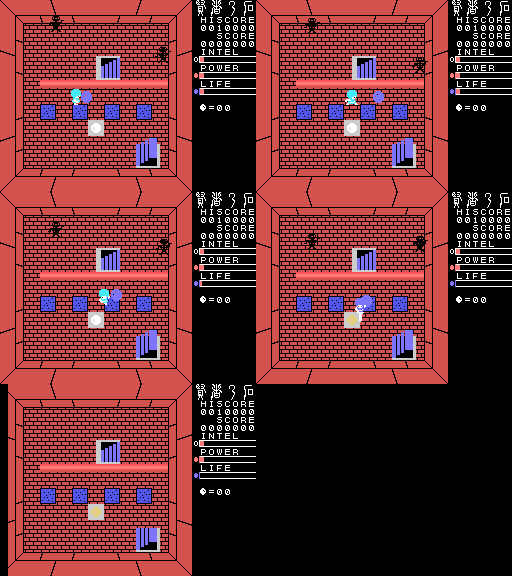
The hero starts at the bottom of room 0; the pilot goes to the staircase, which is stepped on from the side, and goes up to room 1. There are four traps there that take LIFE (the dotted blue tiles: two eighths of LIFE each time they are stepped on, if it is under 32) and, with only 4, he falls at once.

GAME OVER
If he falls in scene 1 or later, before GAME OVER the game tells the title earned: "もうやられてしまったのか / そちのしょうごうは < > だ / またくるがいい / さらば" (have you been beaten already? your title is < >; come again whenever you like; farewell). That title is the password to come back. In the GIF, F1 in scene 1: the title is けんし.
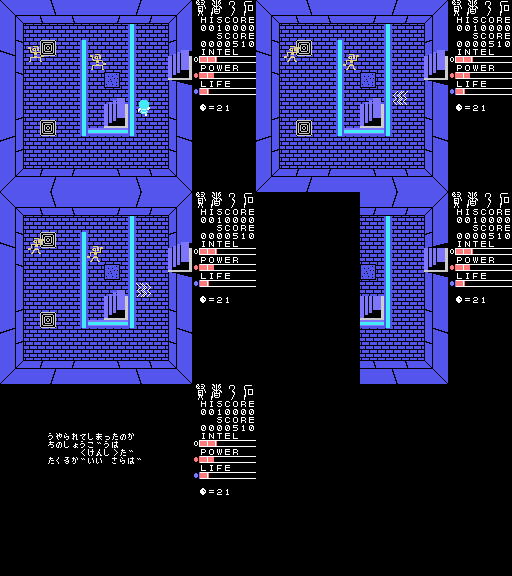
With ESC held during the intro, falling shows CONTINUE PUSH TRIG1 / END PUSH TRIG2: with button 1 the game goes on in the scene's entrance room with LIFE at 6 (see Curiosities).
The points
The scoreboard has a fixed 0 after its six digits: what the game adds, times 10 on screen. A stone gives 50; an enemy, 0 to 100 depending on its type; the stone of the scene, a thousand per scene (1,000 the first, 4,000 the fourth). The high score starts at 10,000.