The game
Road Fighter is a race seen from above. You drive a car down a road that scrolls towards you, dodging the others, keeping off the verge and not running out of fuel. Konami published it for the MSX in 1985 under catalogue number RC-730, and it is 16 KB.
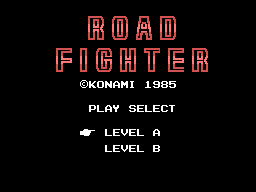
The cartridge builds the title screen step by step. The big wordmark slides in from both sides, which is why the word ROAD is stored backwards in the ROM, with its 0xFF in front: it is read back to front as it comes in.
Six stages, and then another lap
There are six stages. On clearing the sixth the counter at 0x4394 does not stop: it sets it back to one and bumps the lap counter at 0xE042, so the game starts over keeping track of how many times it has been completed.
Each stage has its own scenery, its own road and its own scenery script. There are only five sceneries for six stages: 4 and 5 share theirs, and what tells them apart is the tint given by the table at 0x6A69.
LEVEL A and LEVEL B
The title screen offers two levels, and it is not a difficulty multiplier. The level lives at (0xE03B) and gets involved in four separate places:
| where | what changes |
|---|---|
| 0x706D | whether the sideways push objects spawn with is doubled |
| 0x7374 | the fuel-burn step: 0x0180 against 0x01FF |
| 0x6F72 | the object spawn delay: seven or twelve |
| 0x7044 | removes an entire segment: 0x0A is swapped for 9 |
The start line
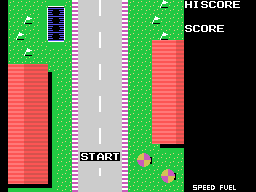
The start screen comes from no list and no map. The routine at 0x77C8 builds it by hand: first it fills the whole ring with grass using an lddr of 0x225 bytes, then it pastes eight patches one after another, each call inheriting the destination the previous one left behind. That is why sometimes only register E changes between one and the next.
The six roads
None of these pictures is a capture. They are drawn by running the cartridge's road engine in Python, routine by routine, and checked against openMSX: across the 264 steps compared -forty-four per stage- the entire 528-byte ring and every generator variable came out identical to the machine's.
They read from the bottom up, which is how they are driven: the starting line and the Konami sign sit at the foot of the strip, the goal at the very top. The engine emits rows in the order they appear over the top edge of the screen, so stacking them the other way round would leave everything taller than one row upside down -the fir trees in stage six, for one-.
Stage 1
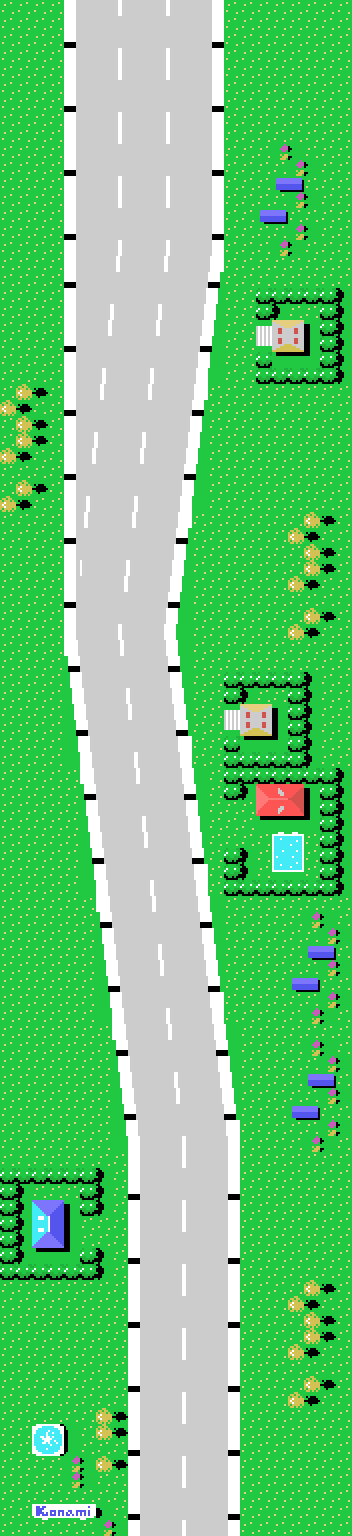
Houses with their hedges, the swimming pool, parked cars, the tennis courts and a Konami billboard near the top.
Stage 2
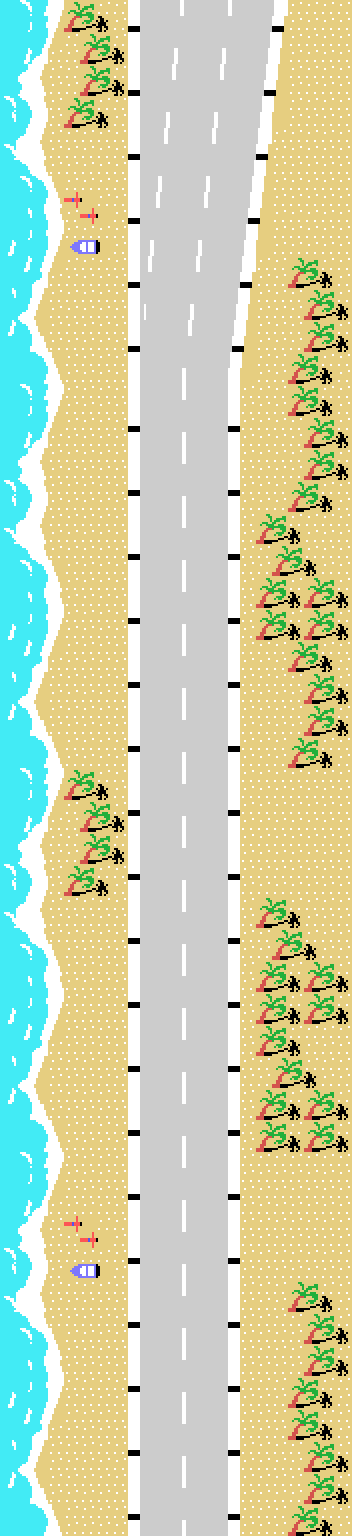
The beach. The four columns on the left come from this stage's own cyclic list, the one at 0x7DC5, walked four at a time and restarted on hitting an 0xFF.
Stage 3
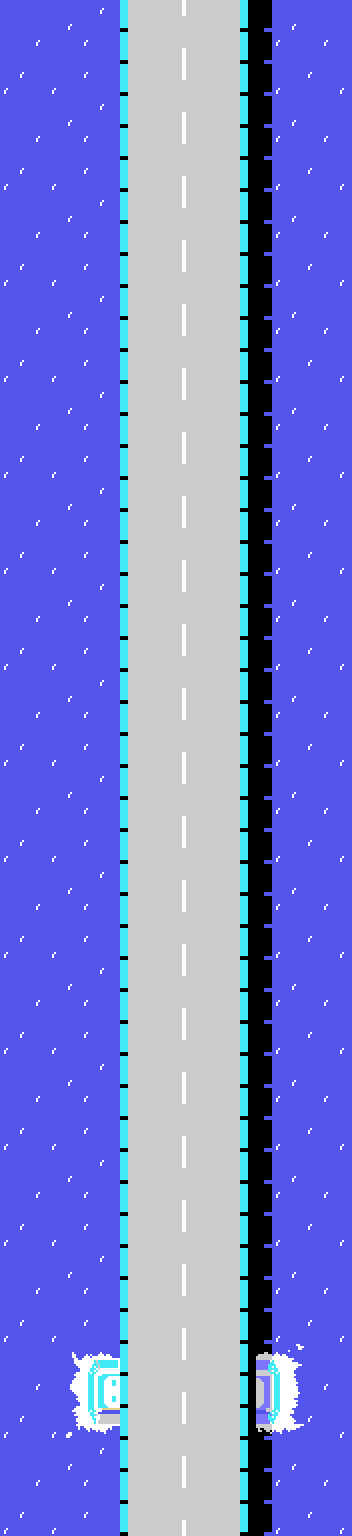
The only one that draws the whole row from a sixteen-bit word, and the only one with road tiles of its own: 0x9B and 0x04 instead of 0x80 and 0x0F.
Stage 4
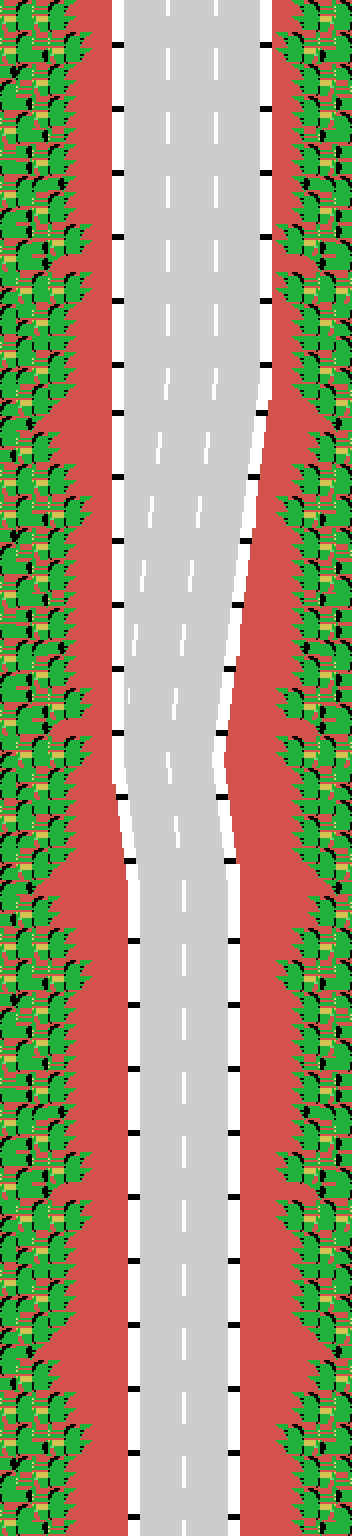
The S-bend. Only the seven columns on one side are stored; the ones on the other are computed by adding 0x0D to each tile.
Stage 5
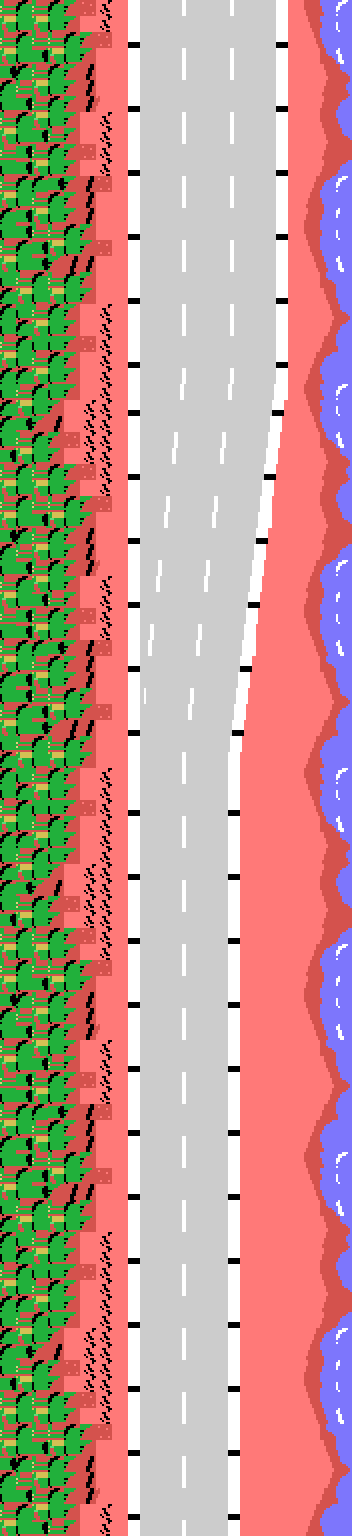
The one that tells the two builds apart: byte 0x53CB, the only difference between them, is the fifteenth segment of this row of the plan.
Stage 6
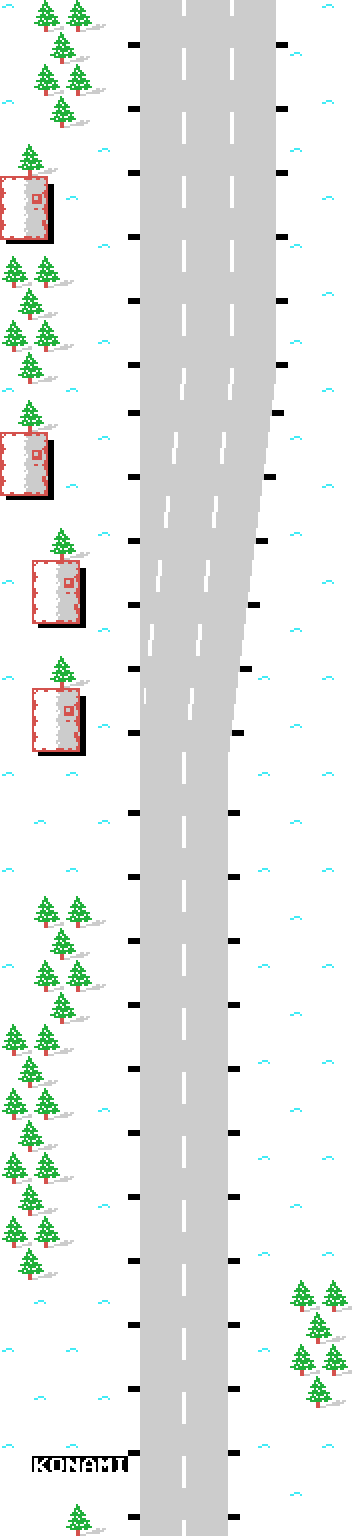
The last one. It is the only one that ends with GOAL instead of CHECK POINT, and it brings its own set of scripts, shared with none of the others.
The car
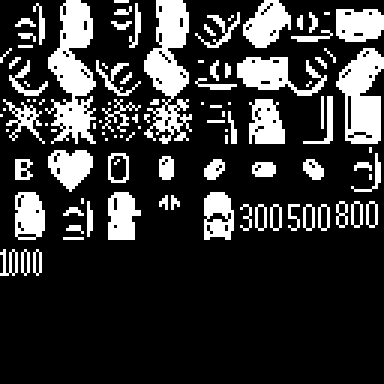
The car is two sprites in the same place: one with the bodywork and one, four patterns further along, with its colour. On the MSX1 a sprite carries a single colour, so overlaying two is the only way to give it two.
The sheet also holds the explosions, the flags and the score pop-ups that appear on overtaking: 300, 500, 800 and 1000.