Curiosities
Findings
Each one says where it comes from: the code, a ROM table or a test in openMSX.
The tests are in tools/pruebas/ and are told in
In the emulator.
Five in a row, not the whole pyramid
A stage is not cleared by finishing every cube but by having five finished
in a row in a row, column or diagonal of the 9 × 9 grid (0x7421). One
routine per frame, in turn, counts the rows (0x7330), the columns
(0x7353) and both diagonals (0x7369, 0x737D), and on each four-frame round
it counts one player's cubes: the mask of the and in the three-byte routine
the game writes at 0xE4FD switches from 0x40 to 0x20.
The fourth check decides: one line is enough up to stage 30, two are needed
from 31 to 40 and three from 41 to 50 (0x7391-0x73A6).
Tested in openMSX: with five cubes on row 4 of stage 1 marked as finished, the game moves to the stage-cleared step and pays the time.
The cubes roll
0x72C0 is 24 rows of four bytes: the rotation each of the 24 turns into when
jumped on in each of the four diagonals. They are the 24 rotations of a cube:
every column is a permutation, and any rotation is reachable from any other in
four jumps at most (measured walking the table; tests/test_juego.py
checks it).
A cube is finished when its three visible faces match the model's
(0x722F), so finishing one means planning the route of jumps.
Rock, paper, scissors
In the duel, if time runs out with equal cubes, or if both fall, JAN-KEN-PON is
played (0x89C6): LET'S PLAY JAN-KEN, each one picks with their joystick (down
paper, left scissors, up rock, 0x8B2B) and the next hand beats the previous
one: scissors beat paper, rock beats scissors, paper beats rock (0x8A89).
Without a press, each gets one at random.
The right-hand hands are the left-hand ones mirrored: 0x8C5F copies 45 tiles
from VRAM to VRAM reversing every byte.

The hidden life
0x9093 records the result of the last three jumps: 1 if it finished a cube,
0 if it rotated one without finishing it, 0x40 if it landed on one already
finished. With three ones in a row, fewer than 8 lives and one player, an
object appears once at Q*bert's height and crosses from left to right one pixel
per frame (0x8FDF), and touching it gives a life with the extra-life sound.
Tested in openMSX: with the streak set by hand, the object appears at Q*bert's Y, crosses, and the lives go from 2 to 3.

F5 and F1
In scene 7 row 7 of the keyboard is read: F5 sets the score to zero, three
lives and goes back to the same stage (0x4396). F1 pauses and unpauses,
but only while the stage tunes are playing (0x6AA3).
Tested in openMSX: the CONTINUE goes back to the game on stage 1 with two lives in reserve; the pause keeps the time still until the second F1.
The bonus stage
After stages 3, 6 and 10 of every ten (0x79AE, on the units of the stage
minus one) bit 0 of the mode turns on, the board at 0xA7AD is loaded and the
game runs another step (0x789D): the screen is uncovered top to bottom,
Q*bert stays on each cube and the diagonals rotate it (0x7A37); when it is
finished he moves on (0x7A47). At the end they are counted: every finished
cube is covered with its points, 100 the first, 200 the second… and with all
27 comes PERFECT 5000 POINT.
Tested in openMSX: after stage 3 the bonus stage starts. The PERFECT comes from the code.
Fifteen objects
Objects 4 to 18 each come out in their own time (0x7444: every 64 frames
their wait drops, and after coming out it goes back to 15) onto one of the two
top cubes. What each one does is dispatched by 0x7628: the green ball freezes
for 128 counts of four frames, the grey one makes everyone run away, the red
one gives the long jump, the yellow one and the turtle change the speed, the
blue one gives invincibility and the cube spinner gives 100 points. The eight
that kill are the moai, the hooded one and the six coloured ones, which stick to
cubes whose top face is their colour (0x750D). The hooded one heads for
Q*bert (0x7559), and if it lands on a spinning cube it falls and gives 1,000
points (0x6E99).
It comes from the code; the drawings, from the ROM.
The green ball writes into the BIOS
0x7763 is ld hl,000BCh and then 0x6E2F writes to (hl) and (hl-2):
0x00BC and 0x00BA are the BIOS ROM and nothing happens. The same code with
0xE2BC would remove object 23. It is a reasoned assumption: the high byte was
lost.
The pattern viewer, run
0x6757 puts the low byte of its address in every cell of the name table: 0,
1, 2… 255, three times. It is a development tool to see every loaded tile at
once, and it stayed in the ROM with nobody calling it.
Run in openMSX (tools/omsx_huerfanos.tcl, which diverts one frame to the
piece and comes back): over stage 1 and over the title. Built from the ROM and
checked: 0 differences in the tiles each screen builds. The rest are leftovers
from earlier screens.
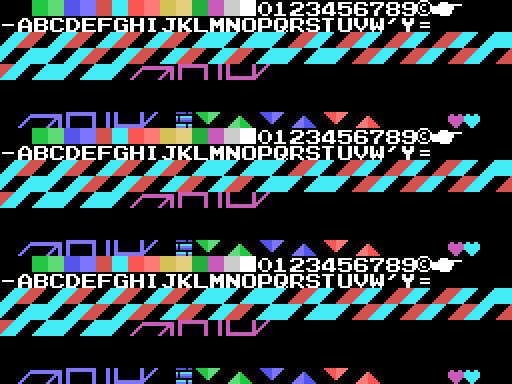
Konami's mark
The last ten bytes: the title in katakana backwards (キューバート), its length, the 0x46 of RC-746 and 0xAA. Nobody reads them.
Open questions
What comes from the code but has not been played, and what is not settled.
- Two and three lines. That two lines are needed from stage 31 and three
from 41 comes from
0x7391-0x73A6; it has not been played. - The whole duel. The sets, the collision between the two Q*berts
(
0x7646) and rock, paper, scissors come from the code; the PON! screen is built from the ROM but not checked. - The row at
0xE29C. The six coloured creatures that stay on a cube of their colour move into a row of five objects (19 to 23) and object 23 comes down with their colour (state 5,0x750D). What that row draws on screen has not been seen. - The green ball and
0x00BC. That theld hl,000BChat0x7763was meant to be0xE2BCis an assumption: the effect it would have has not been tested. - The PERFECT. The 27 bonus cubes and their 5,000 points come from the code.
- The sounds. The engine and the data are read in full, but there is no list of what each of the 93 is beyond what the code that asks for it says (0x11 the extra life, 0x17 the stage tune, 0x47 stage cleared, 0x53 GAME OVER, 0x56 the pause, 0x59 silence…).
0xE108. The Game Master header gives it as a second score; the game neither reads nor writes it outside the clearing at0x4475.