What turned up when the cartridge was taken apart, with the evidence next to it. What is not settled is in Open questions.
The 255 screens take up not one byte of map. The screen you are in is the content of one byte of RAM, 0xE222, and changing screen is stepping it once.
The step (0xB68F) is sixteen bytes of rla and xor (hl): a feedback shift
register, checked over all 256 possible values:
new bit = b7 xor b5 xor b4 xor b3 (mask 0xB8)
The ring is maximal: it visits the 255 non-zero values and returns to the start. 0x00 stays outside —a register like this never leaves zero— and the game uses it for the title screen.
0xB69F is the exact inverse function: it shifts the other way and undoes the step. Leaving to the left brings back the previous screen. The two routines together take 33 bytes, and they are the whole map of the game.
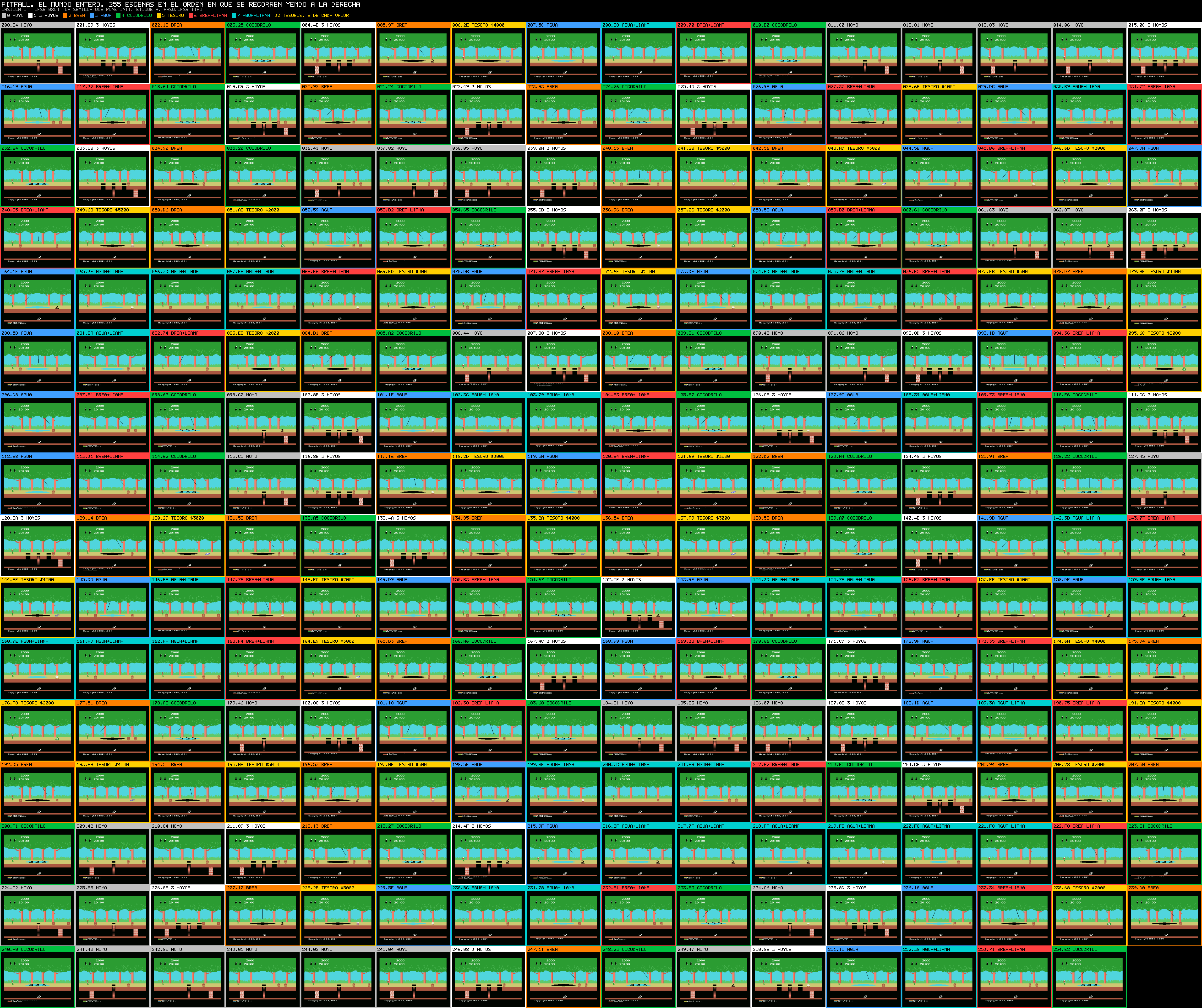
Seeding with 0xC4 (0x8075) gives the order of the world going right. That order was reproduced by two independent paths: simulating the two routines, and capturing all 255 scenes in the emulator. They agree 255 out of 255.
When a scene is built (0x9EE6) the byte splits in three:
| bits | what they choose | where they are read |
|---|---|---|
| 6-7 | which of the four sceneries is drawn | 0x9F91 |
| 3-5 | the kind of scene, 0 to 7 | 0x9EFB |
| 0-2 | the variant within that kind | 0x9EEF |
Bit 7 does a second job: it is read again on its own at 0xA9AA, in the pit scenes, to decide where the bounce box goes —class 10, centred at 0xD8 with the bit set and at 0x31 clear— and whether one pit or three are drawn. The ladder does not move: both branches draw the same script, 0x8F06.
The ring's share-out is counted without playing: 31 scenes of kind 0 and 32 of each of the other seven; 63 of scenery 0 and 64 of each of the other three. The off-by-ones are the missing 0x00.
The treasures are exactly the 32 scenes of kind 5: kind 5 is the only one dispatched through the table at 0xAEA4, that table holds four routines repeated two by two, and the eight variants share out four scenes each. One treasure of each class eight times: 8+8+8+8 = 32.
Each routine writes what its own is worth into 0xE188 —2, 3, 4 or 5, in thousands— and 0x878C adds it on pickup:
8 x (2000 + 3000 + 4000 + 5000) = 112000 points
With the 2000 the score starts at (0x8A28), 114000.
What has been taken is remembered in exactly 32 bits: 0xE21D-0xE220, one byte per class and one bit per treasure, with the index within the class at 0xE223.
The “already taken” check uses no branch: 0xAAFF rotates the bit into the carry
and, if it was set, does pop hl and ret (0xAB19): it eats its own return
address, and the code that would draw the treasure never runs.
On a screen change, 0x9CD2 checks bit 0 of 0xE2EB —surface or underground— and steps the register one place or three. Down there, three scenes at a time.
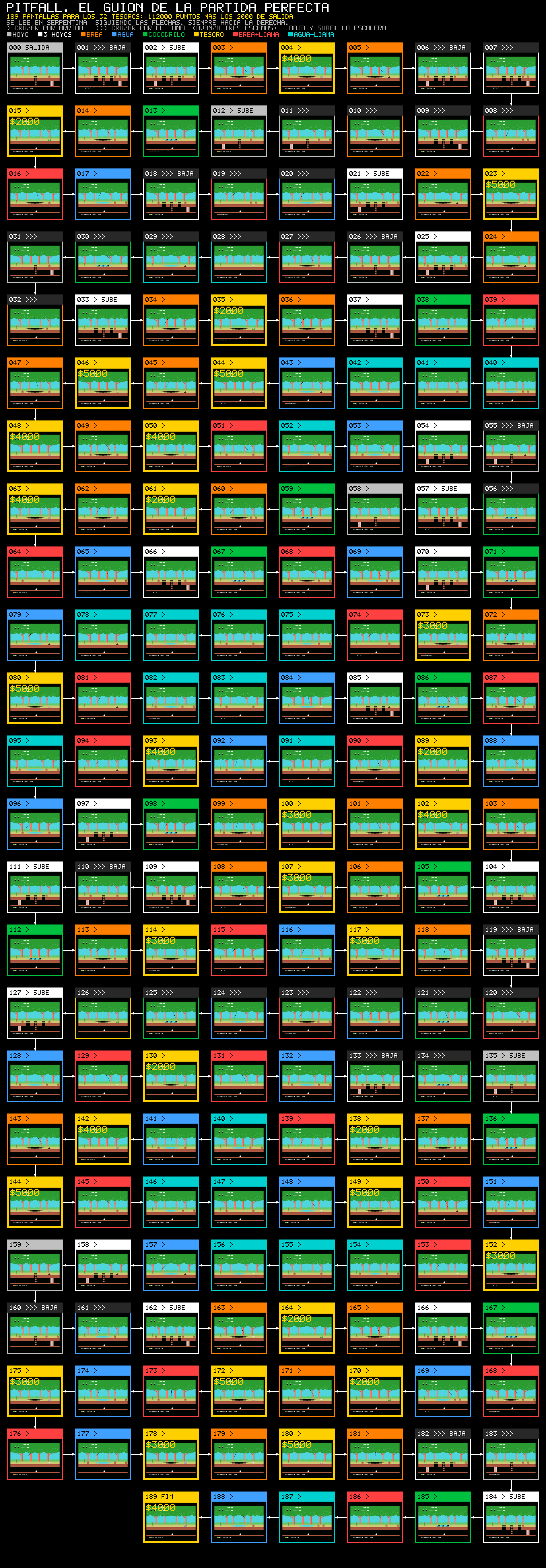
That can be measured: the shortest route that collects the 32 treasures is 189 screens crossed, against 238 never going down —21 % fewer—. And it does not all go one way: right until the first treasure, an about-turn, and the other 31 swept leftwards —13 crossings right and 176 left—. Always going right would cost 190.
The ladders were counted over the 255 captures of the walk, and the result is bimodal with no in-between case: a scene has either 3 vertical strokes —scenery— or 8 —a ladder—. Those with 8 are 63: exactly the scenes of kinds 0 and 1, the same thing the code says. Two independent methods, one number.
The whole ring is the map of the world, and the route, the script of the perfect game, one cell per screen crossed.
Not a string, not an alphabet, not a hidden message. The only font is twelve tiles: the ten digits (0xB8-0xC1), the colon (0xC2) and the blank (0xC3), just enough for the score and the clock.
Everything else that looks like text is drawing cut into consecutive tiles. That is why searching the ROM for strings returns nothing readable. The only signature is the line at the foot of the intro, drawing too: two dates, 1982 and 1984.
The vine you see on screen is drawn every frame, and it is drawn by code: what the cartridge does not carry is a graphic of it. On each step, 0xA471 plots a 16-point straight line onto a bitmap in RAM (0xE18A) and uploads it to video memory as a sprite pattern (0xA594). The slope comes from the table at 0xA61A, indexed by the phase of the swing (0xE1CB), which runs between 1 and 0x20. So the rope is a sprite the game builds for itself, sixteen points at a time.
Only half is drawn: the left-facing sprites are built at boot by mirroring the others (0x8B5E). There are two routines: 0xB1D1 reverses each byte bit by bit —the horizontal mirror— and 0xB20B also swaps the order of the eight bytes. And the sprite's two halves must be crossed too (0x8BC1), because a 16x16 sprite is two 16-byte halves.
The animation scripts square it: walking right uses patterns 0x20-0x30 and walking left 0x44-0x54. The difference, 0x24, is exactly the nine four-pattern sprites the mirror loop processes in one go.
Scene kinds 2 and 3 draw the same thing; the only change is that 0xAC7C writes
1B 1B 1B at position 0x200B of the colour table —black, tar— and 0xAC6B
writes 7B 7B 7B —cyan, water—.
The patch takes three bytes of its own (0xB110). The restore takes none: the
water's 7B 7B 7B is the same one already inside the initial colour table, at
0xB0FB, and 0xAC6B copies it from there.
The same trick in the treasures: the two bars —3000 and 4000— share their colour (0x4B at 0xAE90 and 0xAE92); the pattern tells them apart.
The hook does not end with a normal ret but with eleven pops in a row
(0x810F-0x8122) unstacking what the BIOS saved —alternate registers included—
with an in a,(099h) in the middle (0x811A) that acknowledges the interrupt.
The first pop hl takes the return address to the BIOS, and the ei / ret
at 0x8123 goes straight back to the interrupted program: the rest of the BIOS
interrupt routine never runs.
rst 0 that tries to overwrite the game's own codeAt the end of every frame, at 0x9AE0:
fin_del_cuadro:
    ld hl,fin_del_cuadro      ; 9ae0
    ld (hl),0c7h              ; 9ae3
0xC7 is rst 0, and the address written is that same line's: the frame ends by
trying to write over itself a jump to the machine's reset. On a cartridge it
does nothing, because 0x9AE0 is ROM. What it is for cannot be proven from the
binary; the reading that fits is a guard against running the game from RAM
—there the write does land, and the game kills itself on the first frame—, but
that is a reading, not a measurement.
The intro (0xB7F1) does not upload a picture: every frame it shifts the ten
patterns loaded at 0xE132 by one pixel and uploads them to the pattern
table; every eight frames it reloads the drawing and moves one column on, up to
0x18. Ones come in from the left —the background, the scf at 0xB86E— and from
column 12 a sprite appears and starts walking. Not one stored frame.
You do not leave the intro with a key: you leave when the demo's recorded script has spent seven entries (0xB751).
0xB6B2 sets the video chip's register 0 to 0x02 —graphics mode 2, three independent banks— for the entry banner; 0xB788 puts it back to 0x00, graphics mode 1.
Consequences: the game's colour table is 32 bytes, not 6144 —in the game's mode colour goes per group of eight tiles—, and registers 2, 5 and 6 —name table, sprite attributes and sprite patterns— are never written in the whole binary: the game uses the bases the BIOS left.
Knowing where a table ends is usually the worst of a disassembly: the size is written nowhere and getting it wrong raises no error.
Here almost everything bounds itself, because the data is packed with no gap: the five big blocks of compressed graphics (0x909E-0x95FE), the nine sprite blocks of the scene handlers (0x981E-0x99AF), the six of the intro (0xBAB2-0xBC61), the five cell scripts (0x8F06-0x9090) and the four layouts (0xA096-0xA33E) each end exactly where the next begins. Try N entries and only one N closes.
The floor strips of rows 12 and 13: the layout carries five bytes, and each
byte is at once offset into the table, copy length and video memory advance
(0x8DA7). Each strip copies from tabla+N to tabla+2N.
A side effect that bounds the data: the Ns used by the four layouts are 3, 4,
5, 6, 7, 8 and 0x0A, so usage reaches exactly tabla+0x14.
The pit (0xA870) keeps its width at 0xE133, 1 to 8, and its direction at 0xE132; the class 3 box stretches with it. The cycle is not symmetrical: 0x96 frames with the pit narrow (0xA913) against 0x44 fully open (0xA952) —shut more than twice as long—.
Things that are there and go unused. None is a guess: all were checked by sweeping the cartridge's 16384 words for their address.
rets (0x9CBD, 0xAA73, 0xACB4, 0xADE7, 0xAE37, 0xB6B0): one
0xC9 byte stuck after the end of a routine, pointed to by nothing. Four sit
after a jp that takes control away; two, after another ret.Every byte of the cartridge is accounted for, the listing gives back the original byte for byte and its 337 labels have names. That does not mean they all say what they do: 78 carry their explanation in the label itself and the rest lean on the 988 line comments and the 50 block headers. This page says what those figures mean and what remains unknown.
The only two ways out of a game are running out of lives (0x8975) and running out of clock (0x9DEA), and both end in the same place: the ending sequence at 0x9E0E.
Whether collecting the 32 treasures does anything is neither proven nor ruled out. What has been searched for and is not there: in the traced code there is no comparison against 32 that has anything to do with treasures —the only one compares the vine's swing phase, 0xA5F0— and, apart from the 32 bits of taken treasures (0xE21D-0xE220), there is no counter of how many you carry.
The number comes from walking the ring of 255 scenes with the cartridge's own screen-change rules, counting the underground shortcut. It measures screens crossed and nothing else: jumping, waiting for a log and using ladders are counted as free.
It fits the clock, and that count also comes from the cartridge: walking is 200/256 pixel per frame (0x88ED) and a screen runs from X 0x19 to 0xE7, 206 pixels: 264 frames, 4.4 seconds at 60 Hz. The 189 crossings add up to 49,896 frames —13.9 minutes— against the 72,000 of the 20:00 clock: 70 % of the clock just walking, with about six minutes to spare. Still model arithmetic.
What remains is running the route in the emulator and checking that the 32 treasures show up and the score reaches 114000.
At 0xBAA2 there are two eight-byte lists, and the second is the first with the nibbles swapped: 61 against 16, 91 against 19, B1 against 1B. The range is bounded on both sides, but it has no consumer: no traced instruction reads it, and none of the cartridge's 16384 words holds its address. They are explained as data, not as use.
By the same yardstick: the animation script at 0xAF84 and the second clock copy at 0x8F00 are identified and unused too.
What the 100 % does not mean: that the purpose of every byte is known. It means every byte sits in a named range, and that name comes from reading the instruction that consumes it. The three cases in the section above are the exception, which is why they are written down.
The listing's comments are verified by sampling, not line by line.
A period is not a speed, and a frame counter is not a clock. The code says frames per tick; how long that lasts depends on the machine, and the two are easily confused.
Poking 0xE222 repaints nothing. The only path that builds a scene is 0x9EE6, reached from the game start (0x809F) and from the screen change (0x9CBE and 0x9CF9). To walk the world in the emulator, write 0xE7 into 0xE2A3 —the player's X— and let the game change screen on its own.
The walk's captures are off by one. The photograph is taken after the step, so capture N is not scene N. Cross them by the screen register value, which is in the file name.
Brute-force pointer hunting lies. A run of repeated bytes looks like a pointer, and reading an operand from the middle of an instruction gives plausible addresses that do not exist. Every lead from there is confirmed against the listing; that is why this repository's tools walk instruction starts only.