The screens
All of them are drawn with our own code (tools/vram.py, tools/pantallas.py, tools/sprites.py and tools/animaciones.py) following the steps of the routine that paints them, cited for each one. None is a capture. Each one has been compared with the openMSX VRAM dumped with the game running (tools/omsx_vram.tcl, tools/coteja_vram.py); under each one is how much matches.
The game runs in SCREEN 5 on the V9938 (256 × 212 pixels, 16 colours). Almost everything is drawn in two steps: first the graphics are built on page 1 of the VRAM (the "sheet", 32 characters per row) and then copied to the visible page with VDP commands.
The Konami logo

p03:B670 builds the logo on page 1 (p00:57C6: three strips of one-bit characters and the list at p09:BCA5, with the palette at p09:BE86) and p14:872E uncovers it: every two frames it copies one more row, up to 48, to page 0. Checked: 0 bytes different in two dumps.
The intro
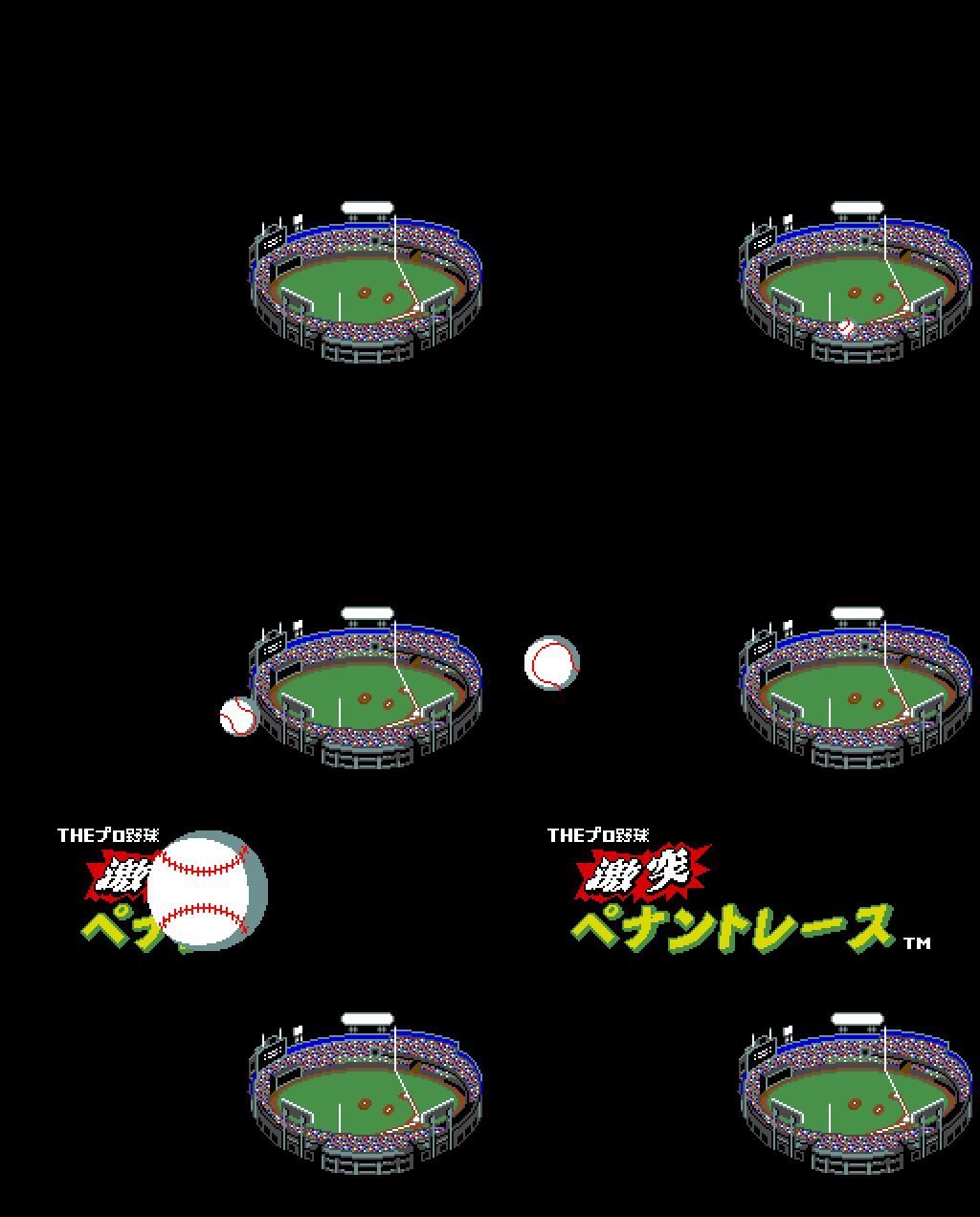
p15:BB97, frame by frame. First the stadium alone, 32 frames. Then a ball comes out of it towards the viewer (p15:BD99: position and speed; every frame it slows down, and every 8 it switches to a bigger shape, 1 to 4 pieces of two sprites, p15:BD13 and p15:BD31). Then, with other sprite patterns (p00:5421), a spinning 64 × 64 ball (two shapes taking turns every 8 frames) crosses the screen at 4 pixels a frame, and behind it the title is copied from page 1, column by column (p15:BC39). Checked against the dump of the crossing: page 0 identical and the 32 sprite attributes identical (the last 8 one frame behind: the game copies them to the VRAM in two batches, p00:42A1).
The "THEプロ野球 激突ペナントレース" title (p00:52E7): the pictures at p09:B07A and the character list at p09:B6B9, built on page 1. Checked: 0 bytes different.
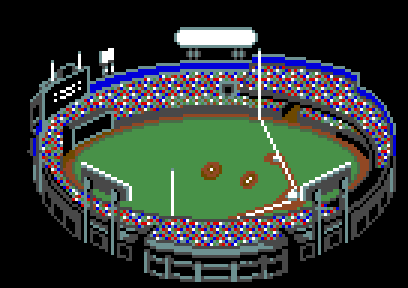
The stadium (p00:5427): the pictures at p09:A619 and 16 × 11 characters in runs from p09:AFC4, with the palette at p07:6000. Checked: 0 bytes different.
The menu
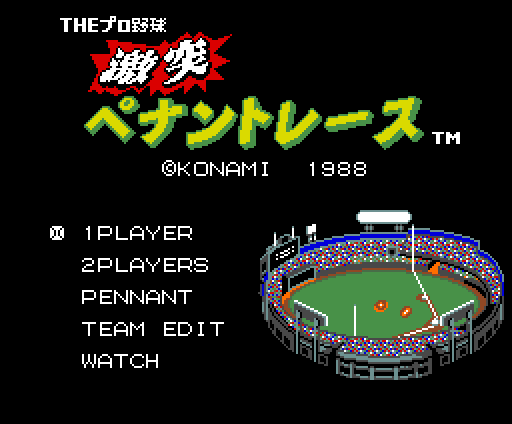
p01:651C: the finished intro, the title copied from page 1 to (0x1C, 0x08), the five texts in a row at p13:7D8F and the marker, character 0x9A, on the row of the chosen mode (p01:65AF). With a disk drive and a Game Master 2 a sixth one appears, MEDIA SELECT. Checked: 0 bytes different.
The menus
The screens before and after a game. What changes from one session to another (the chosen teams, the option, the results) and the palette of that moment come from the RAM of an openMSX dump (tools/estados_menus.json); everything else from the code: tools/menus.py repeats its routines and tools/coteja_menus.py compares. All nine checked: 0 bytes different on the visible page.
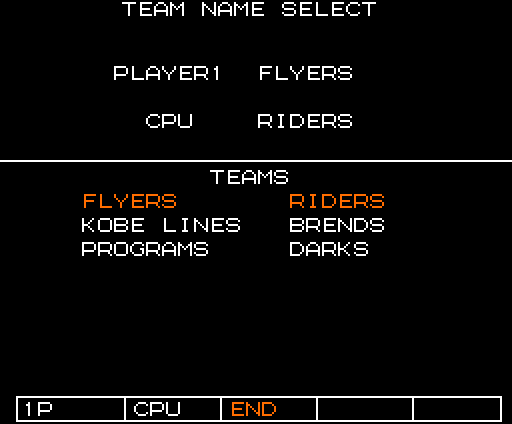
Choosing the teams (p15:A470): the title by mode, the two-column team list (p13:6A0D), with the chosen ones in colour 4, and the option bar (p15:A67A).
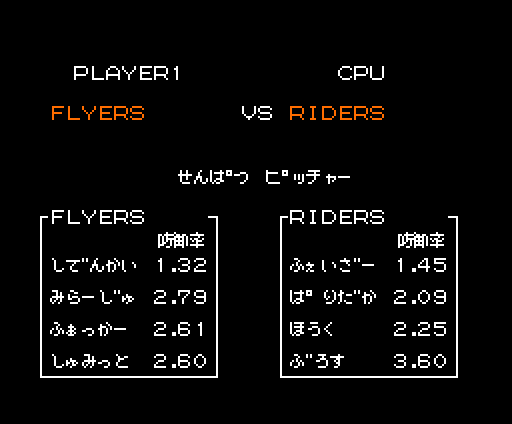
The starting pitchers (p02:9EA9): the game sign (p14:9787) and each team's four pitchers with their 防御率 (p02:9F20).
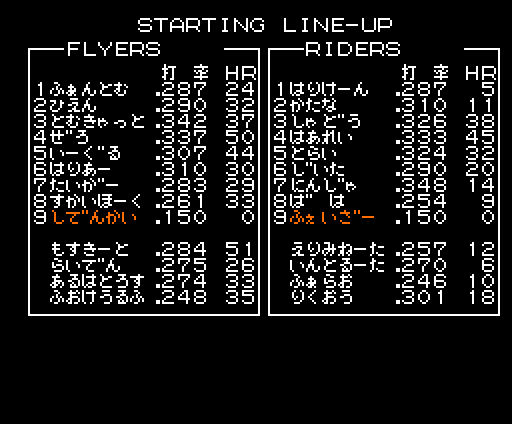
STARTING LINE-UP (p03:A2ED): each team's 12 fielders, with the names in narrow letters (the dakuten moves 4 pixels, p03:A425), and the pitcher on row 9, in colour 4 (p03:A242).
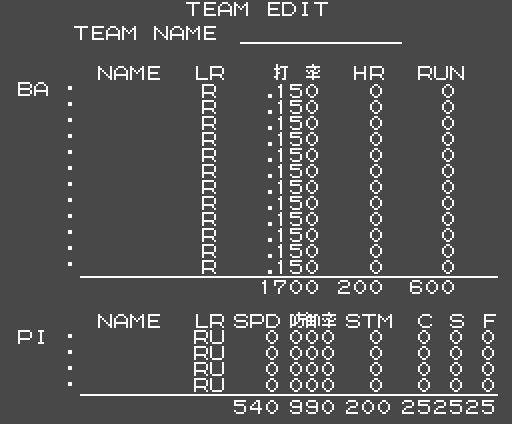
TEAM EDIT with a new team (p03:B9E7): the grey background, the text at p13:7EC6 with the caps and the columns of starting values (p14:8654).
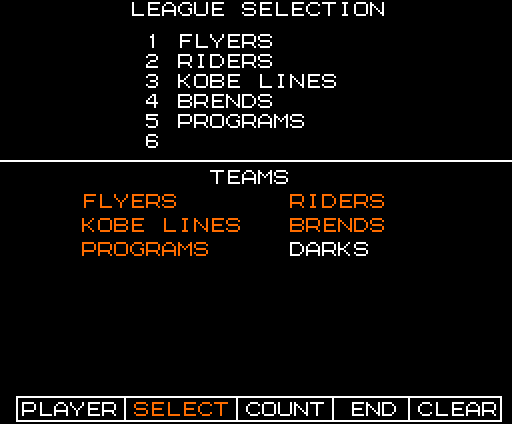
LEAGUE SELECTION (p13:61BD): the league's teams, numbered, and the list of the six.
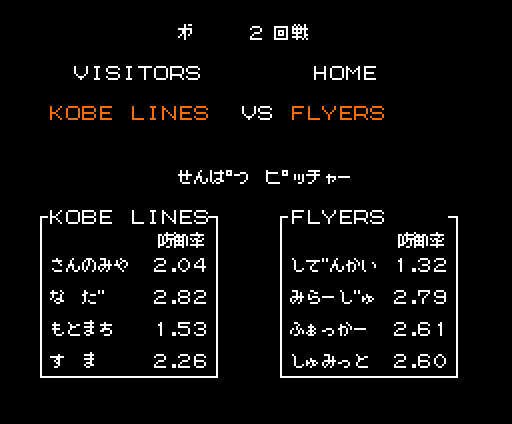
In PENNANT the pitchers screen carries the round (第 2 回戦, p14:971A) and VISITORS / HOME.
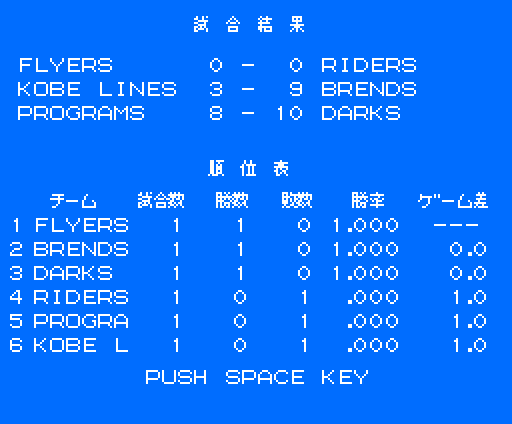
The round's results and the standings (p15:ADFA): the player's game, the other two drawn by lot, and the table with games, wins, losses, percentage (a four-step long division, p15:AFBD) and games behind the leader (p15:B034).
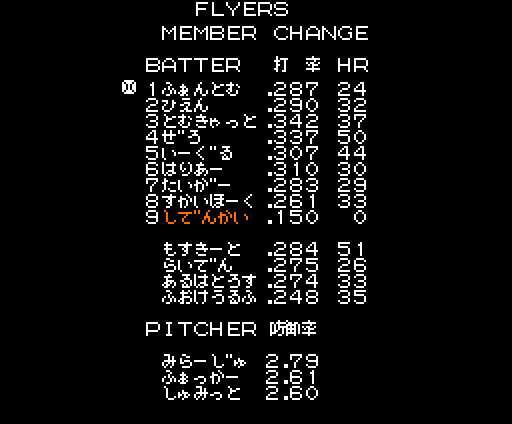
The visitors' substitution screen (p14:9BCC), opened from the pause: the 17 on their list (batting order, bench and pitchers, with their gaps) and the mark on the batter.
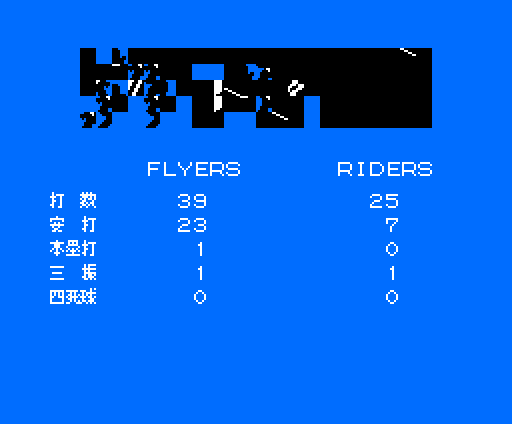
The finished-game sheet (p00:47DA): each team's 打数, 安打, 本塁打, 三振 and 四死球 (p01:60AC), here from a WATCH game played to the end (12 to 2 in the sixth, by the ten-run rule). p01:6991 clears the screen in four rectangles and leaves the top centre band untouched, so it keeps what was there: the half-drawn field at the end of the game. That band is the only part not drawn here; it comes from the dump of a moment before.
The field
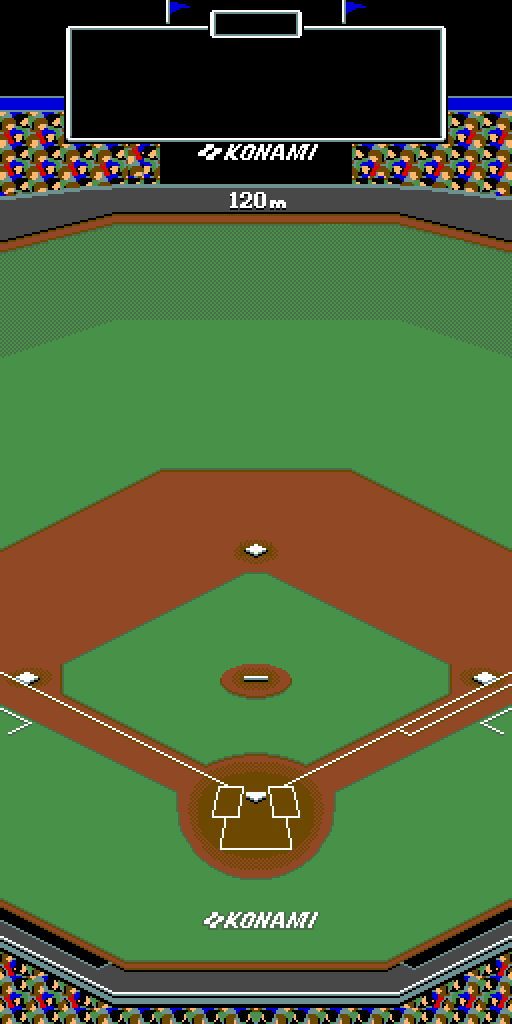
The field has three zones: the centre and the two sides. Each one is 256 × 512 pixels and is a map of 16 × 8 tiles of 4 × 4 characters (p08:9432); the tiles come from p08:95B8 (and from p08:9A58 in the last two strips of the list). The screen shows part of the zone at a time. Checked: centre zone, the 256 lines that were in the VRAM, identical in two dumps; in another three, 8 to 22 lines differ: the signs and strips the game was drawing at that moment.
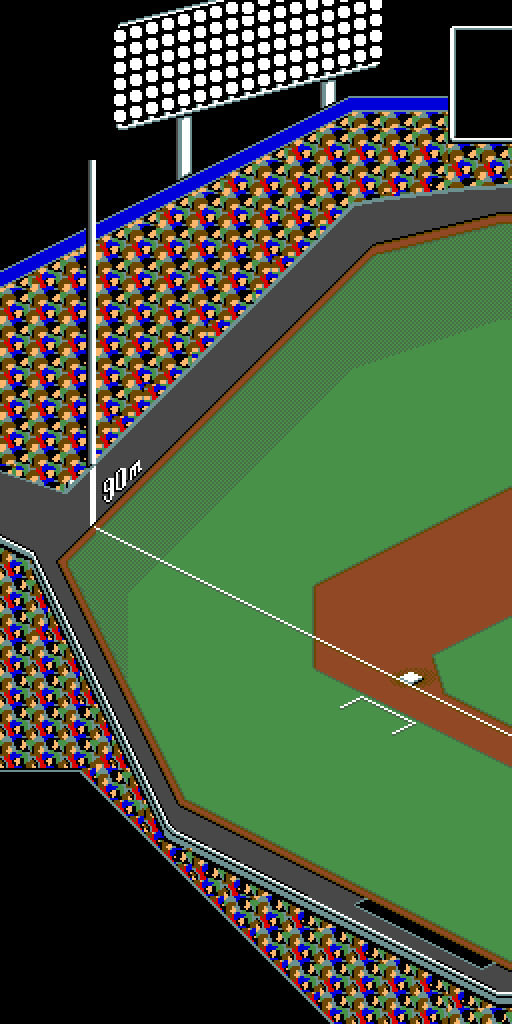
The left field zone (tiles at p08:9B28). Checked: all 256 lines identical in a dump of a WATCH game.
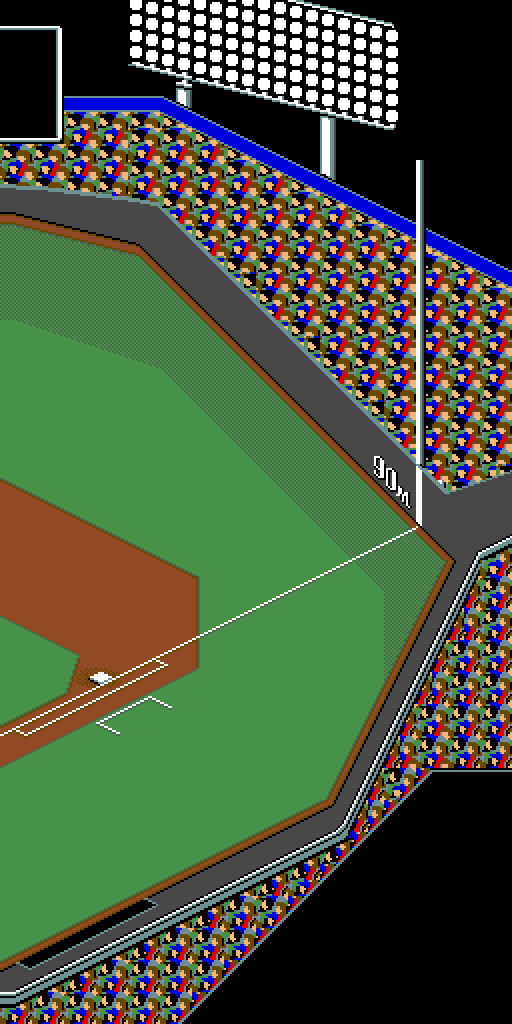
The right field zone (tiles at p09:A088). Checked: 248 of 256 lines identical; on the other 8 the game had written " OUT " on top at (112, 240) (p13:7E69), and drawing that text gives exactly what is in the dump.
The pitch
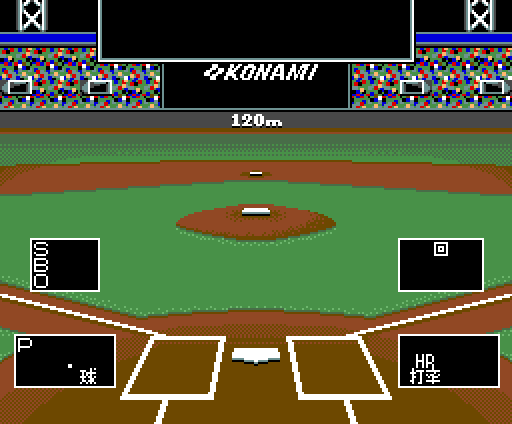
The pitching screen, seen from behind home plate (p01:6352): the background in runs from p08:9220, two frames and the text at p13:7E1E (S B O, the 回 of the inning, HR and 打率). With no game going, the boxes and figures are empty. Checked: 818 of 864 blocks identical; the rest is the little bases window and the figures of the game being played.
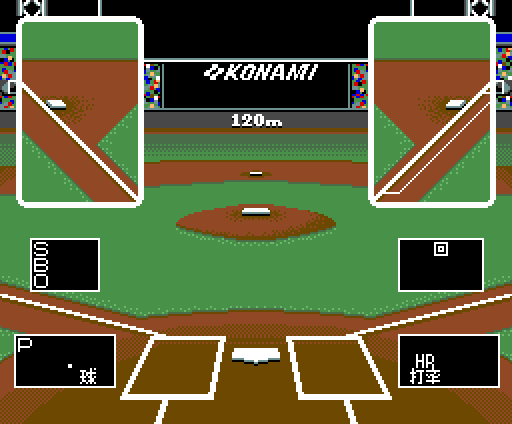
With runners on, the screen carries two little windows with first and third base (p03:AD46): 8 × 12 characters from row 0xA8 of the sheet, from the runs at p08:9178 and p08:91CC; the runner waiting in each is a sprite (p02:988A). Checked: identical byte for byte in the dumps of a WATCH game.
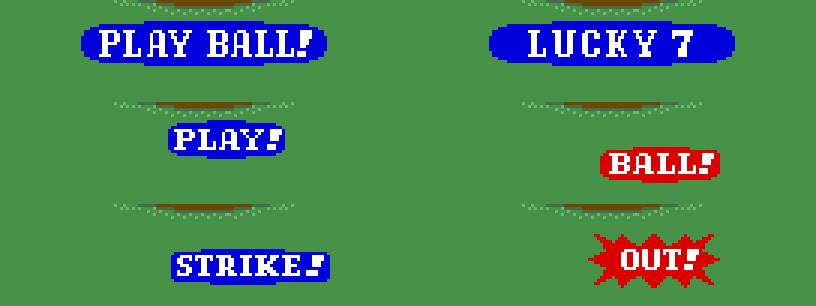
The signs are drawn on it as picture lists, in blue or red (the palettes at p00:51B2), each with a twin for a batter on the other side: PLAY BALL! when a half inning starts (p13:7925), LUCKY 7 in the seventh (p11:96EE), PLAY! (p13:BA9B), BALL! (p11:9401), STRIKE! (p11:94BB) and OUT! (p11:95A8). All six checked, identical byte for byte in the dumps where they appear; LUCKY 7 by setting the seventh inning in RAM (0xE19B = 0x0C) before the game starts.
The players
The players are V9938 mode-2 sprites: 16 × 16 pixels, one colour per line, and two sprites in the same place, the second with the CC bit, mix their colours. The game keeps the attributes in RAM (0xE100); their fourth byte is not a colour but an index: p00:5B1F unpacks its run from p09:BC05 into the sprite's 16 line colours. Each player is an outline sprite (index 7) and a shirt sprite: 0x18 for the home team and 0x1B for the visitors, palette colours 8 and 11, which come from the team (p00:5517, the table at p09:BFDE: FLYERS blue, RIDERS orange, KOBE LINES green, BRENDS light blue, PROGRAMS white, DARKS grey). Here, the demo's: RIDERS against KOBE LINES. Checked: the colours of the 463 visible sprites in the dumps come out of p09:BC05 identical.
The batter
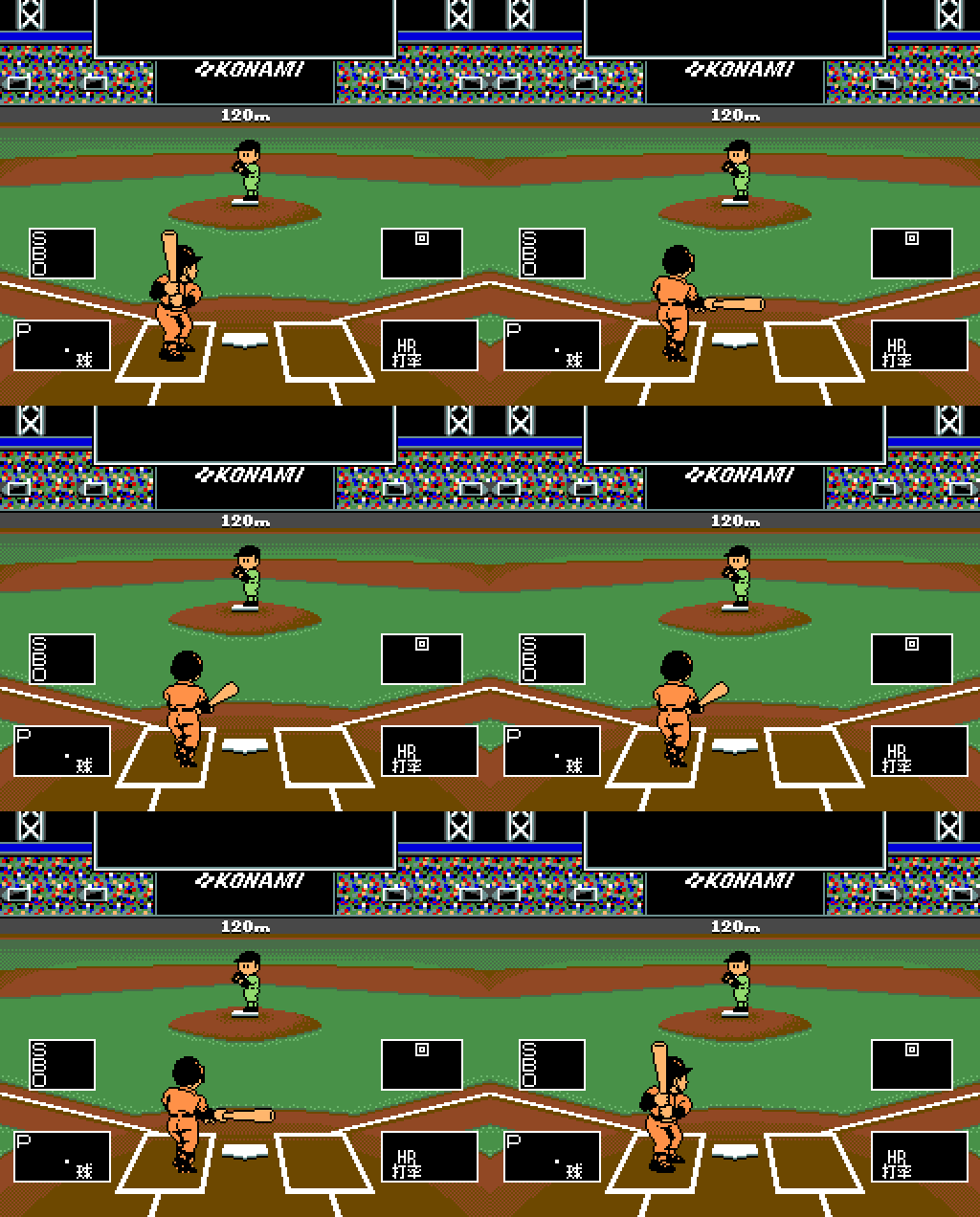
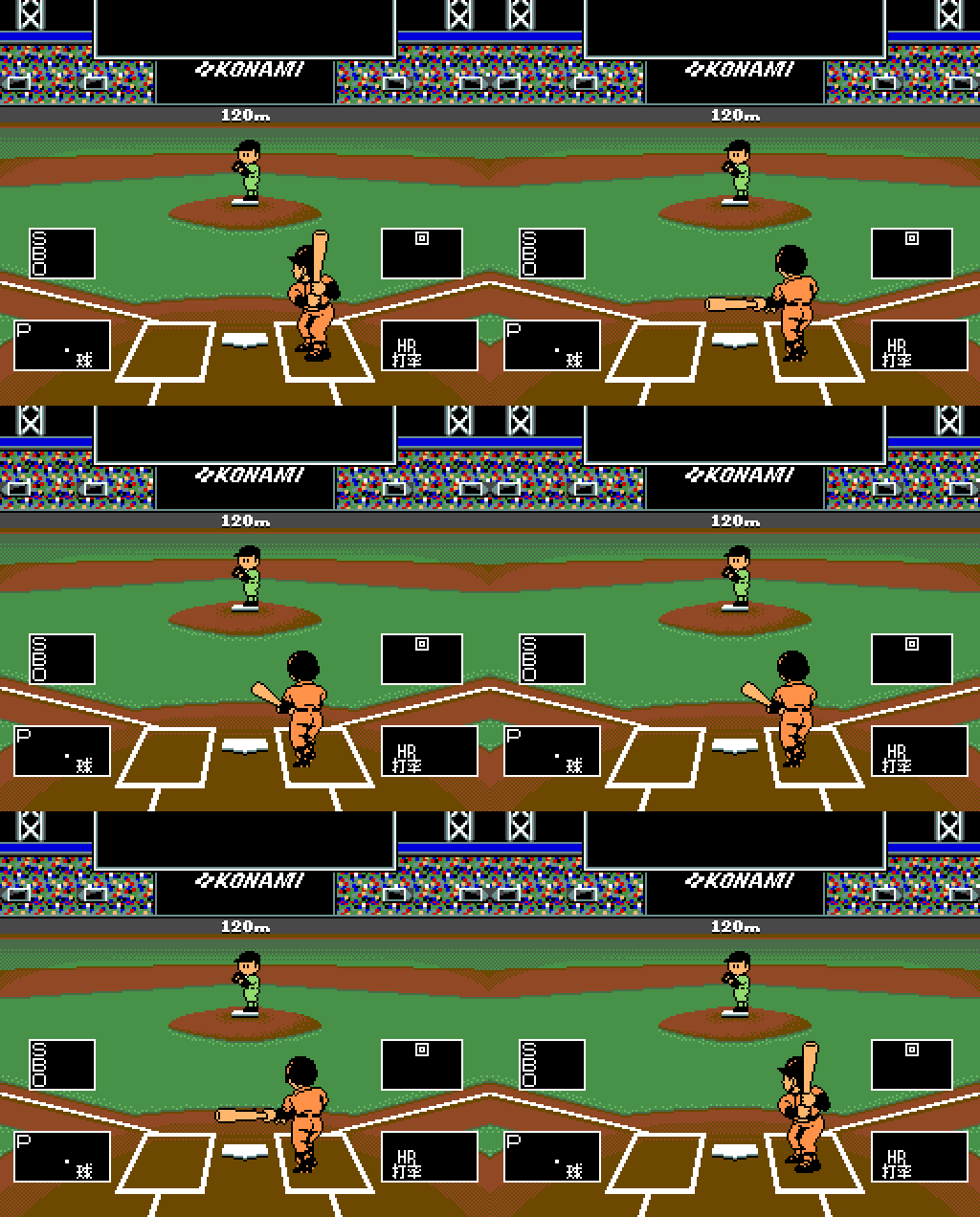
The batter is 18 or 20 sprites. At every new ball (p02:8860), p00:5677 unpacks his pattern store into an off-screen part of page 0 (0x6C00: p10:604D and p10:7C4B, or p10:6808 and p10:7ECB batting left). Each stance (0-6) copies 64-byte half lines from there to the sprite pattern table, following the 11-byte entry at p10:6000 (p00:5761), and sets its attributes (p11:9911, or p11:991F batting left; p00:5877). The swing (p02:8663): at rest stance 4; with the button, every 2 frames 3, 2, 1 and 0; on release, every 3 frames back. In phase 2 the stance is 5 with the stick up and 6 down (p00:584F).
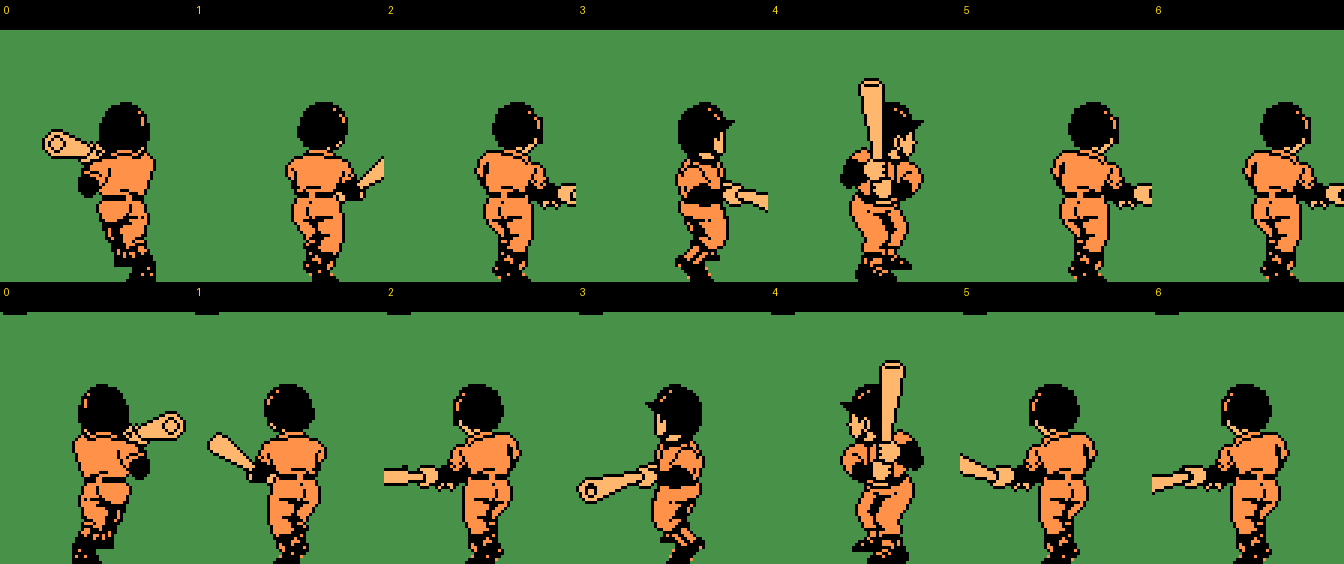
The seven stances on both sides. Checked: the patterns and attributes of stances 0 and 4 on both sides, identical byte for byte in the dumps.
The pitcher
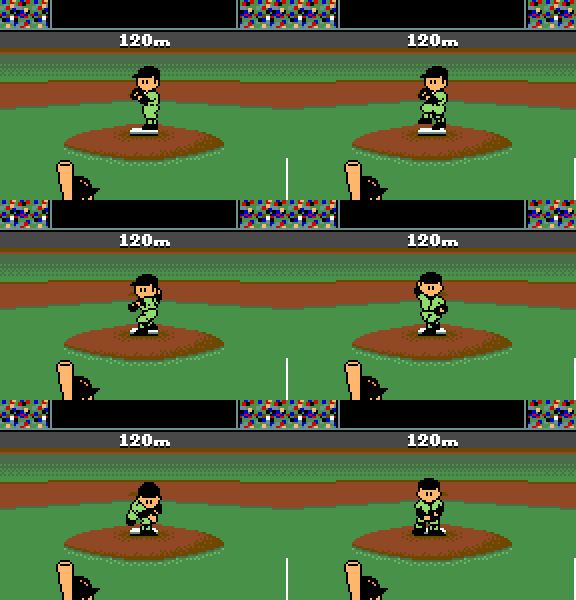
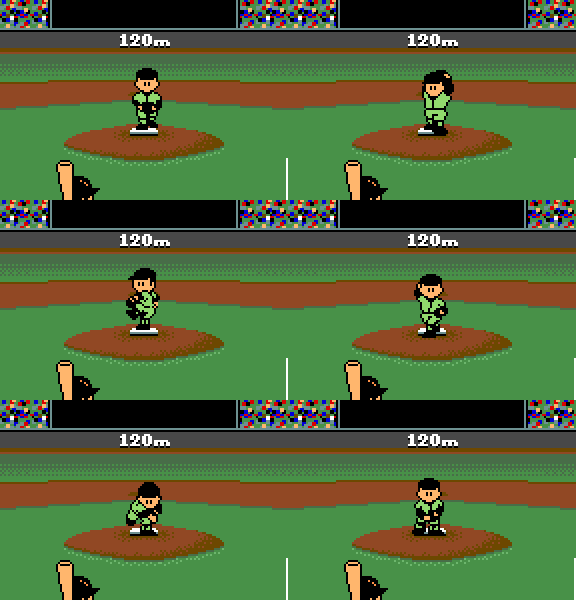
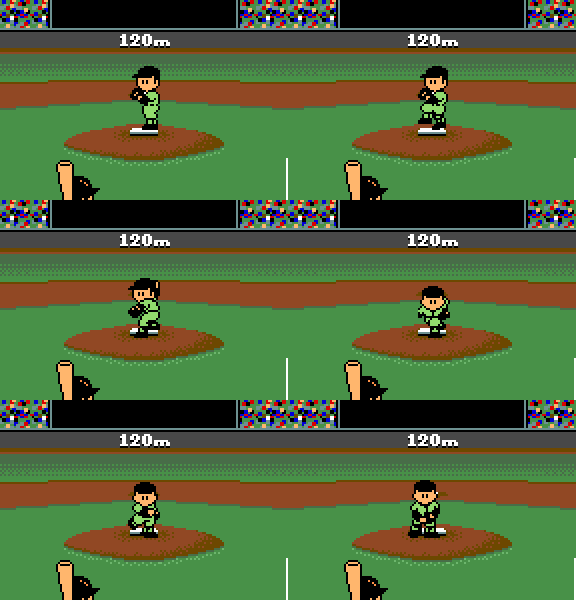
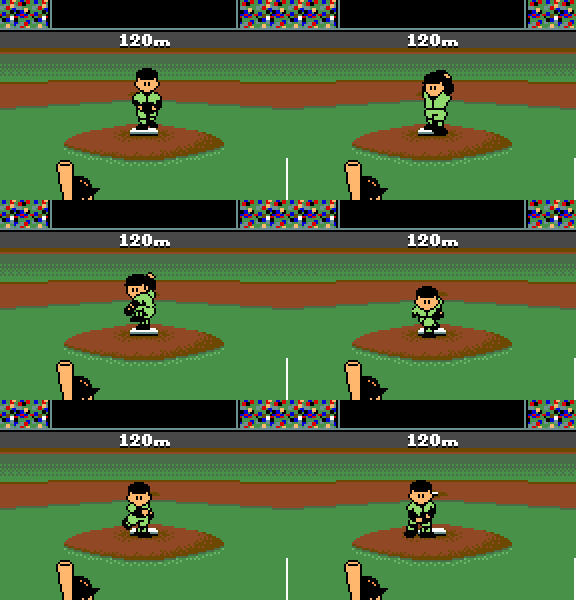
The pitcher is 4 sprites. p00:56C4 copies the 7 poses of his style (p10:6FBE, 4 styles; left-handers, mirrored) to lines 0xF9-0xFF of page 0, and whenever the motion step (0xE1D3) changes p00:56B1 copies that pose's line to sprite patterns 0xB0-0xBF. The step starts at 5 (p03:AA11) and goes down with the waits at p03:A83F (16, 16, 20 and 24 frames); at 1 the ball leaves. The attributes of each step come from p11:9DB2.
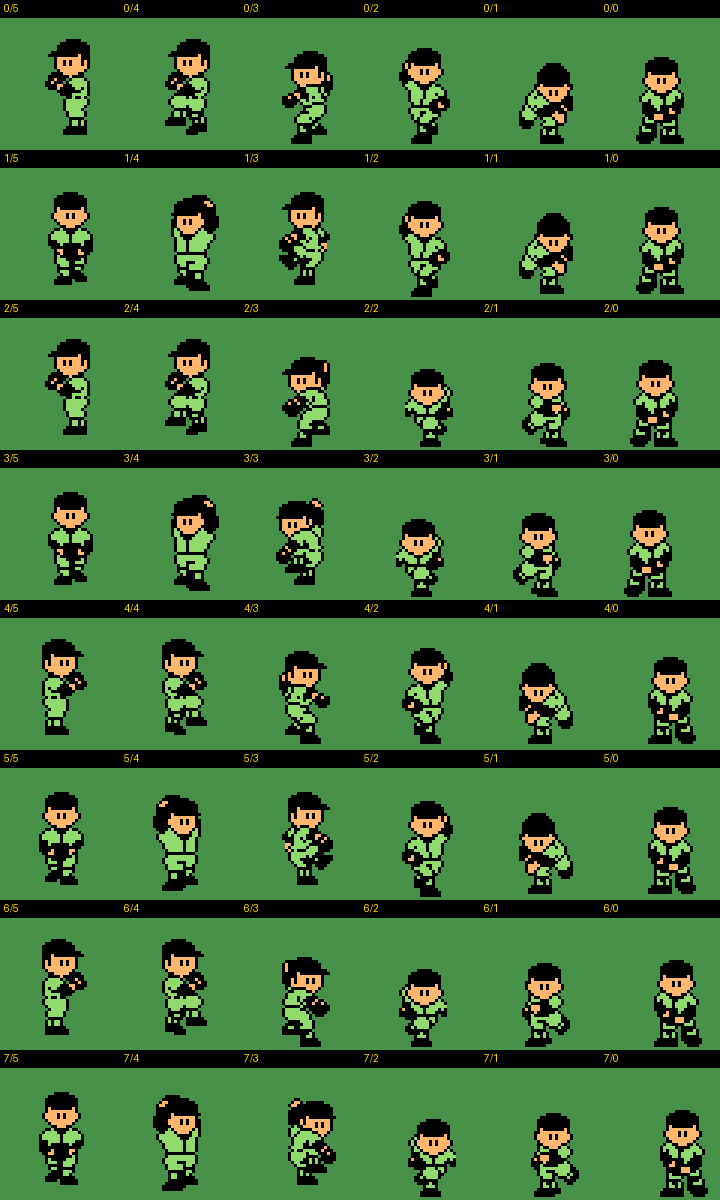
The 4 styles and their mirrors, steps 5 to 0. Checked: the pose and the 4 attributes, identical byte for byte in 18 dumps, with steps 0 to 5.
On the field
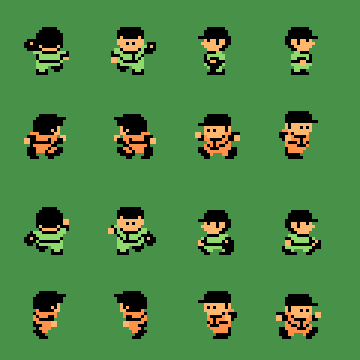
On the field each player is two sprites: pattern d with the outline and d + 4 with the shirt (p01:7594). Fielders go by direction (p01:7280: up 0x00, down 0x10, left 0x20, right 0x30) and runners the same from 0x70 (p02:8FC8); bit 3 of the 0xED0E counter, which changes every 8 frames, alternates the legs.
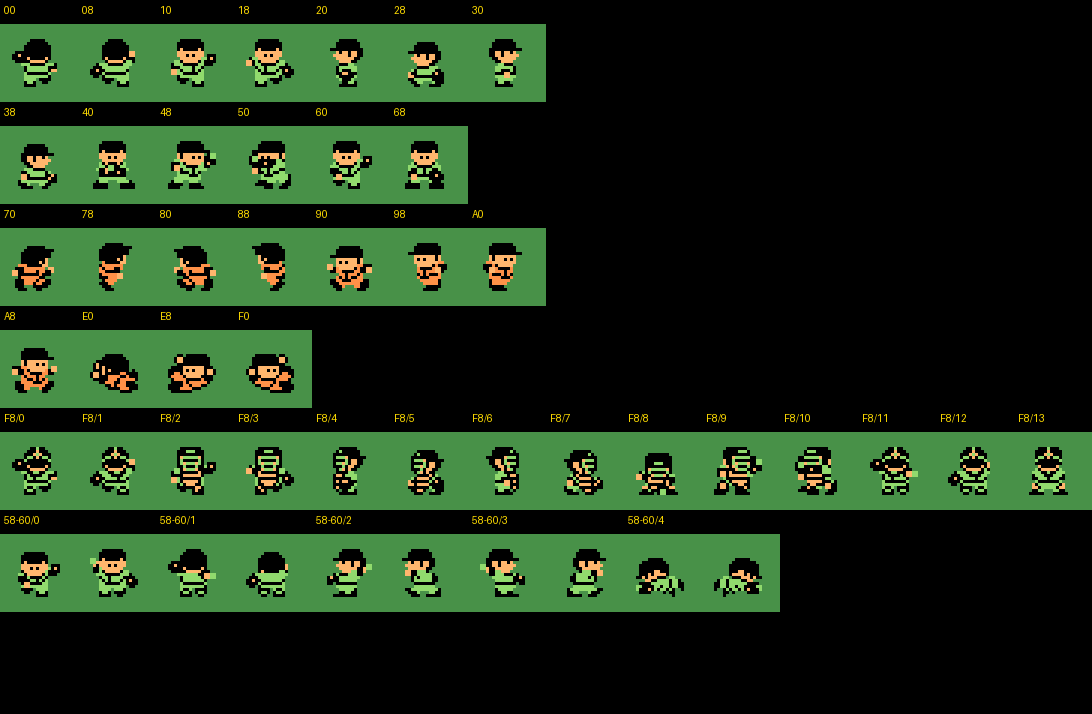
All the poses: fielders (and crouching, 0x40), runners and their slides (0xE0 + 8 per base, p02:8C74), the catcher's 14 (p00:5716, p11:8759) and the 5 of whoever holds the ball (p00:572E, p11:8499). The patterns are the game's (p00:537C, p00:539D, p00:53CC), checked: identical in the field dumps except those the game changes on the fly.
The sprite patterns
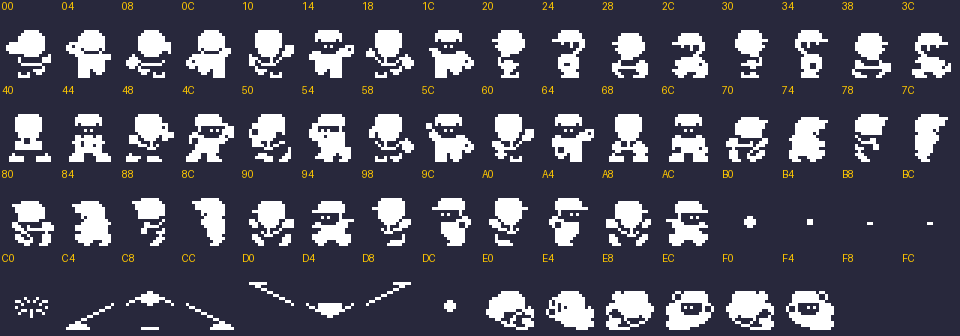
The game's 64 patterns of 16 × 16 (VRAM 0xF800-0xFFFF), in a single colour. On top of them, p00:572E puts the ball holder's at 0xFAC0 and p00:5716 the catcher's at 0xFFC0.
The font
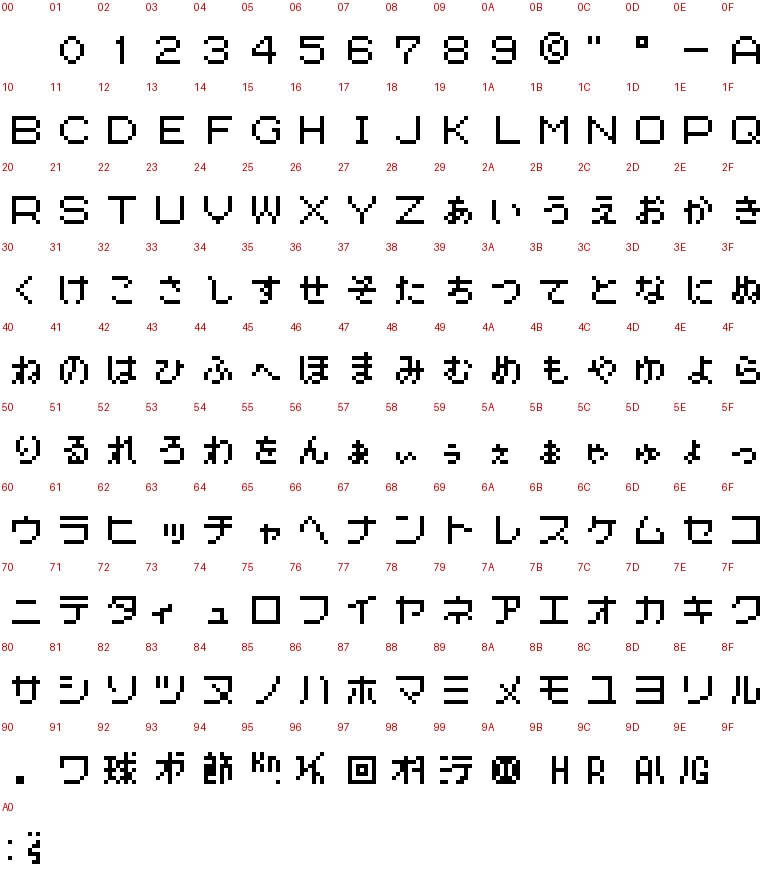
161 one-bit characters at p12:B6C3: digits, letters, hiragana, katakana and signs. They are put twice on the sheet, the second time in colour 4. On top go two kanji sets: 17 from p09:B942 for the game (戦打数安本塁三振四死球盗失策防御率) and 11 from p09:B9DA for the PENNANT screens (試合結果勝敗差順位表 and a quote mark).