Curiosities
Findings
What turned up when the cartridge was taken apart. Everything here is measured -by running the format, or by reading the constants the code counts with- not inferred from how the bytes look.
5730 points spell KONAMI
On a bonus stage, with the protagonist on the exact square X=0x90, Y=0x39,
and only once per game, the cartridge prints KONAMI 5730 PTS and awards those
5730 points.
0x4910   call es_zona_de_bonus
         ret nz                      bonus stages only
         ld a,(0e068h) / and a
         ret nz                      and only once
         ld hl,(0e132h)
         ld a,l / cp 090h / ret nz    the exact X
         ld a,h / sub 039h / ret nz   and the exact Y
         ...
         ld de,05730h
         jp suma_al_marcador
The two figures agree on their own: the caption says 5730 and the instruction adds 5730.
And the number is not arbitrary. Japanese numbers can be read by their sound: 5 = go, 7 = na, 3 = mi, that is go-na-mi. It is an easter egg the company reused across many of its games, arcade ones included.
The cartridge defends itself: copy protection
Two instructions in the start-up write inside the cartridge itself:
- 0x406A puts a
pop hland aretover thedjnzat 0x4146. It does it byte by byte, and it does not invent the0xE1: it reads it from apop hlalready in the ROM. - 0x40A5 leaves a zero at 0x44DF, which is not data: it is the operand of
the
jpat 0x44DE. In memory that turns it intojp 00000h, a dead reset.
Neither of them does anything here. The cartridge runs from ROM, and ROM takes no writes: that is why they look like dead code. They are not. A pirated cartridge is a copy loaded into RAM, and there the write does land and breaks the game. Doing nothing on the original is exactly the point.
This is no one-off idea in this cartridge: the same pair —a write over a djnz
and another over the operand of a jp— turns up in nine cartridges of this series, always in the same two start-up routines, and the second one alone in one more. Manuel Pazos identified
them in his disassembly of RC-727, where he named them ReadKeys_AC and
VRAM_writeAC.
The attract mode is a recorded game
When nobody is playing, the character moves by itself. No routine decides anything: there are 77 recorded keypresses.
They are compressed at 0x5D82, unpacked to 0xE342, and the routine at 0x468F reads them one every two frames and drops them where the joystick reading would go. The script ends with an 0xFF, which is what clears the flag and ends the attract mode.
The values are the joystick masks themselves: 0x01 up, 0x02 down, 0x04 left,
0x08 right, 0x10 the button. The first ones are 02 02 02 02 02 02 08 08 08...
-down six times, then right-. The rest of the game cannot tell whether a person
or the script is playing.
The fit that confirms it: the block unpacks to exactly 77 bytes and the last one is precisely the 0xFF the routine looks for.
The collision map is the screen itself
This cartridge keeps no walkability map in memory. To find out, it reads the screen: it calls RDVRM and looks at which pattern is drawn on the square. Below 0x80 is wall -noted down as 0x84- and from 0x90 on you can walk.
That explains a detail that would otherwise look arbitrary: every time an object is placed, the game notes down what was underneath. Otherwise picking it up would punch a walkable hole in the wall.
Fifty zones over twenty-five maps
0x498E   ld a,(0e053h)      the zone number
         ld hl,06522h       the table of 25 maps
         cp 019h            below 25 it goes straight in
         jr c,+
         sub 019h           and from 25 on it repeats
Of the twenty-five maps, four are the same one: entries 4, 9, 14, 19 and 24 all point at the block at 0x6E87. One zone in five is a bonus stage.
The proof that the RLE format is read correctly is not that the maps look right. It is that all twenty-five, carrying their length nowhere, unpack to exactly 120 bytes each, and fill the ROM from 0x6554 to 0x6EF3 without a gap.
Colours sit below patterns
In SCREEN 2 the usual arrangement is patterns at 0x0000 and colours at 0x2000. Here it is reversed, and the eight bytes the cartridge loads into the VDP say so: R3=0x7F puts colours at 0x0000 and R4=0x07 patterns at 0x2000.
R3 and R4 are not addresses but base and mask. Reading them backwards does not fail loudly: it gives correct shapes and striped colours.
Five enemies, five ways of chasing
The dispatch at 0x569F sends each type to its own routine, and no two do the same thing:
- Type 1: does not go where you are, it goes where you will be, adding a lead taken from a table according to the direction you are holding.
- Type 2: does not chase, it mirrors. It copies the player's direction with the horizontal axis flipped.
- Type 3: heads for your mirror point, and so prowls the screen instead of following you.
- Type 4: like type 1, with a shorter lead.
- Type 5, the big one: goes for the objects.
The shared engine measures both distances, takes the axis you are furthest along, and never picks the U-turn: that last part is what stops them dithering in a corridor.
The sprite table is rotated every frame
The MSX1 only shows four sprites per line, and the first ones in the table always win. The routine at 0x459A dumps the table starting sixteen bytes further along each frame, wrapping at the end. Since the order shifts, the one that loses is never the same: instead of an invisible character, shared flicker.
The flowing scenery stores not one frame
The background animations have no alternative artwork. The pattern already in
video memory is taken and its bits are rotated with rrca or rlca: one
pixel per turn, eight bytes per pattern. The other variant shifts whole bytes
one row with an lddr and wraps the one that falls off.
An address means nothing without a moment attached
0xE0B0 is two different things: while the zone is being built it holds the unpacked map -120 bytes- and during play it is the 32 sprite attributes -128 bytes- dumped in one go to 0x3B00. The same kilobyte does both jobs because they are never needed at the same time.
A loop that counts fourteen over a list of thirteen
The routine at 0x41D5 looks up the zone number in the list of those carrying a
big razzon and, failing to find it, prints NO BIG RAZZON. It enters with
ld b,00eh -fourteen turns- but from 0x609E to 0x60AA there are only
thirteen bytes:
05 06 07 0A 0B 0C 10 11 12 1F 23 25 2B    the thirteen, ascending
08                                        the fourteenth, already outside
The fourteenth comparison lands on 0x60AB, the first byte of zone 0's block -exactly where the zone table's first entry points- and reads 0x08. That 0x08 breaks the ascending order of the other thirteen.
The effect can be stated without guessing at intent: zone 8 matches too, and so it never gets the notice even though it is not on the list.
Code nobody calls
At 0x4575 sit ten bytes that set up a read from video memory -call 0x0050
and the port taken from 0x0007- the exact twin of the write one that is used.
There is not a single call or jp to that address in the whole ROM, nor does
it appear as a word in any table. It was left in.
Open questions
What is not known. This page exists because a disassembly that only reports what went well is indistinguishable from one that is covering up.
What the bonus screen says
The bonus stage map, drawn from the ROM, forms letters out of the scenery's own metatiles: it reads MOP on top and ILLA below.
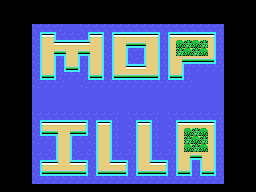
The geometry is confirmed by the code -twelve metatiles by ten, the cp 00ch
and cp 00ah at 0x64CD- so the drawing is faithful: that is what the cartridge
paints. What is not known is what it is supposed to say. It is not the
title, which the presentation screen spells MOPIRANGER.
The bonus stage still needs playing in the emulator to see how it reads with the objects and sprites on top.
What the big enemy does with its fixed route
Type 5 alternates two behaviours on the flag at 0xE2D8: either it heads for the first object on the list, or it follows a route from the table at 0x5812, indexed by the high nibble of its own clock. What it does is clear; what has not been measured is whether that fixed route traces a recognisable shape on screen or is just a service path.
Where the 18 bytes at 0x6099 come from
The first five (01 04 03 02 05) are loaded into DE by 0x4B27, and the next
thirteen are the list of zones with a big razzon. What 0x4B27 does with those
five is traced, but it has not been checked in motion that they mean what
they look like.
The fourteen-over-thirteen loop
That the loop at 0x41D5 reads fourteen bytes from a list of thirteen is
measured, and so is the effect: zone 8 escapes the NO BIG RAZZON notice. What
cannot be asserted is whether it is an oversight or deliberate. The binary
says what the code does, not what whoever wrote it intended.
The routine nobody calls
At 0x4575 are ten bytes that set up a read from video memory and that nothing
jumps to. It has been searched for as the target of call and jp across the
whole ROM and as a word in the tables, and it does not appear. It remains
possible that it is reached by some path the trace cannot see; none has been
found.
Figures still missing
- Nobody has measured how many cycles painting a whole zone costs. Two
breakpoints and
machine_info timewould answer that with a number. - It has not been checked whether more than one build of this cartridge is in circulation, as happens with others by the same company.
If you know something about any of this
The repository issues are open. A correction with a measurement attached is worth more than ten pages of prose: in this series, several already-published claims have fallen because somebody sat down in front of the game and looked.