Under the hood
Getting started
What you need
pasmo and z80dasm to assemble and disassemble, and Python 3 for the
tools. Nothing else.
The cartridge is not distributed with this repository: you need your own
copy, named monkey.rom in the project root. It is exactly 16384 bytes with
this sha256:
fdf62cfa6db239fcaa3614b56263dd58e8797b206663e491588c062220b16b01
With any other dump the listing will not reassemble. make comprueba tells
you in one line.
The commands
make          # trace, generate the listing and check everything
make verify   # assemble the listing and compare its sha256 with the cartridge
make sanity   # what reassembly cannot catch
make test     # the 18 tests on the listing, which do not need the cartridge
make web      # the pictures and these pages
make chains the first four. If all goes well, the line that matters is
this one:
  ensamblado : 16384 bytes  fdf62cfa...20b16b01
  original   : 16384 bytes  fdf62cfa...20b16b01
OK: reproducible byte a byte
What is in each folder
src/monkey.asm |
the commented listing, generated; never edited by hand |
src/monkey.notes |
the annotations: labels, comments, headers and data ranges, anchored to addresses |
src/monkey.entries |
the entry points the trace cannot deduce, each with its justification |
src/monkey.nocode |
the zones the tracer must not read as code |
tools/ |
the tracer, the listing generator, the checks and the drawing tools |
tests/ |
18 tests on the listing and the notes |
docs/ |
this site |
work/ |
what make produces along the way |
How to read the listing
Every routine has an uppercase name and a comment saying what it does and
what it takes. Data blocks are labelled DATA_<use>, with the width of their
structure, and each has an explanation of what it is and how that is known.
Addresses are the real ones of the cartridge in page 1: 0x4000-0x7FFF.
To change anything, edit src/monkey.notes and run make again: the listing
is regenerated and the checks say whether it still holds.
How it was done
The tracer (tools/z80trace.py) follows the flow from the header's entry
point and from what monkey.entries declares: the interrupt and the targets
of the two dispatchers, which jump through tables. Whatever is not code is
left as a gap, and every gap is closed by finding the instruction that reads
it (tools/quien_apunta.py, tools/refs.py) and checking the format the
consuming code implies: the two RLE blocks decompress and end exactly on the
byte they should, and the tile lists run to their 0xFF.
What cannot be read is measured. tools/graficos.py builds video memory by
repeating INIT's copies and the result matches a dump from the emulator
sprite by sprite; the equation generator was sampled six hundred times in
the emulator to check what the code says about it.
Reproducibility
- assembling returns the cartridge's sha256
- no range declared as data comes out as code in the trace
- no entry point falls inside a data range
- all 16384 bytes are assigned: 8962 of code, 7422 of data, 0 unidentified
The cartridge
The header and the machine
The 16384 bytes begin with AB: the BIOS recognises them as a cartridge,
maps them into page 1 (0x4000-0x7FFF) and, once the machine has booted,
calls the header's entry point, 0x40AF. STATEMENT, DEVICE and TEXT are
zero. The five eight-byte stubs after the header (pop hl / ld (0),hl /
ret) are used by nobody: filler for the hooks the header leaves empty.
INIT (0x40AF) disables interrupts, writes jp 0x4038 into the H.KEYI hook
(0xFD9A), sets the stack at 0xE400, loads video memory, clears the game's
RAM, enables interrupts and sits in a two-byte jr $ (0x419B). From then on
the whole game runs inside the interrupt, one step per frame. 0xE005 is
the lock: if a step takes longer than a frame, the next interrupt plays the
music, flushes the sprites and leaves.
Video memory
SCREEN 2 with 16×16 sprites (0x488C: R0=02, R1=A2, R2=0E, R3=7F, R4=07, R5=76, R6=03, R7=E1).
| VRAM | what |
|---|---|
| 0x0000 | tile colours, three identical thirds |
| 0x1800 | the patterns of the 64 sprites |
| 0x2000 | tile patterns, three identical thirds |
| 0x3800 | the name table |
| 0x3B00 | the sprite attributes |
Tiles 0x00-0xB7 come compressed: patterns at 0x5156 (0x515 bytes) and colours at 0x566B (84 bytes), both with the same RLE (0x6C84: 0 ends; n < 0x80 repeats the next byte n times; n ≥ 0x80 copies n & 0x7F bytes as they are). Decompressed they give 1472 bytes each, exactly 184 tiles, and both blocks end where the next begins. Tiles 0xB8-0xC3 are loaded later by 0x4728 from 0x5EFF: the pieces of the big equation digits that did not fit in the first block, sharing numbers with the title sign, which is drawn into tiles 0xB8-0xFF one pixel row at a time (0x4C77).
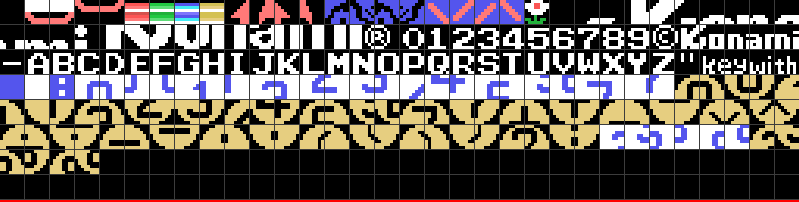
Of the tiles: 0x00 empty, 0x01-0x04 the card edge, 0x05-0x08 the four platform bars (one per colour), 0x09-0x0C the red arrow, 0x0D-0x14 the panel's monkey faces (normal and crying), 0x15 the flower, 0x16-0x2F the big KONAMI, 0x30-0x5B digits, ©, letters and dash in ASCII, 0x5C-0x5F "key" and "with" in small type, 0x60 blue, 0x61-0x7A the cards with their digits, 0x7B-0xB7 the big digits and signs.
The sprites
INIT copies the first six sprites of 0x56BF to 0x1800, and then the 22 of the same block again from 0x18C0, because COPIA_A_VRAM leaves HL as it was (0x40CF). So VRAM sprite n, for n from 6 to 27, is the cartridge's n − 6: that is why the monkey is at patterns 0x00 and 0x18, and the crab at 0x30. The same 22 are mirrored bit by bit (0x4107) into 0x1CC0: the mirror of sprite k is pattern 0x98 + 4k. Besides, 0x597F (500, 100, banana and grapes) goes to 0x1B80, 0x59FF (the monkey walking left, drawn separately) to 0x1C00 and 0x5ABF (the big face, the apple and the card) to 0x1F80.
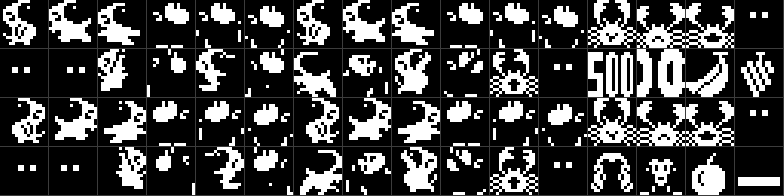
Every character is two overlaid sprites: the body in one colour and the details in another (the monkey blue and white, the crab red and yellow, the professor dark red and white). And the game swaps whole blocks depending on what the monkey carries: 0x6044 points to three sets —normal, with the fruit on his head (0x5B3F) and with the card held high (0x5BFF)—, and 0x5F80 loads whichever 0xE10E asks for into 0x1800 and 0x1C00. The balloons (0x5E3F) overwrite the 500 at 0x1B80 while the equation rises, and the big face of 0x5E7F overwrites the monkey at 0x1800 when the answer is delivered.
The sprite table lives at 0xE0B0 (24 × 4 bytes) and 0x46BA flushes it every frame starting from a different one each time (0xE1B2 goes from 23 down to 0): the TMS9918's four-sprites-per-line limit rotates and no sprite is the one that always disappears.
The RAM map
All in 0xE000-0xE3FF, cleared by INIT. What matters:
| 0xE000 | the game state, index into the table at 0x4226 |
| 0xE002 | options: bit 4 keyboard, bit 5 two players, bit 6 game on, bit 7 the player |
| 0xE008/9 | the controls, before and now, in joystick format |
| 0xE010 | the three sound channels, 10 bytes each |
| 0xE040 | the high score; 0xE043 and 0xE046 each player's score (BCD, 6 digits) |
| 0xE050 | the player in play: lives, stage, extra life, new equation, solved, time, misses, symbols; 0xE080 the other one's copy |
| 0xE0B0 | the sprite table: 0-1 the monkey, 2-7 the crabs, 8-9 the professor, 10-17 the fruit, 18 the card |
| 0xE108 | the four actors, 8 bytes each, read from their sprite as IX+0x58 |
| 0xE140 | the random seed |
| 0xE142 | the equation's result; 0xE144 the equation in symbols |
| 0xE15A | the ten cards of the stage (Y, X) |
| 0xE1AF | the card the monkey holds (0xFF none) |
| 0xE1B5 / 0xE1C1 | each player's equation; 0xE1CD/E the hidden digit |
| 0xE1E4 / 0xE20E | each player's cards: state and digit |
| 0xE24C | the state of each balloon |
| 0xE260 | the eight fruits: state and counter |
| 0xE270, 0xE276 | the answer's and the professor's flags |
What it is made of
| bytes | |
|---|---|
| code | 8,962 |
| data | 7,422 |
| unidentified | 0 |
Of the data: 1,472 + 84 of compressed tiles (0x5156, 0x566B), 2,688 of sprites (0x56BF-0x5F5F), 504 of the title sign (0x4CD0), 1,044 of sound (0x7A71-0x7E85), 287 of 0xFF filler at the end, and the rest tables and lists: card positions per stage (0x50AE, 21 bytes each), platforms (0x6705), fruit (0x6806, 32 bytes per stage), flowers (0x6B42), equation scripts (0x712B), symbols (0x7207), the text of every sign and the tables of the two dispatchers.
There are five pieces of code nobody jumps to, seeded into the trace so they
show as what they are: push iy / ret at 0x4072, a ld a,0F0h at 0x4917
that nobody uses, a list-driven platform painter (0x664F, 0x6624, 0x65F8)
that 0x6685 left without a job, the entry of RLE_A_VRAM that reads the
address ahead of the data (0x6C80), and nine bytes at 0x755C that fall into
0x7565.
The code
How the program is put together, with addresses. The names are the ones in the listing.
The interrupt is the program
INTERRUPCION (0x4038), every frame:
- acknowledges the VDP interrupt by reading its status;
SUENA(0x796F), always;VUELCA_SPRITES(0x46BA), always;- if 0xE005 is zero, sets it, enables interrupts and takes one step:
LEE_MANDOS(0x41A7) from state 7 on andPASO_DEL_JUEGO(0x4209); - restores everything and returns with
reti.
PASO_DEL_JUEGO counts the clock (0xE003), blinks the 1UP during play, reads
keys 1-5 outside it (TECLAS_1_A_5, 0x4678) and dispatches state 0xE000.
The dispatcher
DESPACHA (0x419D) is the call followed by a table: add a,a / pop hl /
call HL_MAS_A / ld e,(hl) / inc hl / ld d,(hl) / ex de,hl / jp (hl). The
return address is the table of words, so it never returns to the call.
Two places use it: 0x4223 with the 20-state table at 0x4226, and 0x602B with
the 11 actor states at 0x602E.
The twenty states
| 0 | ESTADO_0_TITULO |
screen off, sprites and names cleared, music 0xA1 (which is silence) |
| 2 | ESTADO_2_LOGO |
the KONAMI rises one row every two frames (0x6C42) |
| 3, 4 | wait and ESTADO_4_TITULO |
the sign, one pixel row at a time (0x4C77) |
| 5 | ESTADO_5_MENU |
256 frames of menu |
| 6 | ESTADO_6_DEMO_MONTA |
wipe, scoreboard and the equation 3 + ? = 5 |
| 1 | ESTADO_1_GLOBOS |
the balloons rise (0x713D); the same state serves the demo and the game |
| 7 | ESTADO_7_DEMO |
the demo, with the inputs of the script at 0x4B78 |
| 18 | ESTADO_18_OPCION |
the chosen option blinks for 0x60 frames |
| 8 | LEVEL_SELECT |
starts the game the first time, and keys 1-5 |
| 9 | ESTADO_9_PLAYER_N |
spends the life, and PLAYER n / LEVEL n for 0x65 frames |
| 10 | ESTADO_10_MONTA_FASE |
cards, a new equation if due, shuffled digits, balloons |
| 11 | ESTADO_11_READY |
balloons, and READY counting down 15 seconds or until a button |
| 12 | ESTADO_12_PARTIDA |
the game |
| 13 | ESTADO_13_VIDA_O_RESUELTA |
life lost or equation solved; GAME OVER with no lives |
| 14, 15 | player swap and decide | |
| 16 | ESTADO_16_FASE_SUPERADA |
stage + 1 and back to LEVEL SELECT |
| 17, 19 | waits | for the sound to end; 0x80 frames |
States chain through SIGUIENTE_ESTADO (0x4661): most end with an inc
(hl) on 0xE000. And one trap: ESTADO_9_PLAYER_N spends a life every
time it is entered, so whoever goes there without having died (equation
solved, 0x6E4A; stage cleared, 0x45C1) adds one first.
The actors
MONO_Y_CANGREJOS (0x4822) passes the controls to 0xE10B, repaints the cards
every eight frames, checks the collision (0x69B0) and calls ACTOR_PASO
(0x5F5F) with B = 1 (the monkey) and 2 to 4 (the crabs), the latter between
one and four times per frame depending on the stage.
ACTOR_PASO sets IX to the actor's two sprites (0xE0B0 + 8(B−1)) and reads
its record at IX+0x58..0x5F: facing, animation phase, type, state, timer,
load. Before the state, the fruit: ACTOR_TOCA_FRUTA (0x6A4F) returns carry,
D and E if one is within 0x16 pixels, and with that the actor picks it up
(jumping), dies or loses a life (if it is in the air). Then the eleven states
of 0x602E:
| 0 | ACTOR_ESCONDIDO |
waits and appears at the top centre |
| 1 | ACTOR_PARADO |
fire jumps, a direction walks |
| 2 | ACTOR_ANDA |
one pixel, the animation, the floor and the edges |
| 3 | ACTOR_SALTANDO |
the table at 0x6423; at the top, the card; touching the professor, the delivery |
| 4 | ACTOR_SUBE_HUECO |
climbs through a gap in the platform above |
| 5 | ACTOR_SE_HUNDE |
comes down slowly with the card just grabbed |
| 6 | ACTOR_CAE_ESTADO |
four pixels a frame down to the floor |
| 7 | ACTOR_SE_DESCUELGA |
the crab crosses the top platform |
| 8 | ACTOR_TIRA_FRUTA |
the fruit flies off |
| 9 | CANGREJO_MUERE |
the 500 and back into hiding |
| 10 | ACTOR_LE_DA_LA_FRUTA |
fright and life lost |
The stage's platforms are the only geometry: HAY_SUELO (0x6924) walks the
list of (Y, X, width) at 0x66F5 looking for one at Y + 0x10 that covers the
X, and HAY_PLATAFORMA_ARRIBA (0x696B) does the same upwards. There is no
collision map: the table is consulted.
The cards and the answer
PINTA_TARJETAS (0x4EC8) walks the ten at 0xE15A and repaints those with bit
7: the bottom 3 − c rows of a 3×2 block (blank or with the digit,
alternating) and the edge under it. The edge's position comes from
PINTA_BLOQUE (0x6906) returning D advanced by as many rows as it painted;
the 8c + Y computed at 0x4F42 stays in A and nobody uses it.
RESPONDE (0x7708) starts the blinking, TARJETA_COMPARA (0x7796) decides,
and the answer card is sprite 18 driven by the bits of 0xE270 (TARJETA_PASO,
0x7834): 4 waits for the card to close, 3 falls, 1 rides on the monkey's
head, 0 rises on its own. The professor (PROFESOR, 0x7473) watches the same
bits.
The equation
GENERA_ECUACION (0x6F96) writes symbols into 0xE144 following the level's
script (0x7117) with the BCD arithmetic of 0x6E6E-0x6EDB: add, subtract,
multiply by repeated addition and division done backwards (D × E ÷ D = E).
ELIGE_INCOGNITA (0x7253) covers a digit, MONTA_GLOBOS (0x7297) prepares
a two-sprite balloon per symbol, off screen at the bottom, and GLOBOS_SUBEN
(0x713D) releases them at random one at a time; GLOBO_LLEGA (0x71BF) paints
the symbol in 2×2 where each one arrives.
AZAR (0x6F0D) mixes the seed at 0xE140 with the R register and with a word
from the system ROM (0x0000-0x3FFF), and remixes with daa: the nibbles come
out between 0 and 9, which is what the BCD arithmetic needs.
The sound
SONIDO (0x78DF) starts sound A if a game is on (SONIDO_YA, without
checking). 1 to 0x10 are one-channel effects (channel C); 0x91 to 0x9B
two-channel tunes, and from 0x9D three. The table at 0x7A7B gives the first
channel's track and the following words the others', which is why tune
numbers go in twos. Priority is by number: if the channel is playing
something equal or higher, nothing, except 2, which always gets in. SUENA
(0x796F) is the player: per channel a note counter, the track, octave, volume
and an envelope of three steps down when the note starts and two at the end.
Effects are volume/period pairs; music is notes in one nibble with the
duration in the other over the period table at 0x7A71.
What gets painted
VPOKE (0x4082) and RELLENA_VRAM (0x48AA) are the base; PINTA_LISTA_TILES
(0x48E9) walks lists of address + tiles with 0xFE to change place and 0xFF to
end, and every sign is written with it. PINTA_BLOQUE (0x6906) paints B×C
tiles at pixel coordinates, PINTA_RECUADRO (0x66BB) fills rectangles,
PIXELS_A_VRAM (0x6605) turns (Y, X) into a name-table address. RLE_A_VRAM
(0x6C84) decompresses the tiles, ESPEJA_SPRITES (0x4107) flips 22 sprites
bit by bit, and TITULO_UNA_FILA (0x4C77) paints the title sign one pixel
row every eight frames.
Code shared with other Konami cartridges
This disassembly has been compared, instruction by instruction, with
every other Konami one in the series. A block counts when the same
instructions, at least six of them from a label to its ret or its
unconditional jump, are in both cartridges; the addresses are left
aside, because they change from one cartridge to the next. Of the
other 57, 31 have at least one block in common with this one;
these are the ones that share the most:
| Cartridge | Blocks | Instructions | For example (here = there) |
|---|---|---|---|
| Athletic Land | 17 | 255 | SUENA_PASO (0x798B) |
| Cabbage Patch Kids | 10 | 115 | PINTA_BYTES_BCD (0x4A4F) = PINTA_BCD |
| Antarctic Adventure | 9 | 184 | MUSICA_EVENTO (0x7A10) = VOLUMEN_MIRA_FD |
| Super Cobra | 9 | 136 | MUSICA_EVENTO (0x7A10) |
| Konami’s Billiards | 6 | 105 | SUENA_PASO (0x798B) = paso_de_un_canal |
| Circus Charlie | 6 | 49 | PINTA_TILES_SEGUIDOS (0x6C71) = pinta_franja_correlativa |
| Magical Tree | 5 | 53 | PINTA_BYTES_BCD (0x4A4F) = imprime_bcd |
The whole matrix, the 58 cartridges against each other, is on The routines in the series database, along with the method and the program that measures it.