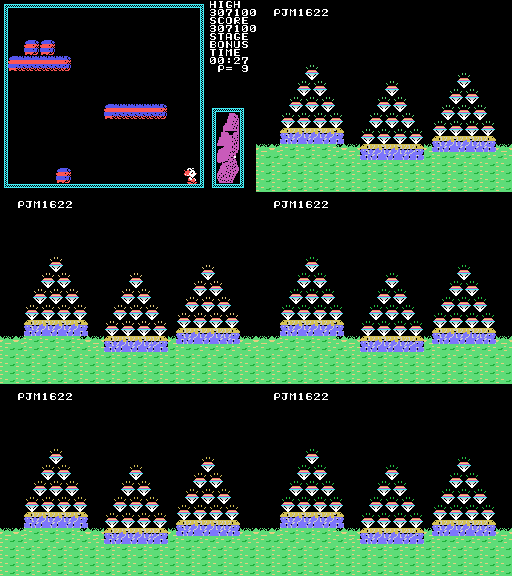
The stages
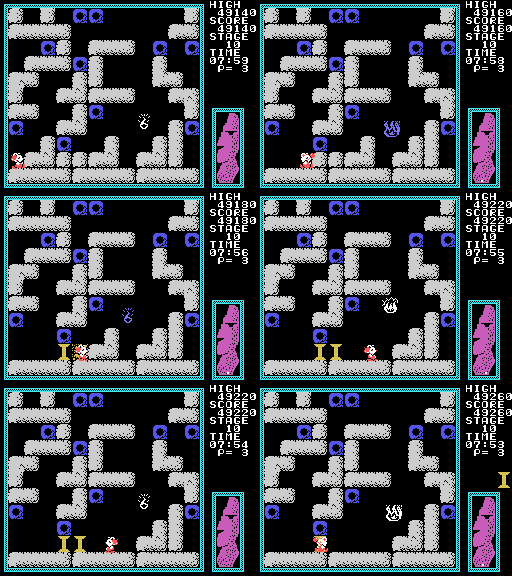
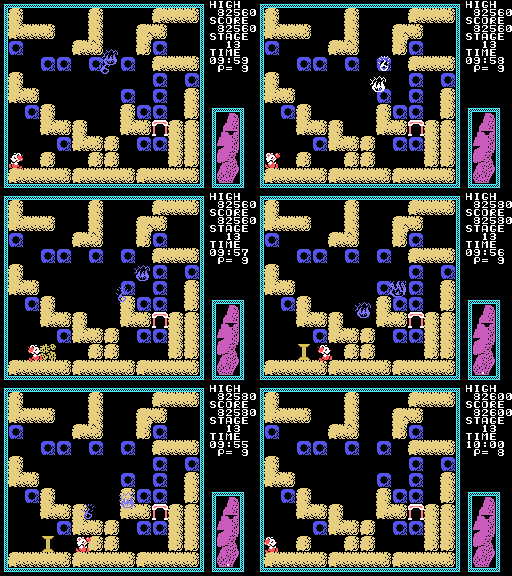
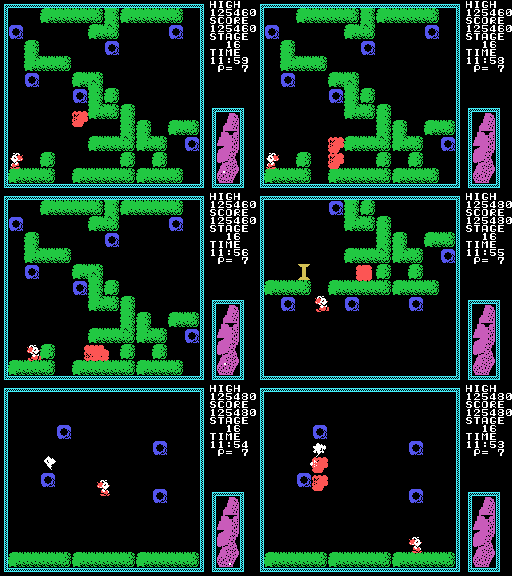
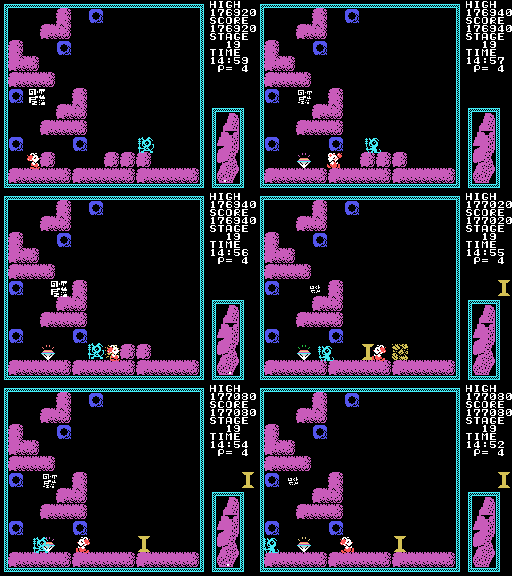
There are 32: 24 numbered ones (STAGE 1 to 24 on the scoreboard) and, every fourth, a BONUS GAME (stages 3,
7, 11... of the game; fase_numero, 0x851E). Each one is 12 blocks of 2 x 2 tiles wide, built in RAM (0xE800) from
its map (fase_monta, 0x849D); the screen shows 11 rows and, when the hero reaches the very top or bottom, the view
goes up or down (vista_sube, 0x8956). The rocks change colour every four stages (0x864E). On the right, the
scoreboard: HIGH, SCORE, STAGE, TIME, P= the lives and, below, a moai with a mark that blinks where the hero is
(prota_cara, 0x403B).
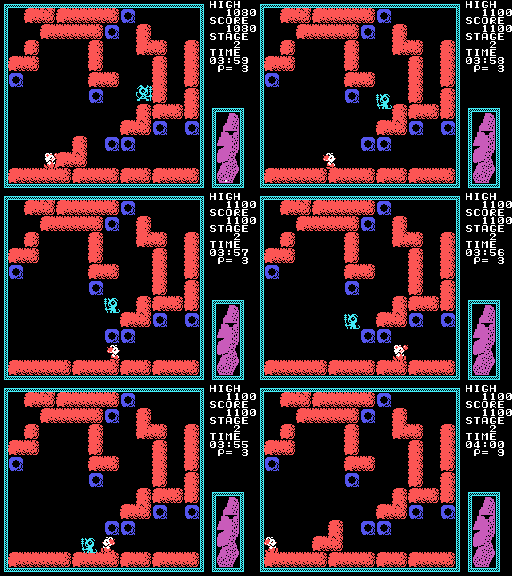
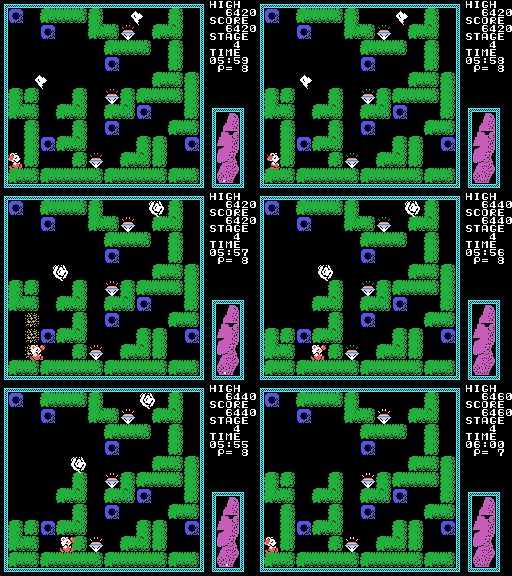
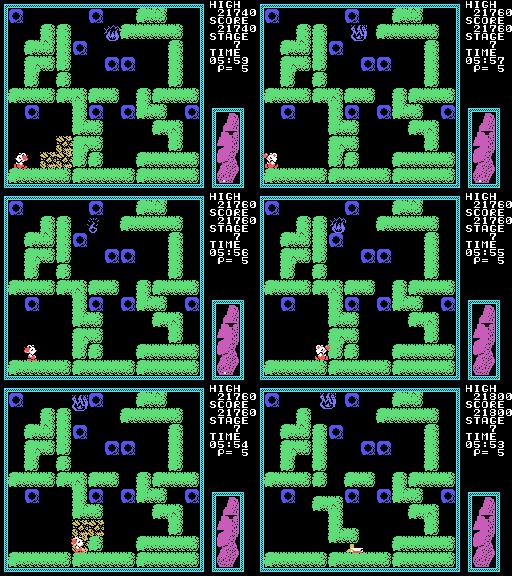
The stage GIFs come from a forced recording: the game pilot plays each stage for a while and then
tools/guiones/forzada.tcl ends it with a poke (0xE03A = 1, the exit; in the BONUS, 0xE183 = 1).
The maps
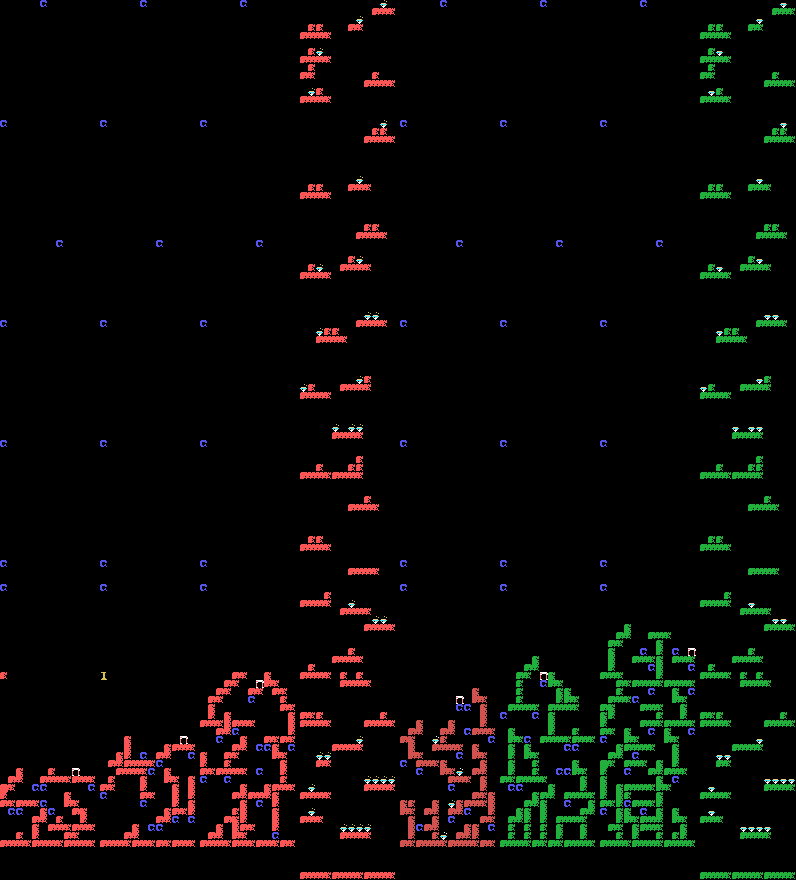
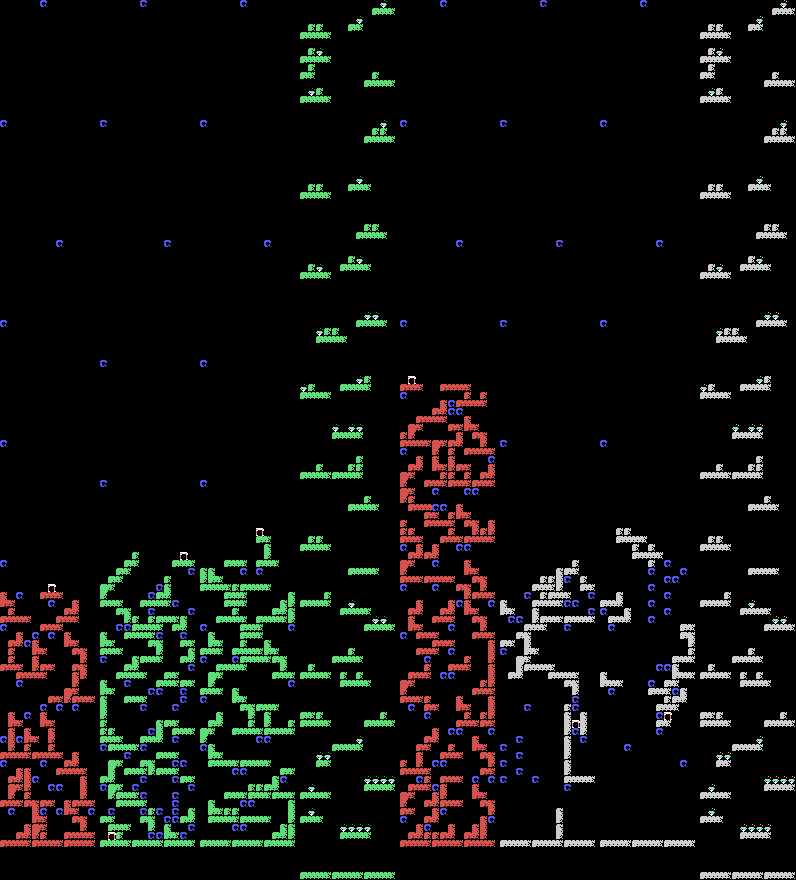
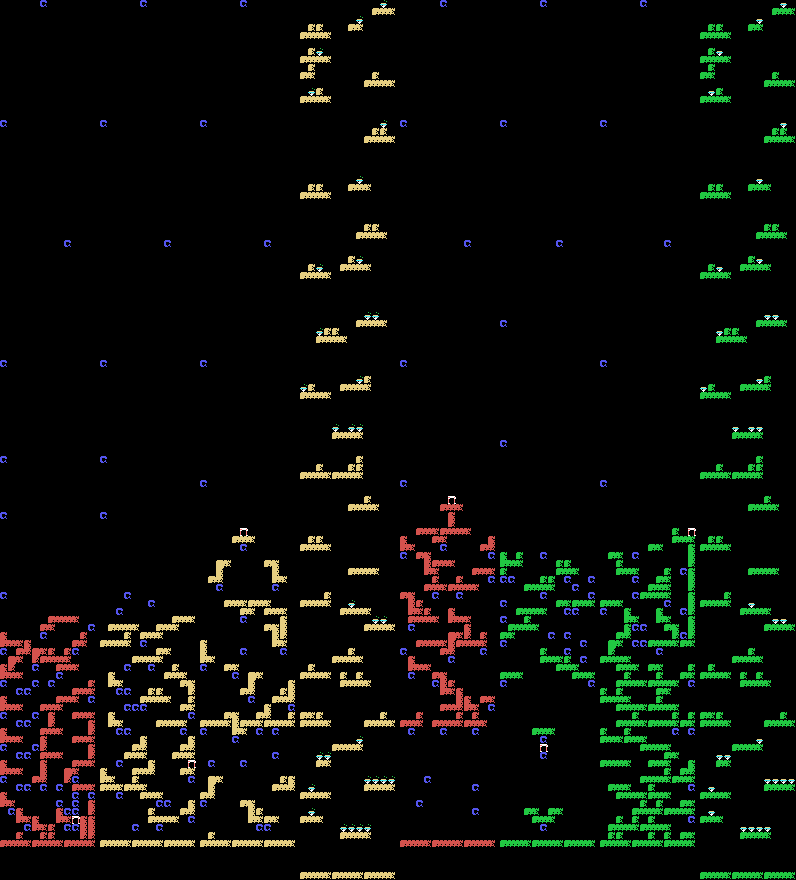
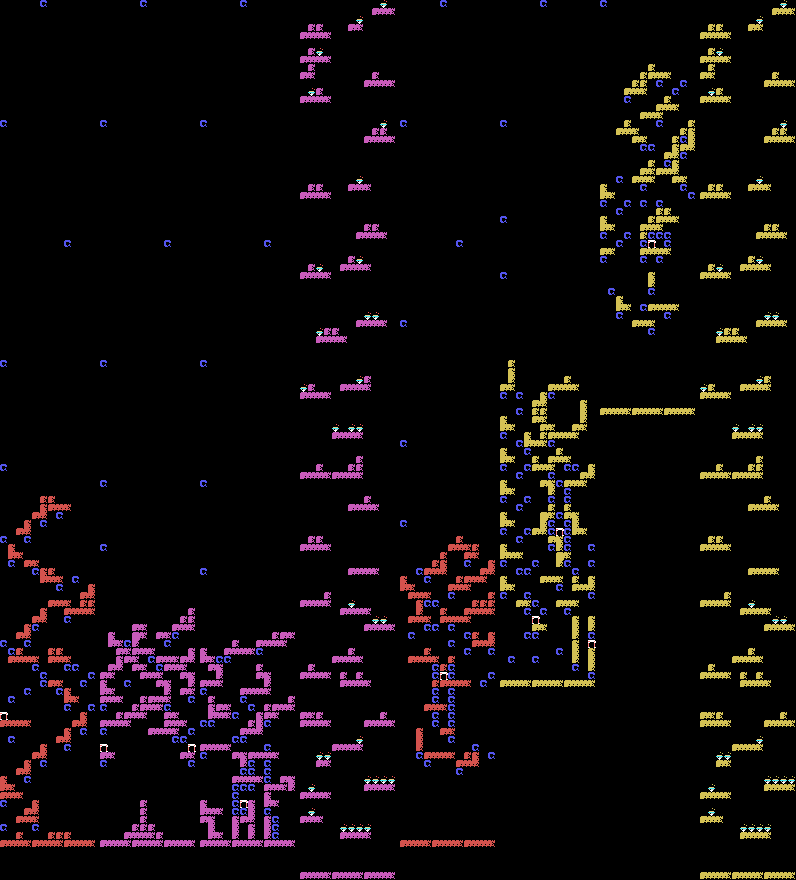
All 32 stages, whole, bottom to top as the game builds them, at half size and eight per image. They are drawn by
running the ROM (tools/mapas.py): fase_monta (0x849D) leaves the stage map in RAM (0xE800, rows of 12 blocks of
2 x 2 tiles) with the pick-ups already placed, and mapa_pinta (0x8D7B) draws it 11 rows at a time, as it does when
the view goes up or down. The tile drawings and colours, which the game loads at the start and every four stages
(0x864E), come from a recorded frame of each stage. No scoreboard or sprites: the enemies and moving objects are not
there.
Check against the forced recording: on every in-game frame, the name table against what is built from the row the view shows (0xE369): out of 59,707 frames, 30,382 come out identical and the median is 0 tiles out of 528. The rest carry what the game changes on screen during play (falling rocks, placed blocks) and the stage changes.
What can be picked up
Things are picked up by stepping on them: the game reads the tile under the hero (prota_pisa, 0xA6BF).
| tile | what it does | points |
|---|---|---|
| 0x80 | two protections (0xE30F) against enemies of types 1, 2 and 5: each touch uses one; with six or more, the jump is higher | 25 |
| 0x84 | protects for good from types 3 and 6 (0xE30C) | 30 |
| 0x88 | two blocks to lay | 40 |
| 0x8C | a jewel (0xE30D) | 100 |
| 0x90 | the exit: the stage is over |
What he carries is drawn on the scoreboard, under P=.
The stage over
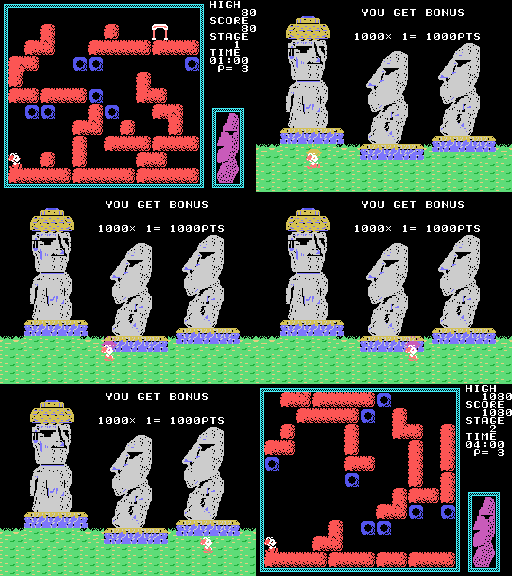
On reaching the door, the prize screen: three moai on the grass, YOU GET BONUS and the stage points
(fase_siguiente, 0x8B9E); the hero crosses it from left to right with the stage-over tune (fase_cruza, 0x8C20),
and the next one starts.
The BONUS GAME
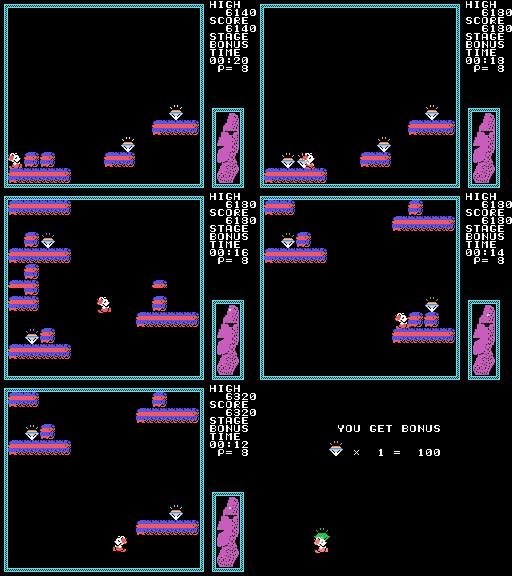
Some platforms with jewels and 20 to 35 seconds. It ends with the time or on touching something: in the BONUS,
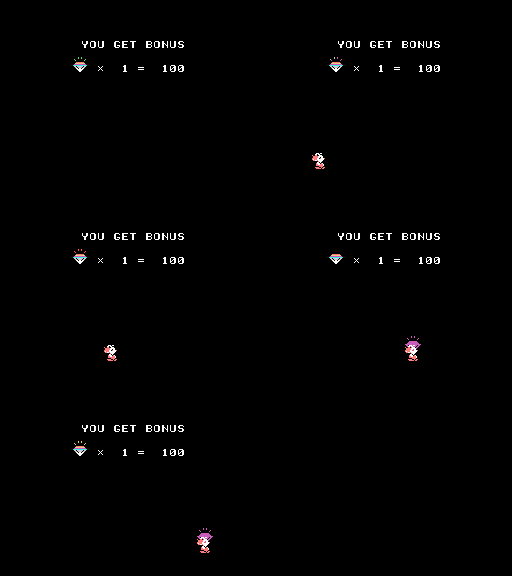
whatever would cost a life in another stage ends it (fase_bucle_fin, 0x88FF). At the end, YOU GET BONUS, the
jewels taken and 100 points for each.
The enemies
There are five at a time (0xE120, 16 bytes each); they come out of the map as each row is painted (fila_bloques,
0x9C66) and each type has its routine (the table at 0x931E).
| type | how it moves |
|---|---|
| 1 | walks looking at the six tiles around it: goes on, turns back, jumps a step or falls (andarin, 0x9334) |
| 2 | rolls: one step every 8 frames and falls if there is no floor (rodador, 0x9505) |
| 3 | flies straight, one step every 16 frames, without falling (volador, 0x9572) |
| 4 | walks changing its drawing and falls if there is no floor (0x95BF) |
| 5 | follows the wall along the passages (laberinto, 0x966A) |
| 6 | goes back and forth, across or up and down (rodante, 0x978E) |
| 8 | blinks and, after 128 times, explodes (parpadea, 0x97DB) |
| 9 | goes straight for some steps and explodes (recto, 0x981A) |
| 10 | follows a path of stretches and explodes (giros, 0x9857) |
Type 7 is the explosion. A rock that falls on an enemy makes it explode and gives points (see Curiosities).
The ending
After stage 32 (the last BONUS), the moai screen again, with the ending tune: the hero crosses it and, as he passes, each moai turns into a heap of jewels (0x412B). PJM1622 appears at the top and the colours cycle, with the tune over and over, until the button is pressed: the title.