The game
Konami's Ping Pong is table tennis seen from behind one player, with the table in perspective and the opponent at the far end. It came out in 1985 as the 16 KB RC-731 cartridge for MSX1.
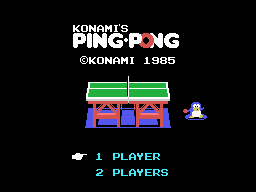
One player or two
The title screen offers both, and the cursor moves between them. What you pick ends up in a single bit: (0xE042) indexes a two-byte table -0x40 and 0x60- and whichever comes out goes into (0xE002). Bit 5 of that byte is the only thing the rest of the game looks at to know whether the other side is a person or the machine.
Five levels
The level menu is painted on top of the table once it is up.
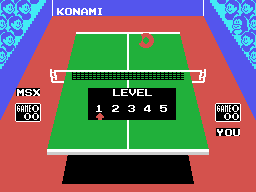
The five values it offers -1, 3, 5, 7 and 9- live in the table at 0x461F, and the cursor is pattern 0x88 placed at the column it names. Internally the level is the index, 0 to 4.
The level does not change the speed of the ball: it changes how the machine plays. It comes in at three different places:
- in the trajectory table, which says where it returns the ball
- in the points threshold past which it starts pushing
- and, on the easiest level, in a latch that makes it miss every other shot
In the attract demo the level is not the one you picked: it is a fixed 3, set by 0x40A9.
The rules are the real ones
They are all inside the cartridge, and they can be read off the code because the score is kept in BCD:
- a game is won at 21
- you must win by two, and if both reach 21 the score resets
- deuce at 20-all
- the service changes every five points, by checking the units digit of the sum of both scores
- and in the third game the players change ends at 10
A match is best of three. The ordinals announcing each one -1ST, 2ND and 3RD- are stored as three six-byte scripts.
What the umpire calls
Four labels, picked by the state of the rally: LET, NET, OUT and IN. Each has its own tune in a sister table, indexed by the same number.
And the other text the cartridge carries: LOVE ALL, GAME, DEUCE, GAME SET, WIN, CHANGE COURT and LEVEL.
Changing ends
When it is time to swap sides, the cartridge does not move the players: it swaps the controls. 0x46EB exchanges one player's two control bytes with the other's, and from then on each one drives the figure on the other side.
The table
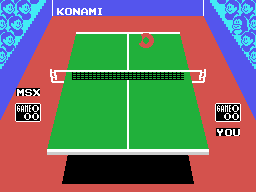
Half of it is drawn and the other half comes from mirroring it. The picture above is built by running in Python the same steps the cartridge runs, and it does not differ by a single byte from the one the emulator holds in its VRAM.