The game
Knightmare — in Japan Majou Densetsu, "legend of the demon castle" — is a vertical shooter in armour. Popolon climbs through eight stages killing monsters to rescue Aphrodite, and the cartridge pulls it off with a scenery engine built in bands and three sprite slots it keeps reloading.
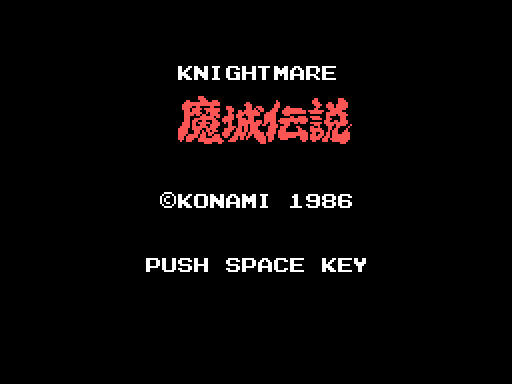
The title screen, assembled by running the steps of monta_el_titulo (0x47BA). The big logo is 33 tiles — eleven by three — written in a row by a loop starting at tile 0x60.
The eight stages, in full
Each stage is a vertical strip of 61 bands of four rows, that is 244 rows of tiles. It is not stored as a map: it is assembled block by block.
Here are all eight, top to bottom and at full size: 256 x 1952 pixels each. They come out of each stage's block codes and the 4x4 tile blocks at 0x9A6D; not one of them is a screen capture.
 |  |  |  |
| Stage 1 | Stage 2 | Stage 3 | Stage 4 |
 |  |  |  |
| Stage 5 | Stage 6 | Stage 7 | Stage 8 |
They read bottom to top, which is how they are played: Popolon comes in at the bottom edge and climbs. The topmost band is the boss gate.
The builder is 0x6502 and it works like this:
- The stage is split into ten sections, and each section into seven bands of four rows.
- Each band is eight groups of four columns. Every group yields a block code: the low seven bits index the table at
0x99ED— 64 pointers to 4x4 tile blocks — and bit 7 says the block goes mirrored. - After each group, an
rlpulls one bit out of a bitmap: with the bit set the pointer moves on to the next block, with it clear the previous block is repeated. That is where the scenery compression lives.
And the blocks overlap each other: 0x9C21 and 0x9C3E fall halfway into another block, so one stretch of bytes serves as two different blocks.
The objects on the map
The question-mark blocks, the grey blocks and the exits are not in the map. Each stage carries a list of three-byte records [type][row][x] at 0x6AF8 — 356 in all, grouped by stage through 0x6A98 — and 0x6A1E plants each one at the top of the screen when the stage's row counter, (0xE091), reaches its row. The type says everything:
- Bit 5: visible from the start. Without it the block is hidden until the first hit:
0x6883paints the question mark of0x6F40as soon as(ix+1)stops being zero. - Bits 0-3: how many shots it takes, from
0x6A7F: 5 for 500 points, 10 for the bomb and the freeze, 15 for a life, 30 for EXIT, 4 for the grey block, 5 for the bridge — one more when it is visible. - Bits 0-2: what it drops, through the dispatch table at
0x6909: a life (the yellow scroll at0x6F24;0x4305isuna_vida_mas), 500 points (cyan), the bomb that kills everything on screen (blue), the freeze (red), a grey block that stays where the question mark was and blocks the way — its tiles0x4C-0x4Fare walls forse_puede_pisar—, the EXIT sign of0x6F38, or a bridge four tiles square over the river (0x9A9C). Value 7 is not a block at all: it is a side passage (types0x97-0x9C, born already open): pairs at the same row, one at x=1 and one at x=248, strips eight pixels wide and 32, 64 or 96 tall; push outwards and Popolon comes out on the other edge (0x69FAflips(0xE604), his x).
The warps. Six EXIT signs, all hidden and only in stages 1 to 4: 1→2, 1→3, 2→3, 2→4, 3→5 and 4→6 — the pair [row][extra stages] at 0x6A8C, plus the one the end of the stage adds. An EXIT is only planted if (0xE006), the highest stage completed since power-on, reaches the current one (0x6A22). 0x4236 caps that counter at 4, which is exactly the last stage with an exit, and only INIT clears it: a game over does not.
Here are the eight maps again with the objects on them, already broken: where each question mark is born sits what it drops — framed white if the block is visible, dashed magenta if it is hidden —; the bridges are painted where the game paints them, around the block; the passages are the cyan strips at the edges. Where each one lands was measured in openMSX, not assumed: at eleven plantings across six stages the top row of the screen was always map row 220 - (0xE091), and that counter climbs to 0xD8 without resetting between sections (0x6463), so a record sits at row 220 - y, column x/8 (tools/objetos.py).
 |  |  |  |
| Stage 1 | Stage 2 | Stage 3 | Stage 4 |
 |  |  |  |
| Stage 5 | Stage 6 | Stage 7 | Stage 8 |
36, 42, 42, 46, 52, 50, 45 and 43 objects; in stages 6 and 8 every one of them is hidden. Asked for by theNestruo in issue #1.
The rivers and the bridges do not belong to the stage
A stage's tile sheet is not loaded by the stage alone. Before building it, monta_el_marcador (0x565C) uploads another block of 41 tiles — 0x27 to 0x4F — and its mirrored copy at 0x87. That block is not just the bottom panel: the rivers and the bridges live in it, the same in all eight stages, which is why any stage's map uses them without carrying them.
Order matters: the panel first and the stage tiles on top, overwriting 0x87 to 0x9F of the panel's mirrored copy. Build the sheet with the stage tiles alone and the bridges and rivers come out black.
Three sceneries out of one colour script
Stage 4 uses the SAME tiles as stage 1. What changes is the palette. Stages 0, 3 and 7 share the pattern script and the colour one. What tells them apart is (0xE661): the block reader (0x443B) translates five colour codes — 0xE1, 0xEC, 0xE8, 0xE6 and 0xE5 — by subtracting 0x50, and another 0x50 when the bank is 2. One 640-byte block gives all three sceneries.
Stages 5 and 6 go further: they share tiles and colour, and differ only in the map.
Popolon is three sprites

The twelve frames. The last four are the explosion.
The figure is drawn with three overlaid 16x16 sprites: 0x5E2D writes them with patterns 0, 1 and 2. The first two are uploaded by the frame — each takes exactly 64 bytes, that is two patterns — and the third is the first of the stage's fixed bank. Each one's y and colour come from a six-byte block: three [y offset][colour] pairs.
There are seven animations in the table at 0xA5B4, and one of them — number 2 — alternates its colours with those at 0xA5EF to make the invulnerability blink.
The bestiary does not fit at once
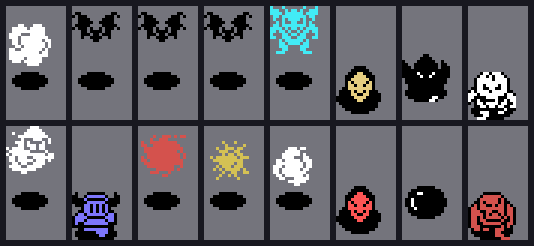
The sixteen kinds of creature, one per block at 0xA993, in the colour the table at 0x7772 gives them.
The MSX sprite sheet is 64 16x16 patterns and that is not enough, so the cartridge keeps three slots — VRAM 0x1D00, 0x1E00 and 0x1F00 — that it reloads in turn: 0x78F9 decompresses four patterns into whichever is next and also takes away the base pattern number, later added to each of the creature's sprites.
Every enemy is drawn with two sprites, and the pair comes from the table at 0x7772: 38 eight-byte blocks with two [dy][dx][pattern][colour] entries. From entry 5 on the pattern byte is relative — 0x7755 compares against 5 and only then adds (ix+0x16) — so a creature cannot be drawn without knowing which slot it was loaded into.
And it can be known, because the type settles both: (iy+0) & 0x0F is what 0x7914 uses to pick the block at 0xA993, and it is also what 0x75E5 uses to pick the subtable at 0x75F3 whose routines write (ix+0x0A), the entry into 0x7772. Tie those two ends together and it closes on its own: the patterns each type's entries ask for are exactly the ones its block carries, not one more and not one fewer, in all sixteen.
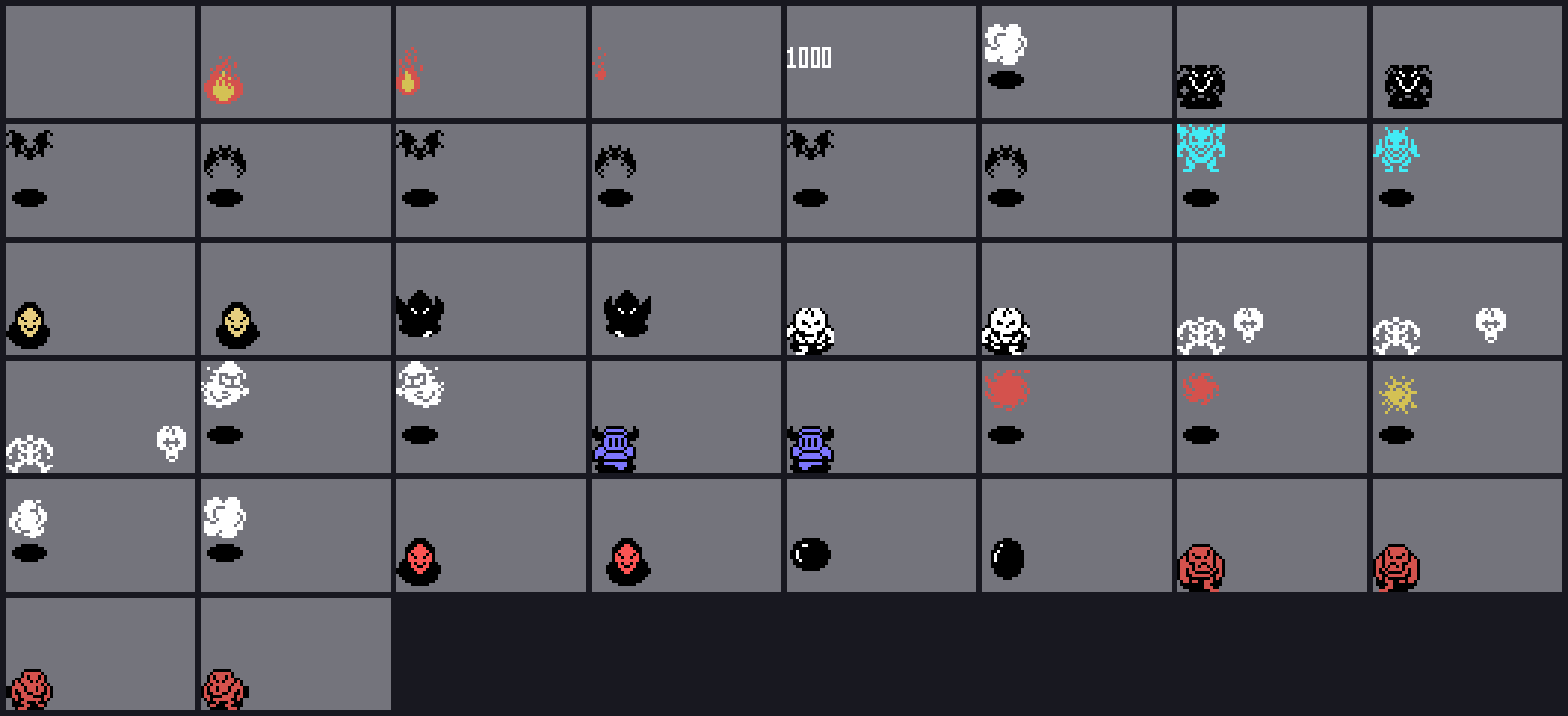
The 42 frames of the table at 0x7772, each with its type's block loaded in the slot. The grey background is deliberate: most of these creatures are colour-1 silhouettes, that is BLACK.
Of a creature's two sprites the first one wins: 0x772A writes them into consecutive attributes, and on the TMS9918 the lower plane number covers the other. Painted the other way round, the solid fill eats the silhouette.
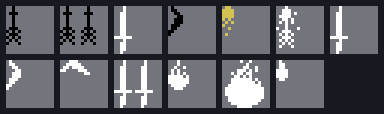
The seven weapons of the table at 0x63FB, a [pattern][colour] pair each. Only the last two animate: 0x636D gives them four frames with an and 003h.

The 37 fixed patterns 0x54BE uploads at the start of every stage: the weapons, the shots and the items. The same in all eight.
The bosses that come with a table
Two of the six bosses are assembled from a whole table of sprites, each entry [dy][dx][pattern][colour]: the stage 1 one with seven (0x902D) and the stage 3 one with nine (0x9338). And the pattern does not point into the fixed bank: before painting itself, each boss uploads its own — 0x8E57 and 0x9224, with descomprime_desde_la_palabra, which carries the destination inside the block — and both go to 0x1B00, exactly the pattern 0x60 both tables start from. Without that upload you get the fixed bank's weapons.


The stage 1 one, with its eleven patterns, and the stage 3 one, with its seventeen.
The other four are not here: the stage 2 boss has three sets of six sprites and 0x9186 adds its tail outside the table, and the stage 4 to 8 ones have not been located. Still open.

The seven frames of a shot leaving, from the table at 0x8250.
The scoreboard and the boss clock
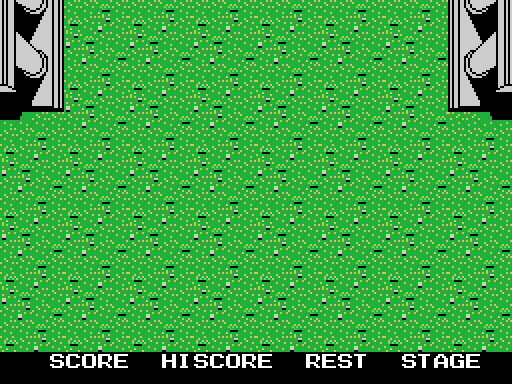
Exactly as it comes out of the emulator: the byte-for-byte check gives zero differences.
SCORE, HISCORE, REST and STAGE sit at the bottom, on row 22, and their digits on row 23. The score is three BCD bytes from 0xE056 and the high score three more from 0xE053; when the high byte passes the threshold in (0xE063), 0x4305 hands over an extra life and raises the threshold by 0x10 — ten thousand points — for the next one.
On the boss screen the lap counter is replaced by a BCD clock counting down second by second: at four minutes the music changes, and at zero it is over.