What the cartridge draws
Under each picture is where it comes from and what is on it.
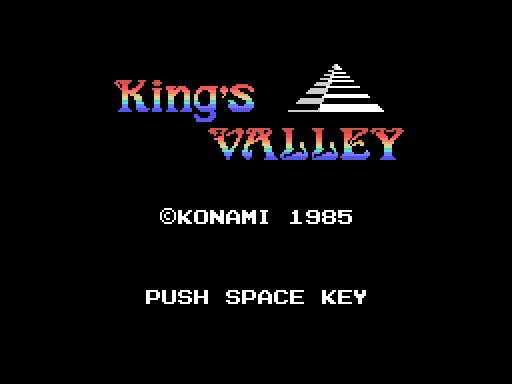
The title screen, built with the cartridge's own steps and matched byte for byte against a real machine's VRAM. The game's wordmark is not one piece of artwork: it is twenty-two steps, one per column, each writing two consecutive patterns from 0x9B on, plus the foot of the G, which drops one row further
The screen BEFORE that one: the Konami wordmark scrolling up, which is task 0. Task 1 erases all of it and paints the game's own on top. They are two different screens, and mistaking one for the other is what kept the wrong logo here until 2026-09-04
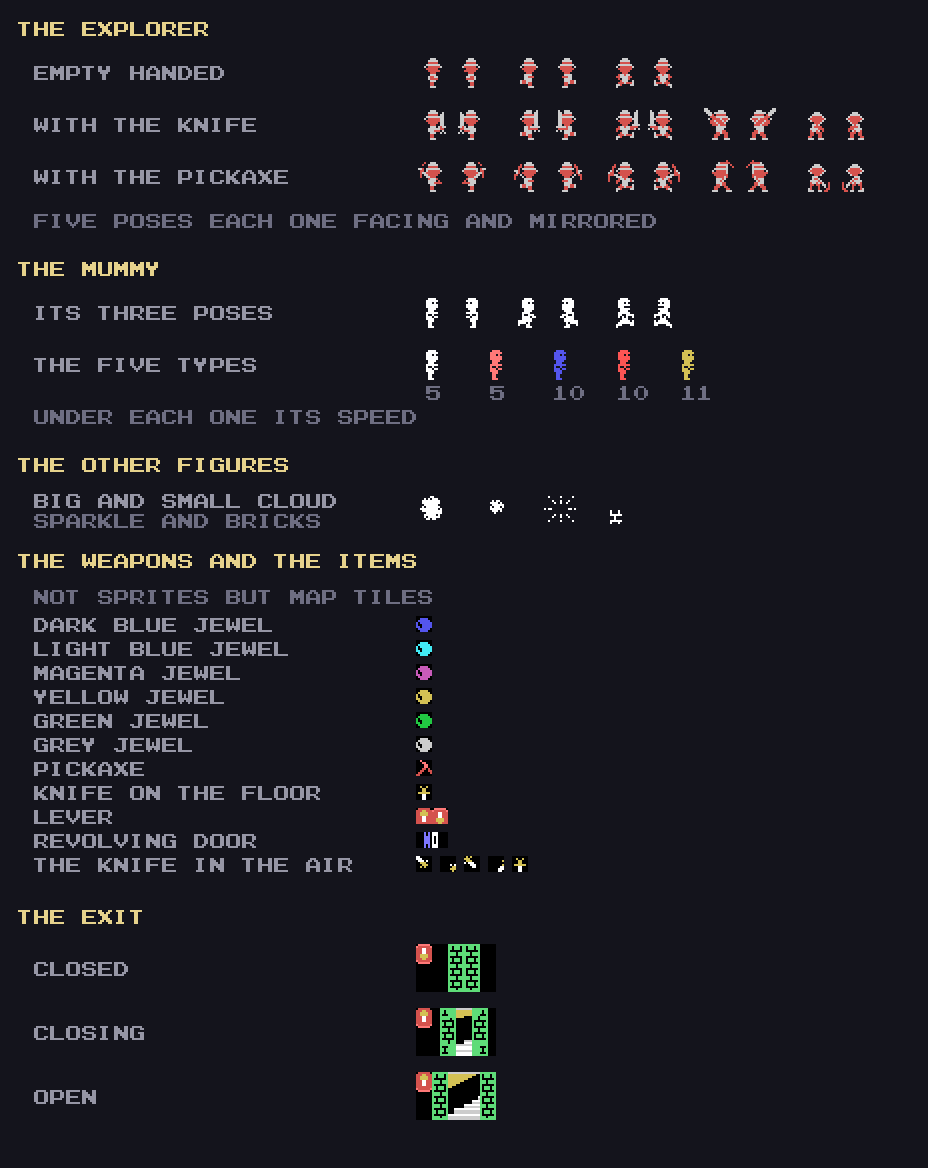
Every figure in the cartridge, named. The explorer has three sprite sets -empty-handed, with the knife and with the pickaxe- that load into the SAME VRAM address, which is why only one can be there at a time. There is no artwork for facing the other way: it is made on the fly by reversing the bits. The captions on this sheet are written in the cartridge's own typeface
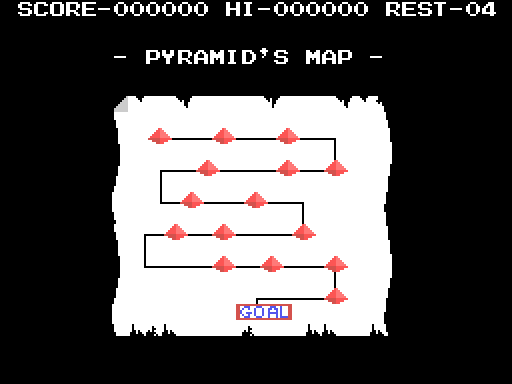
The valley map: the fifteen pyramids and the GOAL sign. It is not a list of levels but a ring, and every door in every pyramid carries the number of the pyramid it leads to. The parchment looks white because of a colour the title screen left behind and nothing touches again for the rest of the game: drawn on a clean VRAM it comes out black, which is how it looked here until 2026-09-04
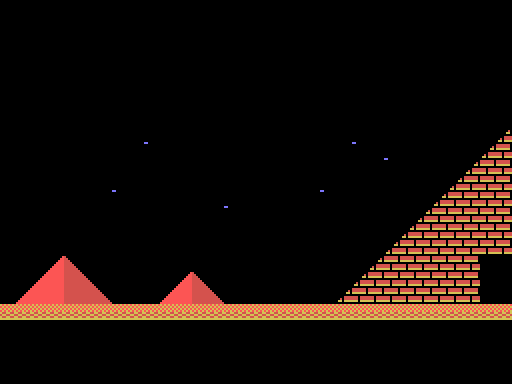
The final screen, with its labels that stretch. They are not artwork: rotulo_horizontal (0x76A7) writes one end tile and fills sideways, dropping a row and growing one cell each time round until it passes VRAM 0x3A80

The game screen frame with no room in it, as prepara_sala_nueva (0x4FC9) leaves it. The wall tiles are loaded but still colourless: columna_decorativa supplies that afterwards, and it is what gives each group of four rooms its own stone
The demo
When nobody touches anything, the cartridge plays itself. It is not an
intelligence: it is a recorded script. arranca_partida puts the pointer
to 0x4ACE into 0xE080, and guion_de_la_demo (0x4621) reads it in (input,
duration) pairs until the 0xFF that ends it. The input values are exactly the
same bits the controller would leave.
The full menu cycle, measured in the emulator in an earlier batch, is task 0 (logo) → 1 (title) → 3 → 4 (room name) → 5 (room at rest) → 6 (the demo moves) → back to 4 → 7 (pause) → 0 again. One round takes 57.6 seconds of emulated time, and the pyramid it plays is always the fifth.