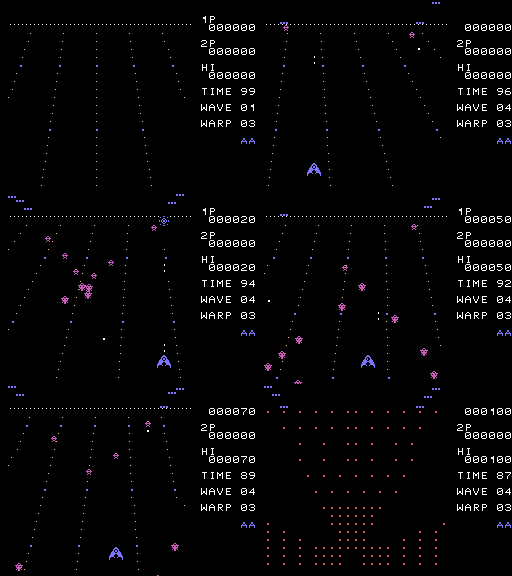
The waves
Juno First has no drawn levels: it has waves. Each one is the same field
with a different number of enemies (oleada_siguiente, 0x1269), and every
fourth one is special. After wave 99 it goes back to 1.
How many enemies
| Wave | 1 | 2 | 3 | 4 | 5 | 6 | 7 | 8 | 9 | 10 | 11 | 12 | 13 on |
|---|---|---|---|---|---|---|---|---|---|---|---|---|---|
| Enemies | 30 | 32 | 34 | 32 | 36 | 38 | 40 | 32 | 44 | 46 | 48 | 40 | 50 |
The first wave brings 30 (partida_nueva, 0x0597); the others, what the table
at 0x125B says for the wave that has just ended. The special ones (4, 8 and
12) bring fewer than their neighbours. What also changes from one to the next:
the enemies fire more often (the table at 0x0E08) and, from wave 8, the dots
falling from the horizon move more slowly (every 8 steps instead of every 6;
0x0B17).
How it starts
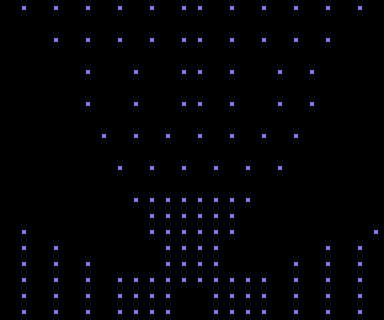
The field stops, is cleared, and the wave picture is built on it, a 24 x 20
dot image (0x1574): the field in perspective up to the horizon and the ship at
the bottom. Then the grid and the ship in the middle (oleada, 0x0609). The
same picture comes up when the ship is lost, from the bottom up.

How it ends
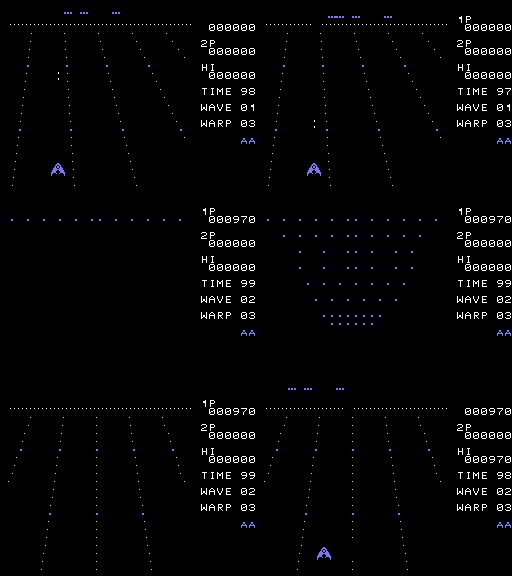
With the last enemy, the field stops, the end tune plays and the TIME left is
added times 10 (oleada_hecha, 0x120B): with 97, 970 points. The next wave
starts with TIME at 99 and three WARPs. The GIF is recorded with the enemies
still to come set to zero with a poke.
The special wave
Waves 4, 8, 12... (those with the two low bits at zero; oleada_especial,
0x16D2). The enemies do not come out at random: they enter from the sides,
one on each side in turn, in diagonal rows, and all of the same type (the
wave divided by four); the field moves at a fixed speed; the capsule does not
appear, and instead of a cap of twelve, a full band lets no more through
(cuenta_franjas, 0x12DE). The GIF is recorded with the wave set to 4 with a
poke.