Curiosities
Two cartridges at once
Right after power-on, the game looks in every slot (the four and the sixteen expanded ones) for a 0x21 at address
0x81B9 (init, 0x4010). That is the byte the first Iga Ninpouchou, from 1985, has there, and none of the other
ten Casio games of this series disassembled before. If it finds it, it sets 0xE060 = 1. In openMSX, with the first
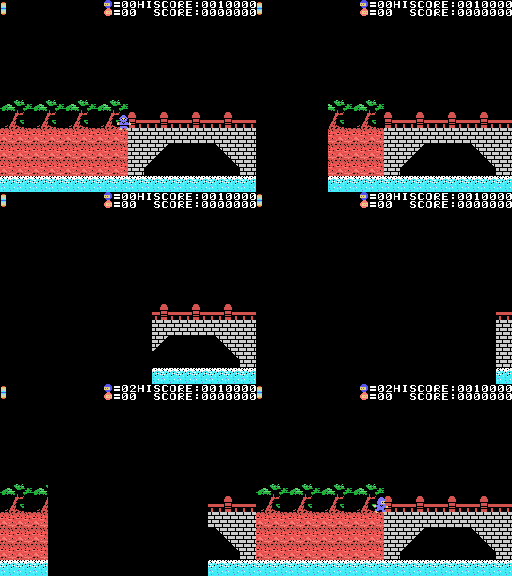
Iga in the second slot, 0xE060 becomes 1. What changes:
- the moon never changes (0x8862): a fixed drawing (0x890A) takes its place and the stage has no time limit;
- on stage 0 the ninja starts down below, on the river bank (Y 0xA0, not 0x70);
- and stage 0 ends without defeating ten enemies: being at the height of the bridge past position 0x48 of the map is enough (0xA7E6). This is read from the code: the pilot of the recording did not get there.

Two keys on the title
When the CASIO intro ends, the game looks at the keys once (0x809C):
- BS held: 0xE023 = 1, and the enemies do not kill the ninja (
ninja_tocado, 0x850C). The spikes, the moon and the boss up close do: those deaths carry a 2 and do not look at BS. In openMSX, with BS, the pilot cleared stage 0 without losing a life. - 2, A, I and G together: 0xE039 = 2, and with no lives left CONTINUE PUSH TRIG1 / END PUSH TRIG2 appears: with button 1, two more lives and the stage again, as many times as wanted. In openMSX, twice in a row.
IGA2
When the boss of stage 6 is beaten, the game writes IGA2 in the tower window (0xAC4D): the same four keys of the continue trick.
STOP and F1
While playing, the interrupt looks at two more keys (0x8D0B):
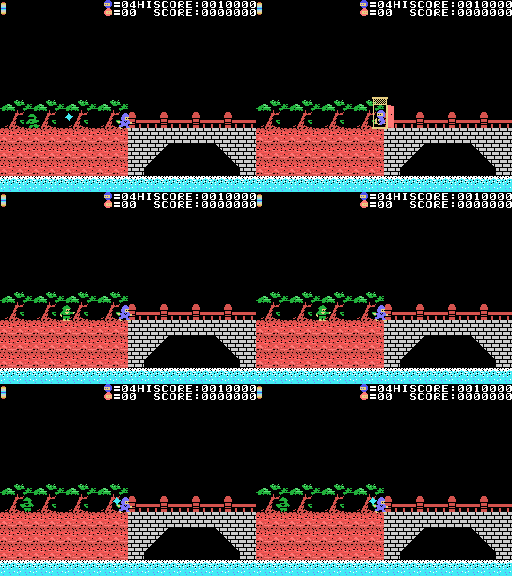
- STOP stops the game (0xE1B7): the ninja is drawn with other sprites (0x5400) and nothing moves until it is pressed again. With C and W held together, other drawings, which go back to the previous ones every 0x60 frames.
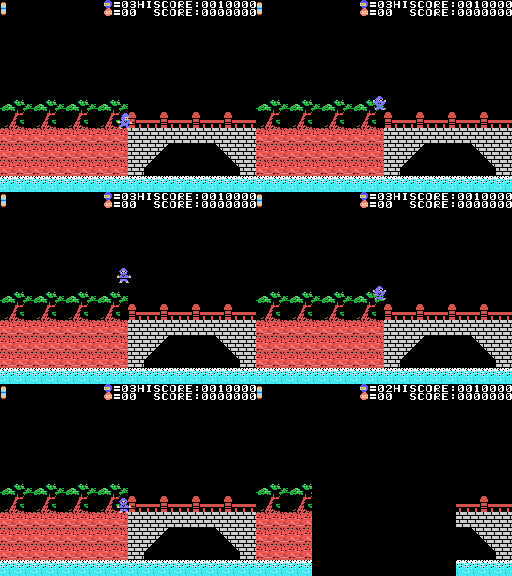
- F1: the ninja falls and a life is lost (0xE1B3), as when an enemy touches him.
Both checked in openMSX.
The title colours come from the BIOS
The game's name changes colours every 4 frames: each time it copies 512 bytes from the computer's ROM, from 0x3000 and one byte further each time, and uses the high half of each one as a colour, or 0x60 if it is below 0x20 (0x8144). The colours therefore depend on the MSX's BIOS: the ones in the title GIF are C-BIOS's, openMSX's.
One life at 10,000
At 10,000 points (1,000 inside: the final 0 is fixed) the game gives one more ninja, only once (0x8C2F).
SCORE is inside HISCORE
The scoreboard writes "HISCORE:" from 0x9073 and "SCORE:" from 0x9075: the last six letters of the same text
(marcador_pon, 0x87A5).
Leftovers from other programs
- 0x9FD5: the start of the routine of the kakejiku that rolls up, from the first Iga Ninpouchou.
- 0xBFBB: the end of the first Iga's routine that paints the screen.
- 0x90D4: a piece of a points routine with a cap at 999999 and one more life when 0xE00D reaches 0x30, which is not this game's.
Code nobody calls
- 0x9A66 and 0x9B02: moving the screen up or down 8 points per step, from one floor to another: a vertical scroll the game does not use.
- 0x8A02: another way of opening the screen, from the centre.
- 0x8930, 0x9C5A, 0x9D63, 0xA049, 0xA0A0, 0xA716 and 0xA78F: pieces of routines that are already somewhere else.
- 0x8506: a byte skipped by a
jr.
None of them ran in the coverage measured in openMSX.