What the cartridge draws
Under each picture is where it comes from and what is on it.

The wordmark, drawn from the ROM: the name table at 0xABA1 with the tiles from 0xAA0E on top. Checked against the emulator: the six pattern and colour tables and the whole name table, 13,056 bytes without a single difference
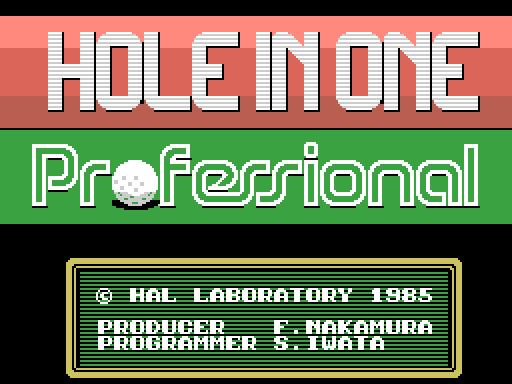
The cartridge's front page, built with its own steps: the wordmark from 0xABA1 and 0xAA0E and, on top, the four rows of twenty-one characters 0x51BF lays down from 0x1A46. It says who made it: © HAL LABORATORY 1985, produced by F. NAKAMURA and programmed by S. IWATA. The at sign is this font's copyright symbol, and > is its full stop
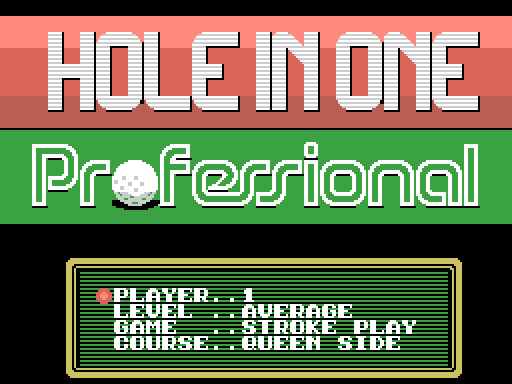
The menu, with its factory settings. Four lines and three parallel tables: 0x40CC says which routine lowers the value, 0x40D4 which raises it and 0x40DE which RAM variable it works on. The jump is not a jp: the address is pushed and the ret does the jumping
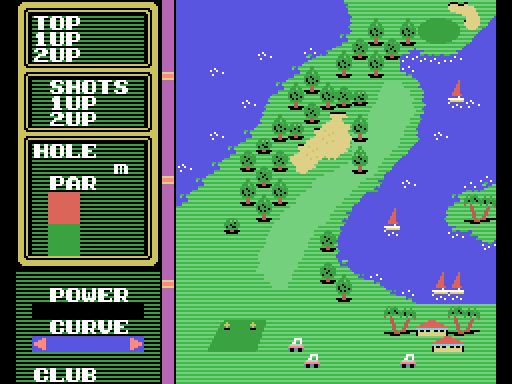
Hole 1 of QUEEN SIDE, par 4 and 352 metres, with the panel on the left exactly as 0x67EF writes it and the map starting at column eleven. This is the screen that is compared against the emulator: the whole name table, 624 of 768 cells, with zero differences — the 144 left out are the six columns where the game writes live figures
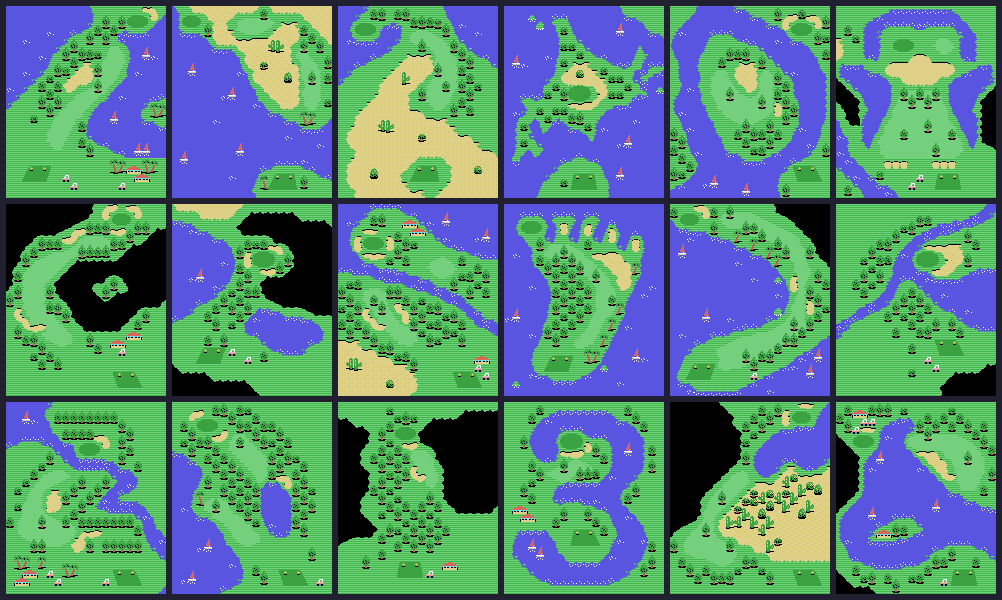
QUEEN SIDE in full: the eighteen holes, par 72 and 6,166 metres, drawn one by one with the same script interpreter the Z80 runs. Four par 3s, ten par 4s and four par 5s. Look at hole 10, shaped like a foot, and hole 16, which draws a figure three
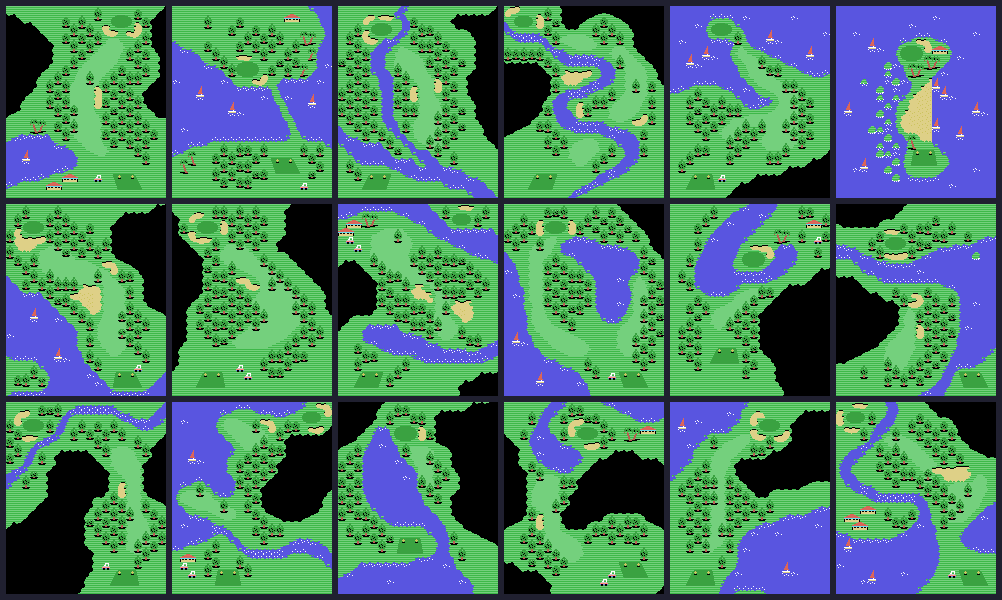
KING SIDE, the second course: also par 72 with the same spread of pars, but 6,290 metres and visibly much harder. More water, narrower fairways and a lot more black, which is tile 0x00 and the game treats it as out of bounds
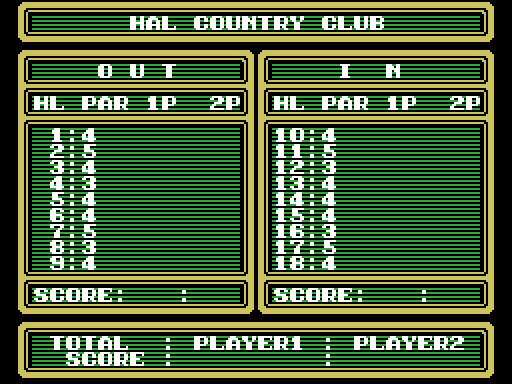
The second name table, at 0x1C00: the eighteen-hole scorecard with its OUT and IN halves. The hole numbers and pars are not in the table: 0x49D8 writes them, reading each hole's par off the tee tile in its script. Here they are placed by that same arithmetic, and they land exactly on the cells the table at 0x4A18 points to
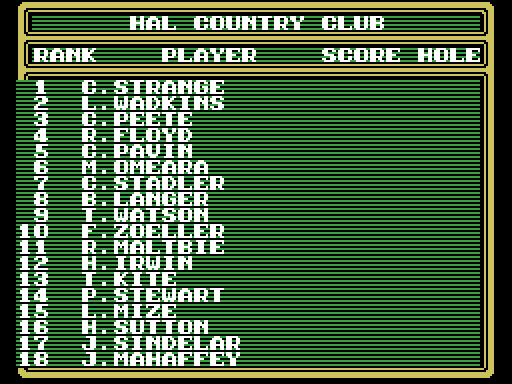
The third name table, at 0x3C00, with the first eighteen of the thirty-five professionals at 0x5009, written in the cartridge's own font. The order is the table's, not a round's: the tournament shuffles them at the start
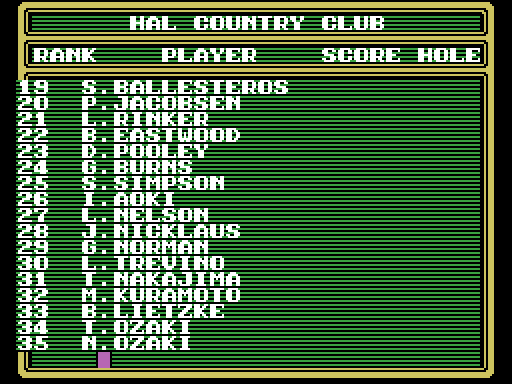
And the remaining seventeen. Ballesteros, Nicklaus, Norman, Trevino, Aoki, Nakajima, Kuramoto and both Ozakis: the mid-eighties tour, European, American and Japanese

The seven frames of the swing, from 0x9F21. Each frame is four by five tiles and every row starts with a four-bit mask: a bit set is a gap, a bit clear takes the next tile off the strip. The scripts at 0x9EC0 chain them, and on the third — the impact — track 5 plays
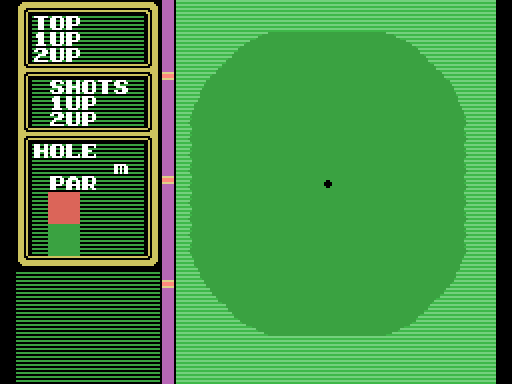
The close-up view. There is one green script for all thirty-six holes (0x9D6C) and it is built at 0xCCE0 instead of 0xCB00; the patterns and colours that draw it decompress on top of the course's, which is why the panel's bottom six rows are blanked first. The hole goes wherever the table at 0x7128 says, the same nine-position grid but in green coordinates
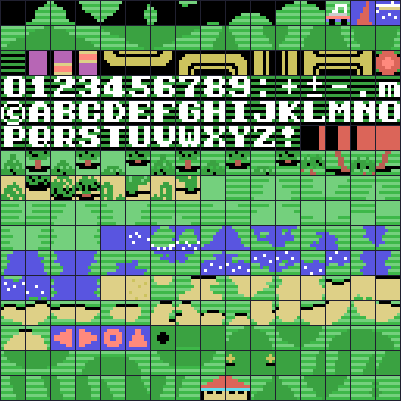
The whole pattern table, 256 tiles of 2 KB decompressed from 0x9F85 and copied into all three thirds of the screen. Here are the panel frame, the font — with © on the at sign and the full stop on > —, grass, water, sand, trees, the golfer and the clubhouse
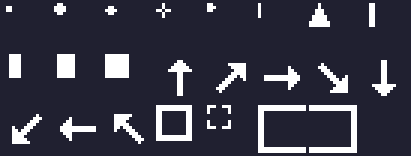
The twenty-three sprites, decompressed from 0x6898 to 0x3800. The ball in five sizes — it grows with height, which is how you see it is airborne —, its shadow, the flag, the eight wind arrows and the editor's cursor boxes

And the scorecard's banner, which is the closest thing to a title in the ROM: HAL COUNTRY CLUB
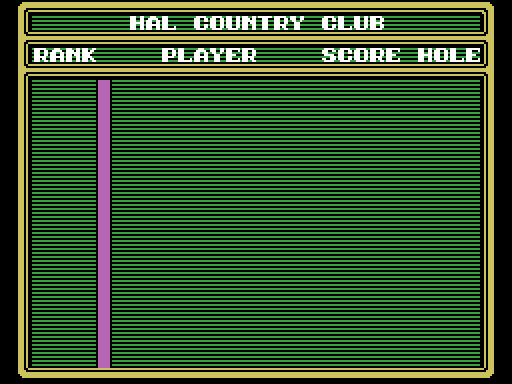
The tournament leaderboard screen as it comes out of the ROM, before anyone writes on it. RANK, PLAYER, SCORE and HOLE, and eighteen rows 0x674E builds by repeating the same thirty-two-cell block eighteen times