What the cartridge draws
Under each picture is where it comes from and what is on it.
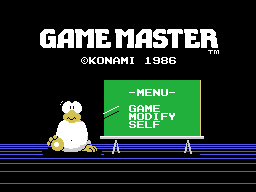
The title screen, built step by step the way the cartridge builds it: the four compressed background blocks, the two character rectangles, the label block with the © KONAMI 1986 that dates the build, and the six sprite attributes. Checked against openMSX's VRAM: of the 16,384 bytes the only one that differs is 0x39A9, and it is not a mistake — it is the cursor blinking
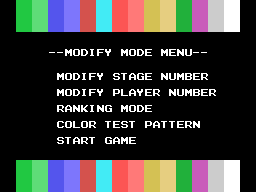
The MODIFY MODE, which is what you came for: pick the stage to start on and how many lives. The colour bands top and bottom are not a stored picture: a loop (0x504E) writes them, repeating each tile twice from 1 to 15 and round again, four whole rows per band
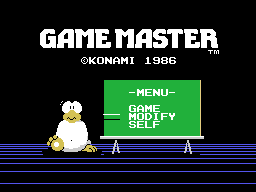
The start-up menu, with the chalk pointer aiming at the chosen line. The three pointers are twelve tiles each (0x4FA9, 0x4FB5 and 0x4FC1) painted in the same spot on screen, and finding out what they were meant drawing them: read as bytes they say nothing
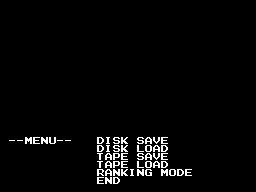
The disk and tape menu. On a real machine the top half is the running game: this screen only clears the bottom eight rows, and the game's VRAM has been carried into RAM beforehand so it can be restored on the way out. Here it shows on black because there is no game to put
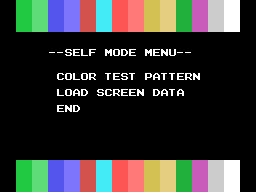
The SELF MODE, the test menu: the colour test pattern and loading saved screens
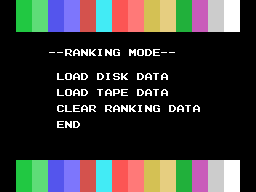
The RANKING mode. The cartridge keeps a high-score table per game, prints it if there is a printer, and when cleared leaves all six places under the house name: KONAMI