The game
F-1 Spirit 3D Special is a 1988 Formula One game for the MSX2+, made jointly by Konami and Panasoft (Panasonic's software label): that is why it carries two catalogue numbers, Konami's RA005 and Panasoft's SW-M007. The race is seen from behind the car, with the road drawn in three dimensions. It comes on three 720 KB disks: the Opening Disk, which only shows itself off, and two game disks, Game Disk A (the menus) and Game Disk B (the race).
Every picture on this site comes from running the game from the disks on a Z80 and a V9958 written for this project (tools/f1run.py) and painting each frame with our own code from the video memory and the registers of every line (tools/foto.py). They are not screenshots; the animations play at the MSX's speed (60 frames a second, one picture every 4 frames).
The Opening Disk
It starts with a picture of the car in SCREEN 12, a screen mode that only the MSX2+ has (19,268 colours, with the colour shared between groups of four dots). Game Disk A has another version of the same picture. Both are painted here straight from the disk sectors (tools/yjk.py):
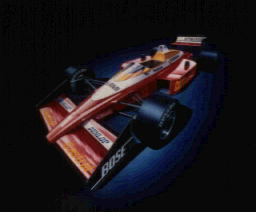
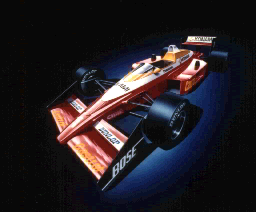
Then it walks through the game's menus on its own, as a presentation: the specification of a 1988 Formula One car, the modes, the choice of circuit with its map and record, the body and its colours and the six settings of the car:

And then a demonstration race, always in France, which the computer drives:
The title and the modes
Game Disk A starts with the title:
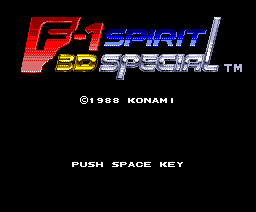
There are four modes: FREE RUN A and FREE RUN B (a single race on the circuit you choose), GRAND PRIX (the season) and BATTLE MODE (two players).
The Grand Prix
The season has the 16 races of the 1988 championship, in their order, from Brazil to Australia (they are all on The circuits). You start a new season or continue one, type your name, choose whether to change the car's settings, and for each race choose PRACTICE or RACE. Points are given as in real Formula One that year: 9, 6, 4, 3, 2 and 1 for the first six.
After each race the game writes the season to Game Disk A (sector 1088): up to four entries, each with the name, the next race, the car's settings, the order of the drivers and their points. With four entries in use, it asks which one to overwrite.
At the end of a race, the results screen:
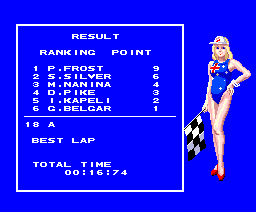
If you finish in the top three, there is a scene with your place before the table. This is the winner's (You won the first prize) and the table after it. To record it the race was ended with the usual shortcut (0xC420 = 2) and the place was set by hand: 0xC103 = 1, the slot rs_primero (res3 0x0875) looks at (tools/gif_resultados.py):
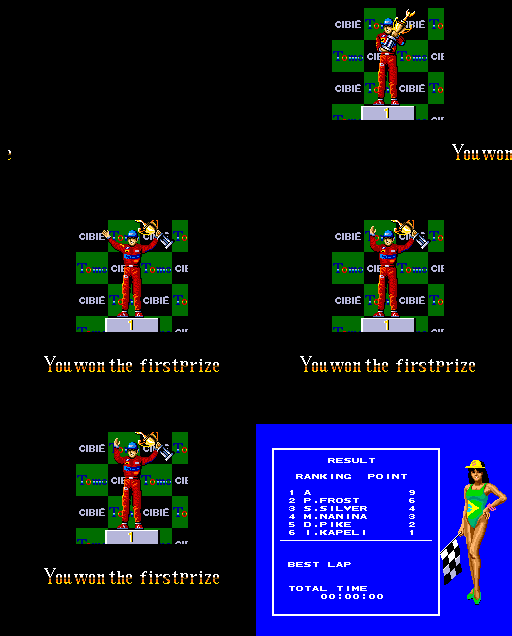
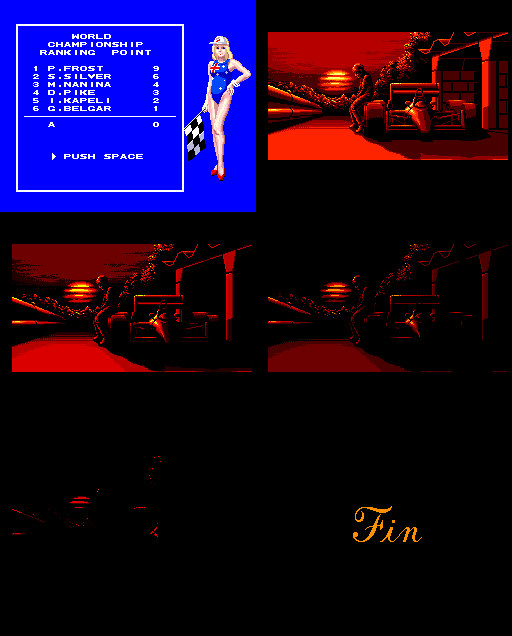
After the last race comes the championship standings and then one of two scenes. If the player is first (0xC140 = 0, rs_campeon at res3 0x08DB), the world champion one; here that 0 was also set by hand:

If not, the other one (rs_fin, 0x0903), which ends in «Fin» and goes back to the title without saving:
The car
Before racing, the car is set up part by part:
| Part | What can be chosen |
|---|---|
| ENGINE | V6 turbo charged 1500 cc 700 PS or V8 turbo charged 1496 cc 650 PS; in a season already started the engine cannot be changed, and you get TORQUE SETTING (1 to 4) instead |
| TIRES | slick or rain, each from soft to hard |
| SUSPENSION | from soft to hard |
| BRAKES | three settings |
| GEAR | HI GEAR, BALANCED or LOW GEAR, and manual or automatic gearbox |
| WING | the down force, from low to high |
The body and its colours are chosen too. These are the texts the game shows; what each one does to the car is in the race code (Under the hood).
The race
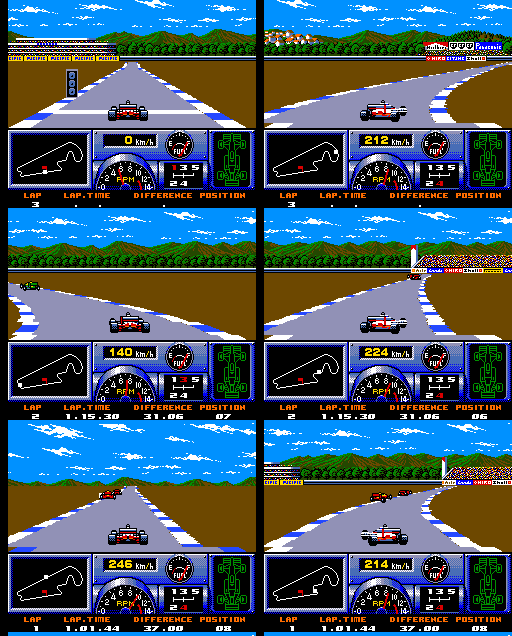
The screen is split in two: the landscape and the road above, the cockpit below (the map of the circuit with the cars, the speed, the fuel, the rev counter, the gearbox and the car with its worn parts). At the bottom, the lap, the lap time, the difference with the car ahead and the position.
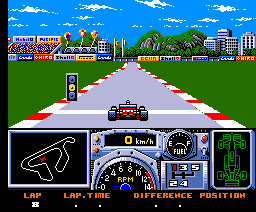
The road bends because the game changes the horizontal scroll of the V9958 on every line of the screen, and the landscape turns with it.
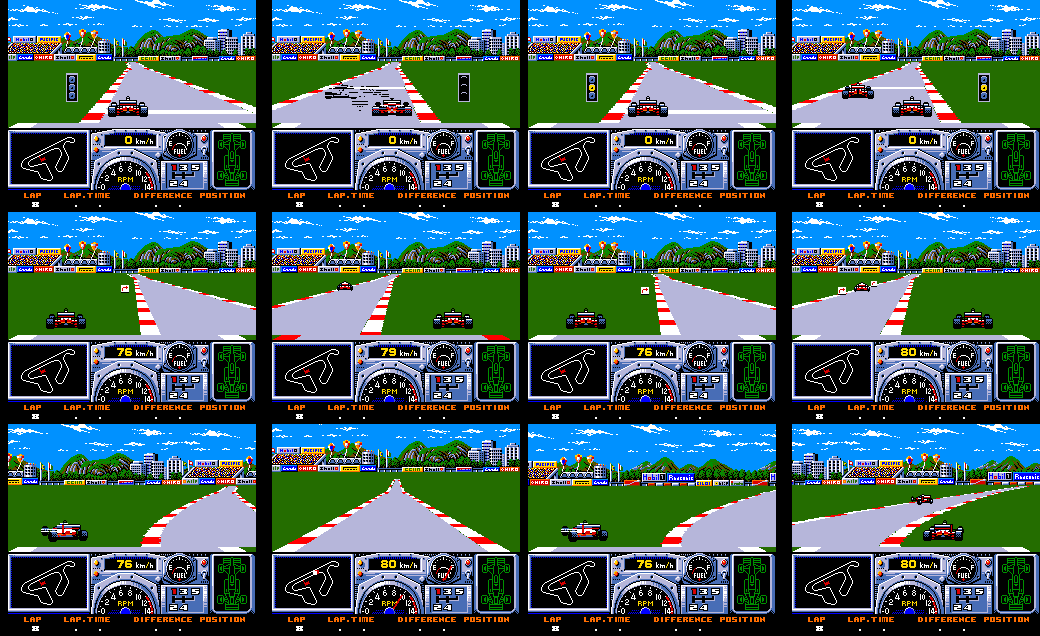
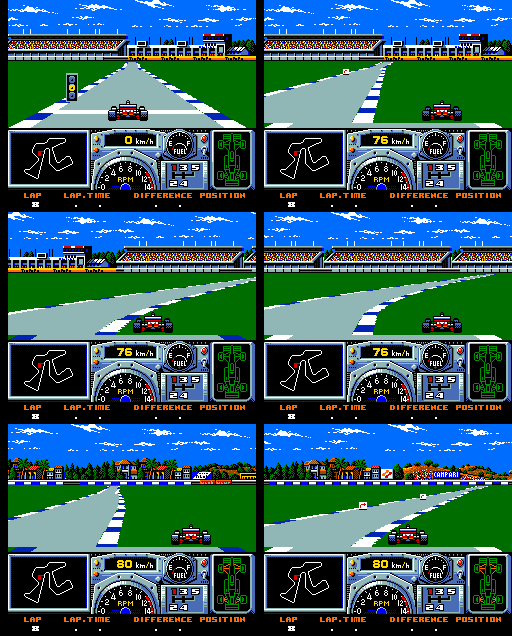
A start in Spain, played from the grid: the lights and the first 20 seconds. The driver is an autopilot that only looks at the game's variables (the car's side, 0xC403, and the coming curve, 0xC41C) and does not change gear, so it does not go past about 80 km/h (tools/gif_carrera.py):
The pits
At the end of each lap, keeping to the right, the car goes into the pits. A menu of eight lines asks what to fix (front wing, rear wing, brakes, suspension, engine, gearbox, tyres and OK); with the tyres, whether to put dry or rain ones. While the mechanics work, the rivals go past: the position gets worse, and the time of the stop is added to the lap. Then you accelerate to leave.
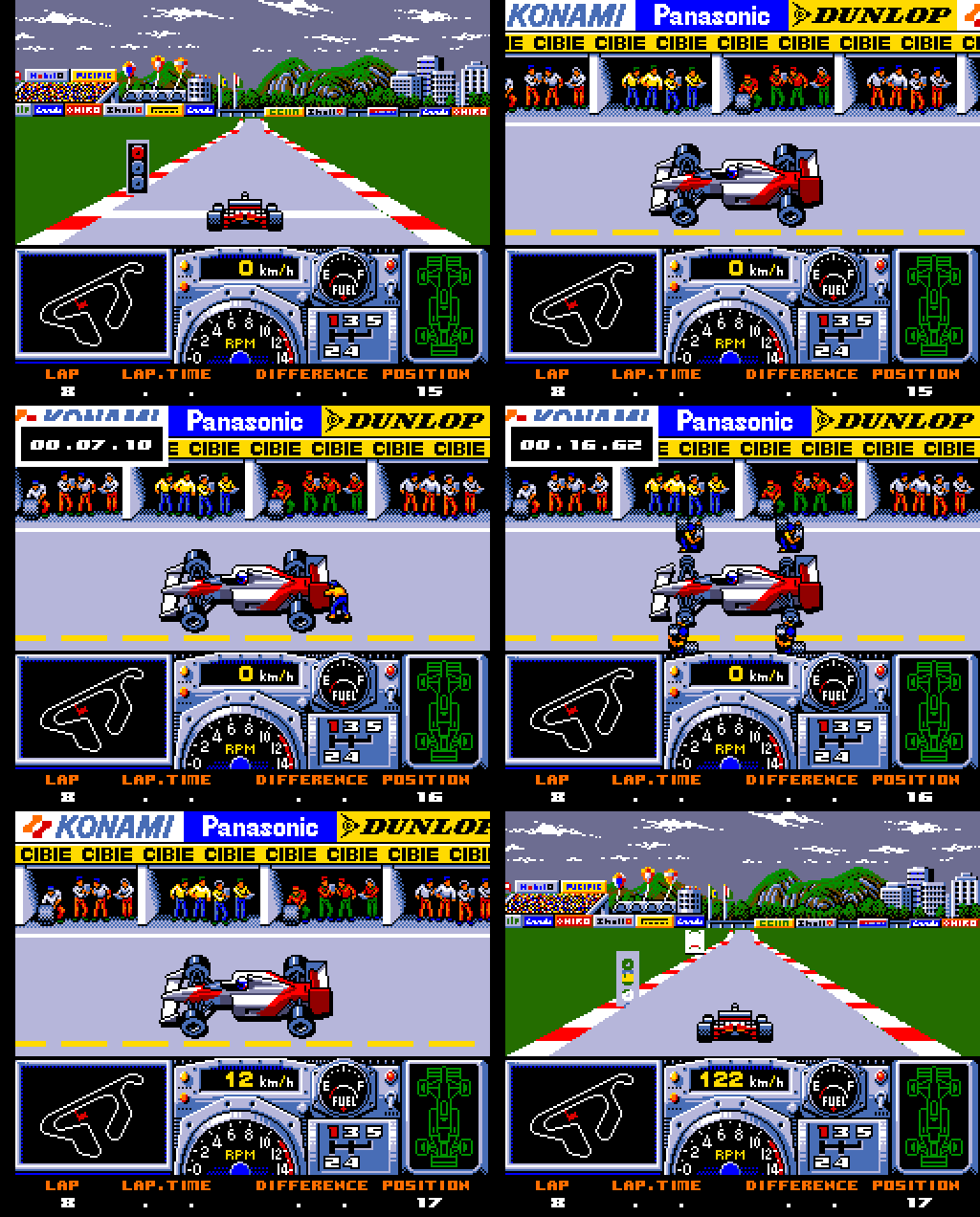
To record this one, the entry to the pits was triggered in the emulator by writing the two values the game writes when the car comes in (0xC020 = 1 and 0xC44E = 24, race code 0x27C9); everything after that is the game's own, with the keys pressed by a script.
Two players
BATTLE MODE is for two MSX joined by a cable in the joystick ports: both machines greet each other through the sound chip's port lines, and the screen says WAITING until the other one answers. The first one to arrive sends the circuit to the other, and during the race they swap the car's position, side and posture every frame, one bit at a time with an acknowledgement (carr3b 0x4385). The cable crosses port 2 of both: pin 6 of one to pin 1 of the other, 7 to 2 and 8 to 3: the simplest wiring that fits the protocol in the listing.
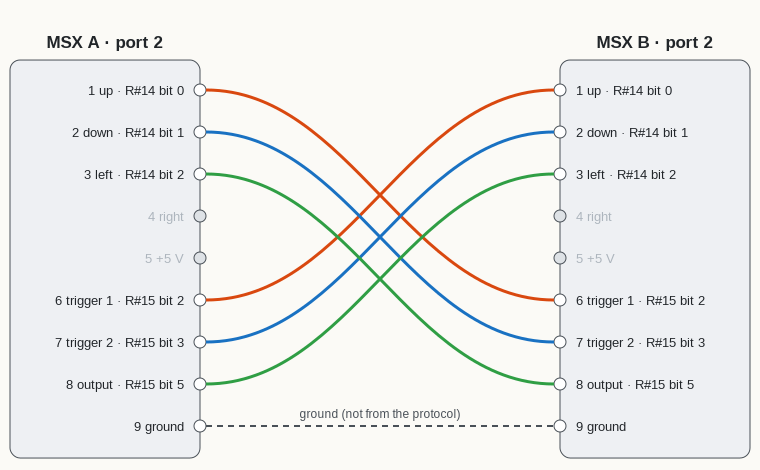
For each bit, the sender puts the data on pin 8 (green) and pulls pin 6 (orange) low to say so; the other reads the data on its pin 3, answers by pulling its pin 7 low (blue), which reaches the sender's pin 2, and both raise them again for the next bit (manda8, carr3b 0x447A; recibe8, 0x44BD). Ground does not appear in the program: any cable carries it.
To record it, two copies of the game were run at once, joined like that instruction by instruction (tools/battle.py), both with the autopilot. On the left the MSX that was waiting; on the right the one that came later, which sees the other car on its road: