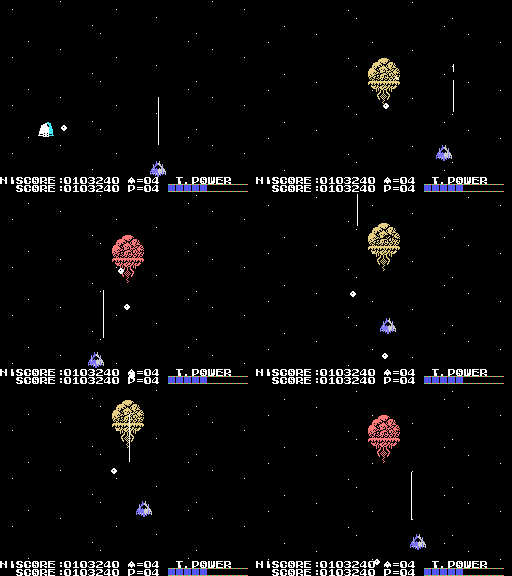
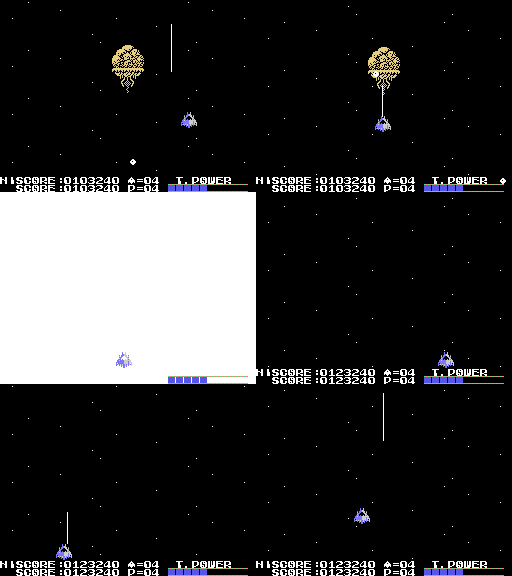
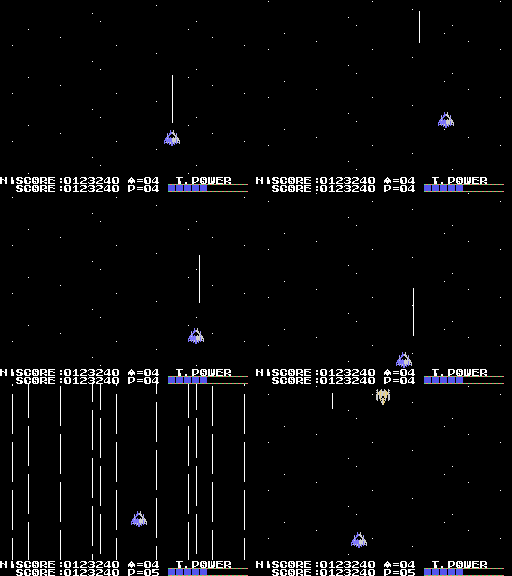
The stages
The map is one single journey: 81 positions (0xE051, from 0 to 0x50), each one a 24-row piece with its tiles and its
ground targets (the table at 0x4038). Every three frames the map goes down one step and, every four steps, a new row
comes in at the top (avance, 0x92D6). The stages are stretches of that journey, and each one ends when the
fortresses that close it fall:
| P= | map positions | at the end |
|---|---|---|
| 01 | 0-0x12 | one fortress |
| 02 | 0x12-0x29 | two fortresses |
| 03 | 0x29-0x48 | three fortresses |
| 04 | 0x48-0x50 | the enemy at the end |
Past position 0x50, the map goes back to 0 and the scoreboard keeps counting: P=05 is the start again, but harder.
Enemies come out more often, because the random wait between one and the next gets two shorter per stage
(oleadas, 0xAA79), and the fortresses take more hits.
What was measured comes from a game recorded in openMSX with TAB held on the title, so that the ship is never lost (Curiosities): the pilot reached the end and started again.
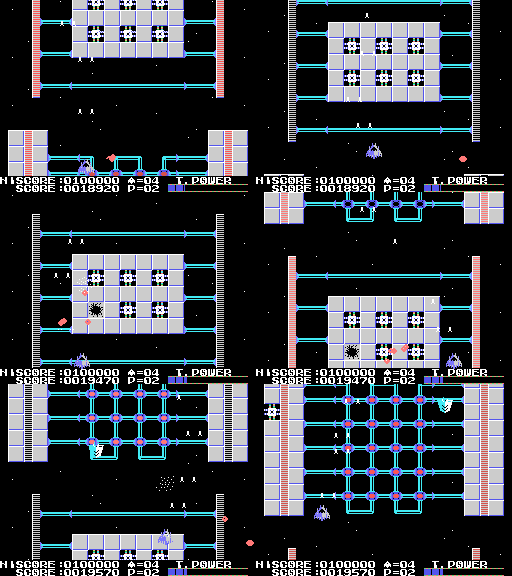
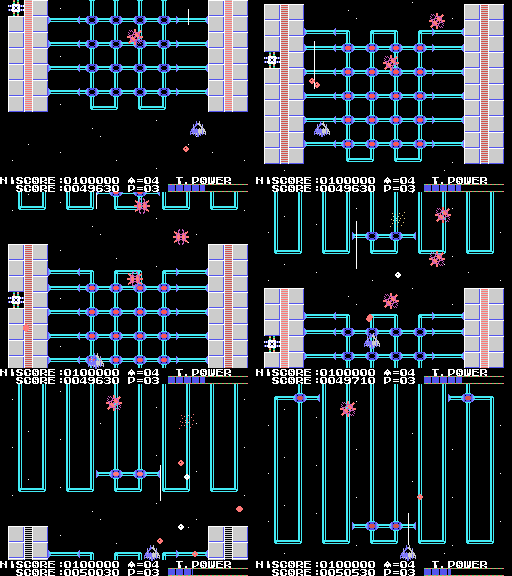
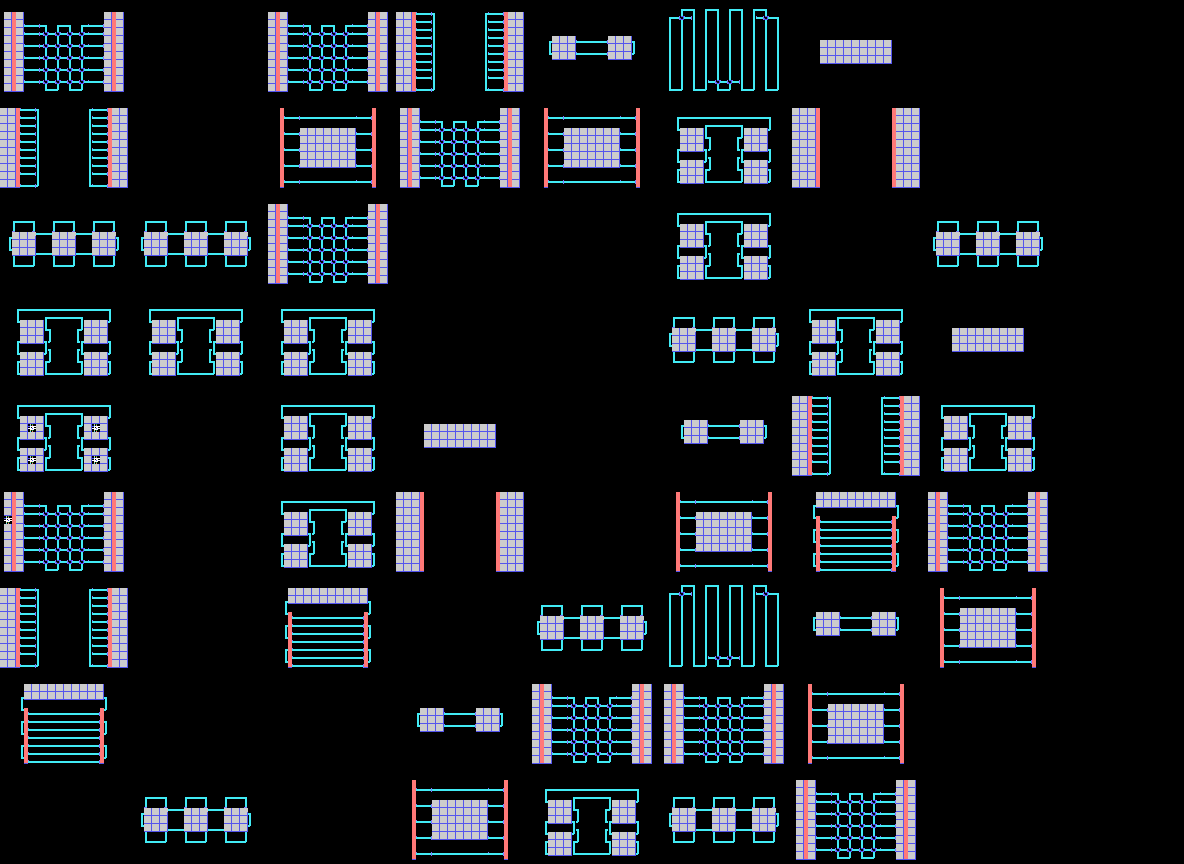
The map
The whole trip, all 81 positions, in columns of nine from bottom to top (position 0 at the bottom left) and at half
size. It is drawn by running the ROM (tools/mapas.py): trozo_pon (0x914D) builds each piece in RAM (24 rows of
32 tiles, bottom to top) and its first byte asks for other tiles, which casillas_cambia (0x865C) loads from the
ROM; the 81 positions are built in order on the same machine, as on the trip. No scoreboard, sprites or ground
objects; the background stars are single dots and barely show at this size.
Check against the recording (work/invencible.bin, which goes through every position): 43 of the 81 built pieces are
identical to the one the game holds in RAM at that position; the other 38 differ by 4 to 52 tiles out of 768,
what the game changes in that RAM while passing, and they have not been looked at one by one.
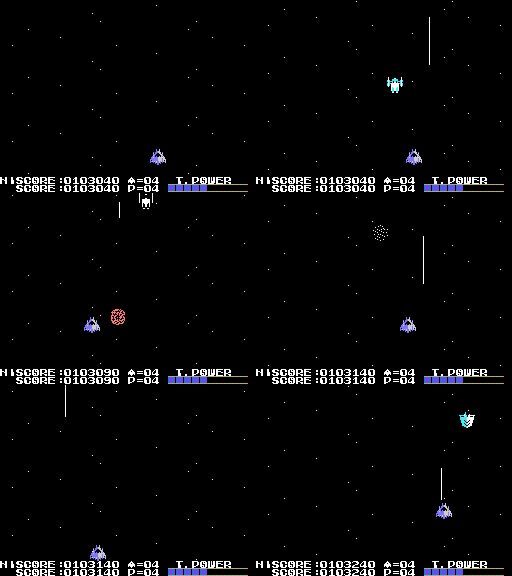
The enemies
At the start of each stage, groups of type 9 come out; after that, every so often, one in a free slot, of the type for
that part of the map or type 10 (oleadas, 0xAA79). There are 16 types (the table at 0x9AB9). With the fortress on
screen, none come out.
The ground targets
The ground targets are painted on the map and go down with it; there are also 16 types (the table at 0x99DF):
| type | what it is |
|---|---|
| 0, 1, 4, 5, 6 | a target: it breaks with five shots; it leaves a hole and gives 500 points and two of power (blanco, 0xA4B1) |
| 1 | it also fires a fast bullet when the ship is at its height |
| 4 | it also gives speed |
| 5 | it also gives the barrier: the ship changes colour and, if it is touched, nothing happens |
| 6 | it also gives the shield: the enemies stop shooting |
| 2 | the roulette |
| 3 | the fortress |
| 9 | the remains of the fortress: when they have all gone out at the top, the stage ends (final_marca, 0xAA3B) |
| 7, 8, 10-15 | nothing: they go down and away |
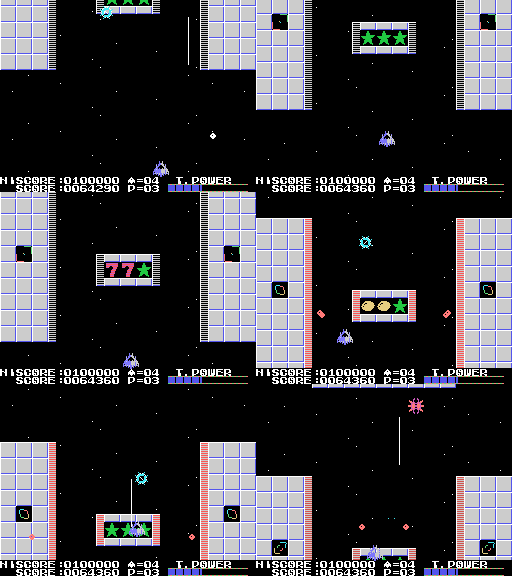
The roulette
Three tiles that change drawing every frame, among four. Each shot stops one; with the three stopped (ruleta,
0xA539):
- the three on the same drawing, the second: its tune plays, a long shield and 3,000 points;
- the three on the fourth: the same tune plays, five more ships, 5,000 points and a long barrier;
- anything else: nothing.
The fortresses
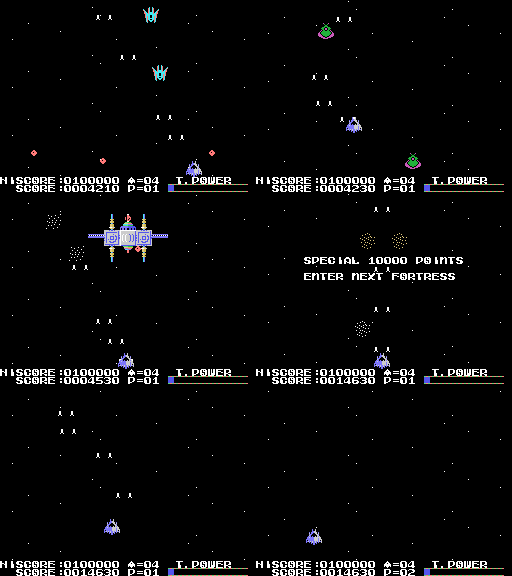
When the first fortress of the stage arrives, a noise plays and the sign GET READY FOR FINAL ATTACK comes out. The
fortress goes down to its place and the map stops (0xE1E0). From there it fires fast bullets to one side and the
other every 8-39 frames, at random. It takes as many shots as the stage x 2 + 16 (16 on P=01, 18 on P=02...). When it
breaks, it is painted broken, the screen flashes and it gives 10,000 points (fortaleza, 0xA8F1). When none is left,
the fortress tune plays, the ship flashes and the sign SPECIAL 10000 POINTS / ENTER NEXT FORTRESS comes out.
The enemy at the end
At position 0x4C, when no other enemies are left, the screen flashes and the enemy at the end arrives (type 13,
six sprites). It goes up and down shooting, and its core pulls the ship in every three frames: if it has it closer
than 12 points, it destroys it. It takes 100 shots in the core; then it gives 20,000 points, its tune plays, the
screen flashes and the map goes on to its end (tipo_13, 0xA0FE). In the recording, the pilot took about 90 seconds.