The game
Exciting Baseball is the Japanese high-school baseball tournament (the Japanese title, Nessen Koushien, means "the battle of Koshien"). It is played against the computer or between two players, and the screen is the field seen from behind the batter: top left, the tournament bracket; in the middle, a window showing the pitch close up or the signs; on the right, the count of strikes, balls and outs. The tournament is in The tournament, and a whole game in The plays.
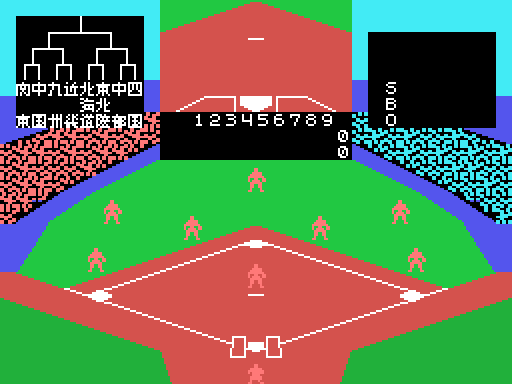
Every GIF on this site is the ROM running in openMSX (a Japanese MSX1, at 60 frames
per second): on every frame the VRAM and the VDP registers are logged, and
tools/vdp.py paints them.
The controls
Each player has a direction and two buttons (mandos, 0xA8C8):
| direction | button 1 | button 2 | |
|---|---|---|---|
| player 1 | the cursor keys or joystick 1 | RETURN or the joystick's button 1 | BS or button 2 |
| player 2 | E, S, D and X or joystick 2 | CTRL or the joystick's button 1 | TAB or button 2 |
Against the computer, the space bar and GRAPH are also player 1's buttons, and the
second player's keys work for the first one. Diagonals are reduced to a single
direction (diagonales, 0x8375).
The pitcher
Before pitching, the pitcher moves sideways with his joystick, from X 0x74 to 0x7C
(lanzador_mueve, 0x972A). Button 1 pitches; button 2 with a direction throws to that
base, to catch a runner who has wandered off (tiro_base, 0x9917). While the ball
flies to the batter, the pitcher's joystick gives it spin: up, down, to one side or
the other, from halfway on (pelota_vuela, 0x983D).
The batter
The batter moves forward and back in the box and raises or lowers the bat with his
joystick; the button starts the swing (bateador_swing, 0x9D9C). What happens is
decided by the frame of the swing (0xE016) when the ball reaches the hitting zone
(bateo, 0x885B):
| swing frame | what happens |
|---|---|
| before 10, with the bat still | bunt: the ball drops short in front (toque, 0x8921) |
| 10 to 12 | early hit |
| 13 to 17 | on time hit |
| 18 to 21 | late hit |
The direction of the hit comes from that moment and from the part of the bat that meets the ball (four sections): twelve directions (0xA011). If the bat has moved and misses, it is a strike; if the ball goes through the zone without a swing, too.
The count
Three strikes, out; four balls, the batter goes to first and those forced move up
(base_por_bolas, 0xA205). Three outs, CHANGE and the other team bats (outs, 0x9131).
The signs BALL, STRIKE, FOUL, OUT, SAFE and CHANGE come up in the window with their sound.
The runners
The batting side commands its runners with the button and a direction: right the one
on first, up the one on second, left the one on third. With button 2 before the pitch,
they steal (robo, 0x88D6); with the ball in play, they advance or go back
(corredores_ordenes, 0xA029). Each runner goes from base to base along its path, with
its steps (corredor, 0xB3B8).
The fielders
The nine fielders are not sprites but tiles, 2 x 2, in their places on the field
(defensa_pinta, 0x8F6F). When one goes for the ball, his place is erased and he
becomes a running sprite (campo, 0xA2E0). The one who catches it picks with his
joystick the base to throw to (a mark blinks on it) and throws with the button (tiro,
0xA5C4).
The computer
The computer plays with the second joystick: in each phase it writes into 0xE08E the
direction and buttons a player would press (ordenador, 0x94DE). It pitches with random
spin, bats by moving the bat towards the ball, steals at random and, fielding, throws to
the base that is needed.
The innings
Nine innings. If in the ninth the team batting second is already ahead, it does not
bat: an X shows on the scoreboard (0x9382). There are no extra innings: the game ends
after the ninth, and against the computer a tie counts as a defeat (fin_partida,
0x8125). If a team reaches 100 runs, the game ends too.