Findings
What you cannot see by playing, with the address where it is and how it was measured.
The court is 56 columns wide and is seen through a 32-column window
The whole court, with the stands and the SUPER PLAYERS DUNK SHOT * HAL LABORATORY banner, is a 56 × 24 map of patterns compressed at 0xB69E (714 bytes giving 1,344). There is no hardware scrolling: 0x5F33 copies into the name table, row by row, the 32 columns starting at the one in 0xE830 (0 to 24), and 0x5E7C moves it one column at a time when the ball crosses the centre. The 21 × 4 scoreboard (0x77AB) goes on top, at column 6.
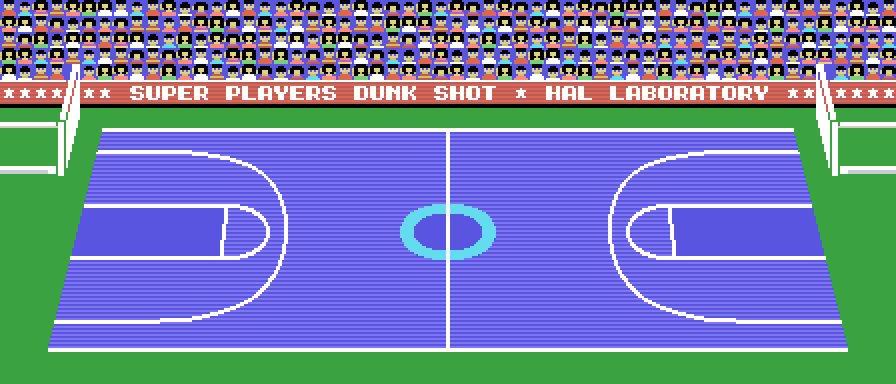
Measured by building the window at column 12 and checking it against two dumps of the match: 0 differences in names, patterns and colours.
Every player is four sprites, hence the flicker
Hair, upper skin, shirt and lower skin: four 16 × 16 sprites per player, six players, plus the net, the ball, its shadow and the arrow. The TMS9918 only draws four sprites per line, so 0x5E1B sorts the seven groups by depth, 0x5C0B builds them in that order, 0x5BAB copies them reversed as well, and the two orders go to two attribute tables (0x1B00 and 0x1F00) that register 5 alternates every frame (0x5B77): one frame the near players are in front, the next the far ones. The flicker is deliberate. On an MSX2, with eight sprites per line, a 164-byte patch brings it down from 66.7 sprites not drawn per frame to 1.7.

In the dumps, the 24 player sprites appear in a different order in the two tables, and the one shown is the one bit 2 of register 5 points at.
The 160 poses and the 32 looks
A pose is four pattern numbers (0xA4CE) and four offsets (0xA38E, one per group of four poses) that 0x5C40 subtracts from the position of the feet; the 196 patterns live in RAM, decompressed from 0x9725, 0x9B08, 0x9F80 and 0xA360. Each player's look is one of the 32 pairs at 0x80E4 (skin 0x0B, 0x0A or 0x01 and eleven hair colours) and the shirt is the team colour (0xEA2C/0xEA5C).
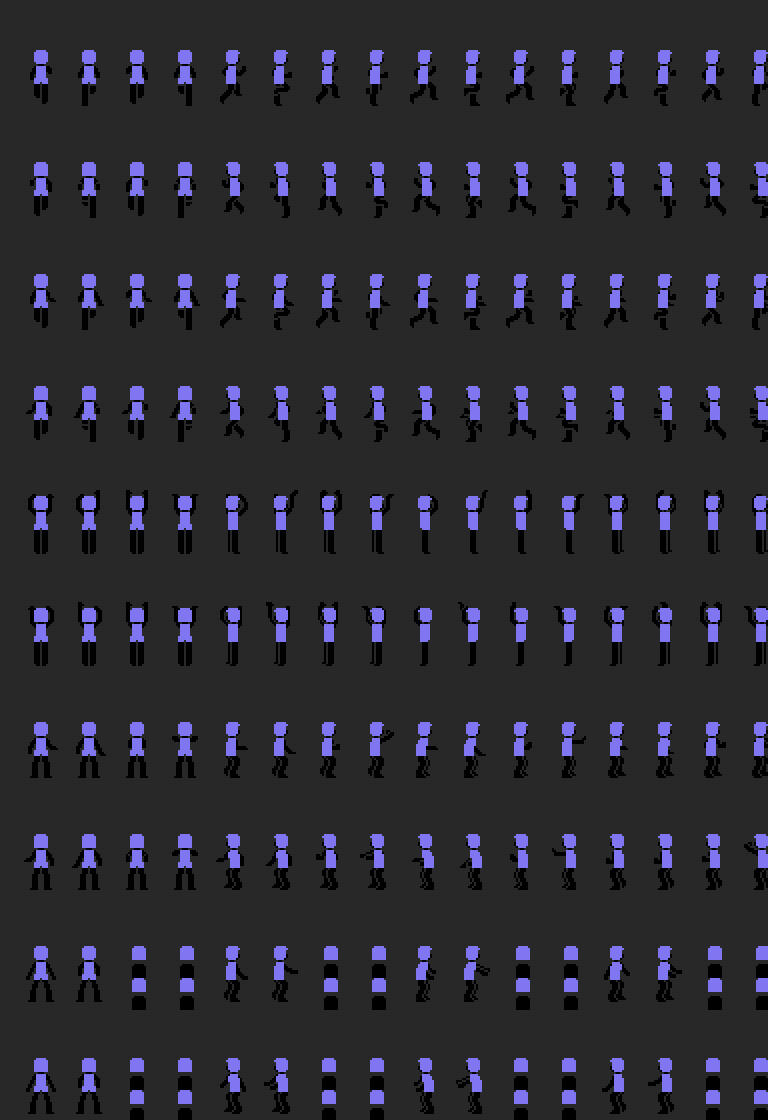
Pose, patterns and colours are checked on the six players of two openMSX dumps: for each one, the four sprites in the attribute table give the same foot position once their offsets are added back, carry the colours skin-skin-hair-shirt, and their patterns in VRAM are those of the pose.
Computer teams are generated by level
ELM, JNR, HIG, COL, YUG, ESP, USA and PRO are not stored rosters: they are levels 1 to 8. When one is chosen, 0x72CA generates eight players with 30, 20 and 25 skill points plus 30 for each level above the first, and a random look taken from the Z80's R register. The name is copied from the list at 0x7CA1 and the level is kept in byte 3 of the team.
Teams are saved to tape as a BSAVE
SAVE DATA writes the team block (0xEC bytes: name, level, colour and eight 29-byte players) with the cassette BIOS, using the binary header, ten 0xD0 bytes, and a six-letter name: the team's three letters and three 0x7F (0x8C33). LOAD DATA finds and reads it (0x8C71) and VERIFY compares it byte for byte (0x8C87). With no tape, the message is ERROR!
Three courts, one colour table each
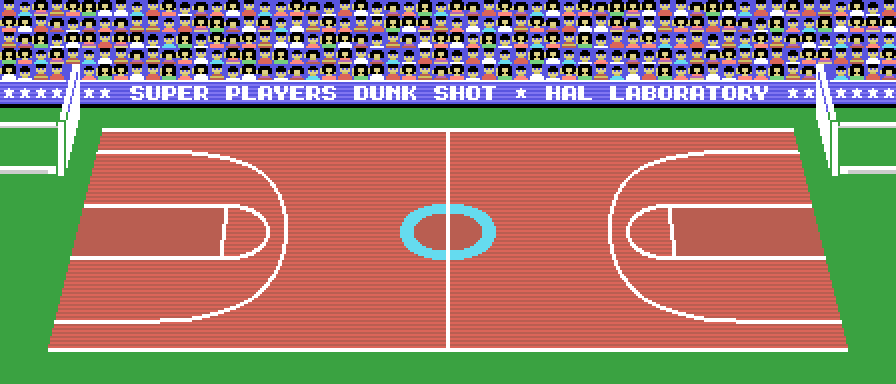
COLOR OF COURT chooses between three compressed colour tables (0xABA8, 0xACB0 and 0xADB8: 264 bytes each, 2,000 when decompressed) for the same 250 patterns. Green, blue and red; the stands and the banner do not change.
The computer's plays
The 720-byte table at 0xAF5F is five formations with six variants each, and in every variant an eight-byte script per player: a delay and waypoints (Y, X, code) up to a 0x80. 0x6F48 picks the variant from the current formation and a random bit, and button 2 of the team with the ball in the opponent's half moves on to the next one.
What is never drawn and what nobody runs
Three court patterns (0x73, 0x85 and 0x86) and the E and S of an ESC in the logo's pattern set (0xFB, 0xFC) are never shown; the C (0xFD) is, in the title. One sprite pattern, number 195, is used by no pose.

And seventeen pieces of code nobody reaches: alternative entries, a five-digit counter (0x7AAE) and a routine that writes a zero into the ROM itself (0x8B3C), from when the program ran in RAM.
At 0x4EEC, besides, everything points to a bug in the original: it loads ld hl,(0xE6DF) where the surrounding code suggests ld hl,0xE6DF, and compares and writes at the address formed by "who shot" and "left jumper", which is 0xFFFF at start-up. What it does is measured in the listing; what it was meant to do is not.