Curiosities
Findings
What turned up when the tape was taken apart. Everything here is measured -by running the format, by reading the constants the code itself counts with, or by cross-checking against the machine- not deduced from how the bytes look. What is not settled is not here: it is in Open questions.
0xD300 is not code: it is a pointer
The CARGA binary runs from 0xC000 to 0xD3DF, but its execution address is
0xD302, not 0xD300. The reason is in those two bytes: they hold 69 D3, the
word 0xD369, which is the loop that reads a tape block.
The first half of the game ends like this:
5CC2  ld hl,(0xD300)
5CC5  push hl
5CC6  ret
That is how it returns to the loader to ask for the second half without carrying the address in its own code. The loader at 0xD300-0xD3DF survives both programs because no tape block reaches past 0xD2FF.
The BIOS never reads the two big blocks
Files 04 and 05 on the tape have no header. The loop at 0xD369 reads them by
hand with TAPION and TAPIN, byte by byte, and splits each into three sync bytes
(03 02 01), 0x2400 bytes at 0x4000 and 0x5300 bytes at 0x8000.
3 + 9216 + 21248 = 30467
which is exactly what block 05 measures. Block 04 is five bytes longer, and they
are .cas alignment padding: zeros, checked.
Hence the two halves of the game occupying exactly the same addresses, and hence this disassembly being five listings and not one.
Inside the caravel: 128 x 52 tiles
The second half does not play out in screens: it plays out inside a longitudinal cutaway of the ship, 1024 x 416 pixels, with the deck, three masts with their sails and rigging ladders, and three runs of cabins and hold below.
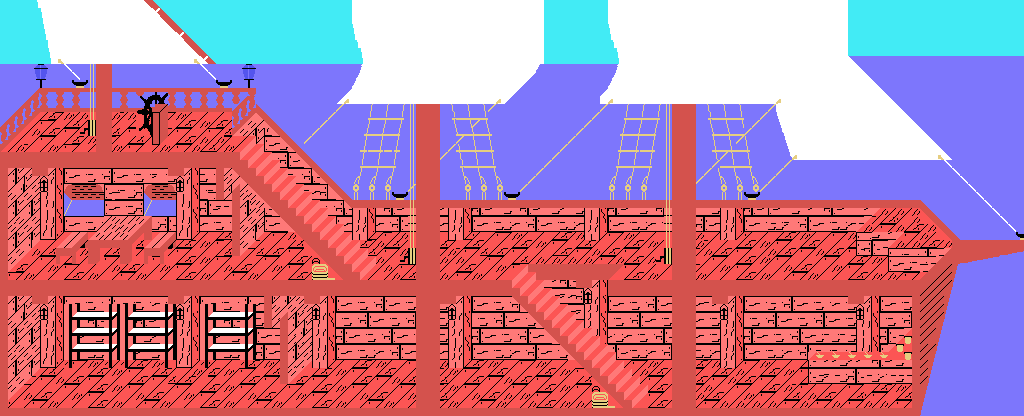
The 0x1A00 bytes run from 0x9000 to 0xA9FF. What says the width is 128 is no declared constant at all: it is the 0x80 step between rows in the loop at 0x4285. The check that it is read right is that the 32x24 window the game cuts matches the emulator across all 768 tiles, zero differences.
What you buy is drawn stowed in the hold
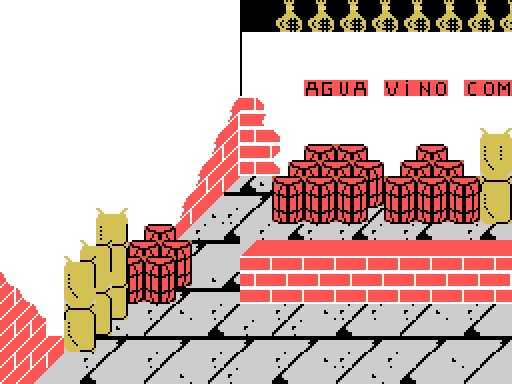
The five commodities are bought at the quayside warehouse, each costing one of the sixteen units of MONEY. But the number does not stay in a counter: the routine at 0x4F60 in the second half stows the cargo in the hold, one pile per commodity and as many pieces as units remain.

Drawn out, the tiles of each pile are staved barrels for water and wine (0xBF-0xC4), tied sacks for food (0xB9-0xBE), stacked planks (0xC6-0xC8) and rolls of cloth (0xC5, 0xC9 and 0xCA).
Which counter is which has to be measured, and the handover crosses them
At the end of the first half there is a summary with seven figures. The labels are artwork, not text, so which is which cannot be assumed — and this disassembly's first attempt had it wrong.
How to measure it: the loop at 0x5D0C paints the fourteen digits on consecutive tiles from 188 on, so it is enough to look those tiles up in the name table at 0xC310 to see which label each one falls under.
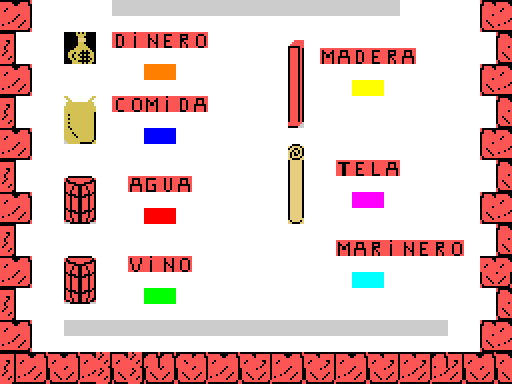
| counter | label | row, column | goes to |
|---|---|---|---|
| 0xF8B4 | water | 13, 9 | 0xD6D9 -> 0xF39A |
| 0xF8B5 | wine | 18, 9 | 0xD6DA -> 0xF39B |
| 0xF8B6 | food | 8, 9 | 0xD6DD -> 0xF39E |
| 0xF8B7 | timber | 5, 22 | 0xD6DB -> 0xF39C |
| 0xF8B8 | cloth | 12, 22 | 0xD6DC -> 0xF39D |
| 0xF8B9 | crew | 17, 22 | 0xD6DE -> 0xF39F |
| 0xF8BA | money | 4, 9 | not handed over |
They follow neither the order of the addresses nor the order on screen, and the trip through 0xD6D9 crosses food with timber. A test pins the positions.
With that table in hand the second half reads itself: 0xF39A and 0xF39B are the drink and are used one after the other -water first, then wine-, 0xF39E is the food and has its own cycle, 0xF39C is the timber that plugs the leak, 0xF39D the cloth that smothers the fire, and 0xF39F how much crew is aboard.
7,564 bytes nobody reads, and one stretch of them is a snapshot of memory
The tape records fixed-size blocks no matter what, but the first half's program ends at 0x5F9F and the second's at 0x5C3F. Whatever was in memory got recorded behind them: 7,564 bytes out of 66,016, 11.5%, identified and accounted for but touched by no instruction.
One of those leftovers can be read in full. From 0xCC56 to 0xD2FF the first half
carries 1,706 bytes identical to the CARGA file but for a single byte
-0xCC56 itself, which is 0x1F there and 0x19 here-. It is the loading screen,
still sat in memory when the block was recorded. Nobody reads it: the only
routine that would upload it is the one at 0xD330, and that only runs on entry
through 0xD302, which had already happened before that block existed.
The second half, at the same addresses, carries something else: only 4.1% of the bytes match.
All three programs end with a truncated copy of themselves
All three end with a stretch of their own code repeated, always cut mid-instruction:
| program | leftover | copy of |
|---|---|---|
carga |
0xD3D8-0xD3DF | 0xD358-0xD35F |
| first half | 0x5F9F-0x5FF7 | 0x5F1F-0x5F77, 0x80 higher up |
| second half | 0x5C42-0x5C79 | 0x5BC2-0x5BF9 |
All three checked byte for byte. Nobody executes them; it looks like a slip of whatever tool the blocks were built with.
The publisher's signature carries a typo, and it is on the tape
Decoding the name table at 0xD000, down the right margin of the loading screen you read "OMIKRON Softwarwe", with two w's. The typo is on the tape, not in this disassembly, and a test pins it.
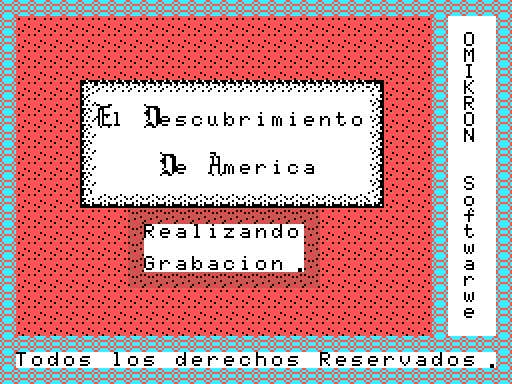
The letters are not ASCII: they are tile indices, and they use two different alphabets inside the same table -0x00-0x19 and 0x20-0x39, two sets of tiles for the same twenty-six letters- plus six tiles (0x3A-0x3F) for the tall two-tile capitals that start "El", "Descubrimiento" and "America". The space is 0xFF.
A flag hidden inside the artwork itself
The first half's start-up does:
420A  ld a,(0xC103)
420D  cp 8
420F  call nz, voltea_los_patrones
0xC103 is not a variable: it is a byte of the pattern table, used as a flag so the same artwork is not flipped twice. The routine at 0x561D reverses the bit order of every byte between 0xC102 and 0xC138, which is how the game gets its mirrored artwork without spending any more tape.
The music only hangs off the interrupt in the first half
The first half installs a JP at H.KEYI (0xFD9F) pointing to 0x4046, and the
music plays on every scan interrupt, before the BIOS reads the keyboard. The
state is fourteen consecutive bytes (0xF8CB-0xF8D8) with three bytes per
channel, which is why the cursor at 0x4181 steps by three and the same routine
serves all three channels without a single table. There are sixteen tunes
indexed at 0xCB95.
The second half installs nothing: it writes the PSG straight from the main loop, at 0x5213. Checked by searching for writes to 0xFD9A and 0xFD9F across all traced code: there are none.
Screen 7 has no name table of its own
Screens 0 to 6 of the first half each carry their own table, exactly 0x300 bytes apart, from 0x82F5 to 0x94F5. The seventh does not: it is cut as 32 columns out of a 64x24 map living at 0x97F5, and the sideways travel is half a screen -the counter at 0xF89D runs from 0 to 0x20-.
There is not one credit across the five pieces
Sweeping all five for ASCII strings, only three blocks of text come out: the opening (0x8200), the eleven on-screen labels (0xC28A) and the five crossing disasters (0xCBF2). Not a name, not a set of initials, not a build date.
The only name on the whole tape is the publisher's, and it is drawn, not written.
Open questions
Every byte of the tape is accounted for and every routine has a name, but that does not mean everything is known. What is still open is set out here, with the measurement that has been made and the one that has not.
1. What the block fillers are
There are three, 4,534 bytes in total, and no instruction reads them:
| listing | range | bytes |
|---|---|---|
p1bajo |
0x5FF8-0x63FF | 1,032 |
p2bajo |
0x5C7A-0x63FF | 1,926 |
p2alto |
0xCCD8-0xD2FF | 1,576 |
What is known
The first half's is empty. It repeats 00 FF FF FF FF 00 00 00 from 0x5FF9
with not a single exception, and its autocorrelation is 100% at every multiple
of 8. It does not carry one bit of information.
The second half's two do not. They have 39 and 13 distinct values, and a
clear structure: eight-byte records in which four end in F and four end in
0.
What has been ruled out, and with what measurement
It is not a SCREEN 2 colour table, however much it looks like one. Two measurements knock that down:
- The low nibble is 0 or F in 100% of the bytes; across this same game's
colour tables that happens between 0% and 36.5% of the time
(
colores_comunes12.5,pantalla_1_colores0.0,pantalla_4_colores4.4,fuente_barco_colores6.3,pantalla_3_colores36.5). The only table on the tape with this shape is the loading screen's, which is ink on white and gives 98.4%. - And above all, the phase. Sweeping all eight possible offsets, the four-and-four rule holds at 100% starting at 0x5C7A, 0xCCDA and 0x5FFA, and only at 50% at the 8-aligned addresses. In all three fillers the records fall at addresses with remainder 2 when divided by 8. A SCREEN 2 colour table is 8-aligned by construction, base + tile*8.
It is not a picture: drawn at widths 32, 40, 48 and 64 all that comes out is vertical stripes, which is what an eight-byte structure with nothing in two dimensions produces.
It is not a copy of anything on the tape: searching 24-byte windows across
the five listings, p2bajo's filler does not appear outside itself.
It was not on screen: against the two openMSX VRAM dumps, 16 KB each, there is not one 32-byte match.
It is not what the first half left in memory at those addresses: 27.5% and 4.1% of the bytes match, against a background match between the two programs of 2.3%.
What is left
That the phase is the same across all three fillers, living in unrelated areas of memory, says the three come from the same place and that it is not coincidence. The live lead is that two-byte offset: it points at eight-byte records with a two-byte header in front, or at a buffer that starts two bytes in. What exactly, is not known.
2. The sprites nobody names
From 0xA66D to 0xA6BF in the first half there are 0x53 bytes that are still sprite artwork -two more blocks of the 0x30 series the routine at 0x59FB uses, the second one cut in half- but that no instruction names. From 0xA6C0 to 0xAAFC there are 1,085 consecutive zeros, with not one exception.
It could be an animation that was dropped, or simply reserved room. There is no way to settle it from the binary.
3. No full game has been played
The game has been loaded and started in openMSX, and the second half has been reached by forcing the jump to (0xD300), but it has not been played from start to finish.
What that means: the screen names come from looking at the artwork, and the mechanics -what each object does, how you move between screens, what each setback counts- come from reading the code. Playing it properly would probably correct one or two.
4. Who programmed it
Across the five pieces on the tape there is not one credit nor a set of initials in ASCII. The only texts are the opening, eleven on-screen labels and five disaster messages. The only name that shows up is the publisher's, and it is drawn in tiles, not written: OMIKRON Softwarwe, typo included.
If anyone knows who signed this game, we would like to hear.